How Do Pre-emptive Term Sheets Affect Overall Fundraising Outcomes
Pre-emptive term sheets close rounds 40% faster yet often reduce founder leverage. Learn when accepting one actually helps.
Pre-emptive term sheets typically close rounds 30 to 50% faster, but they reduce competitive tension and can lower final valuations by 10 to 15% compared to fully marketed rounds. Founders who receive unsolicited offers gain speed and certainty at the cost of negotiation leverage. The net outcome depends on timing, existing alternatives, and how founders manage the process after the offer arrives.
What Is a Pre-emptive Term Sheet
A pre-emptive term sheet is an unsolicited offer from an investor designed to close a round before other firms can compete. The investor moves aggressively, often with favorable terms, to lock in a deal and avoid a bidding process.
• Offered before or early in a formal fundraising process.
• Usually comes with a short decision window (5 to 14 days).
• Signals strong investor conviction in the startup.
• Often includes deal terms designed to discourage shopping the offer.
Pre-emptive offers are most common at Series A and B, where lead investors compete for breakout companies. Understanding decision timelines helps founders evaluate whether the pressure is real or manufactured.
How Do Pre-emptive Offers Change Round Dynamics
The biggest shift happens in competitive tension. A pre-emptive offer removes the auction dynamic that typically drives valuations higher in a marketed process.
Speed vs. leverage tradeoff:
• Rounds close in 2 to 4 weeks instead of 8 to 14 weeks.
• Fewer investors participate in diligence, reducing founder time commitment.
• Founders spend less time fundraising and more time building.
• Final valuations tend to be 10 to 15% lower than competitive rounds.
Investor behavior shifts:
• Other VCs may accelerate their own process or withdraw entirely.
• Follow-on investors accept terms set by the lead without negotiation.
• Signaling risk increases if the offer comes from an existing investor.
Founders who understand fundraising momentum can use pre-emptive offers as catalysts rather than constraints.
When Should Founders Accept Pre-emptive Term Sheets
Not every pre-emptive offer deserves acceptance. The decision hinges on where founders sit in their fundraising process and what alternatives exist.
Accept when:
• The valuation matches or exceeds internal targets.
• The investor adds strategic value beyond capital.
• Fundraising market conditions are tightening.
• The startup needs capital quickly to capture a market window.
• Running a full process would distract from critical execution.
Negotiate or decline when:
• The offer arrives before founders have tested the market.
• Valuation sits significantly below realistic expectations.
• The investor demands terms that limit future flexibility.
• Multiple investors have already expressed strong interest.
• The decision window feels artificially compressed.
Knowing when investors delay decisions after initial interest helps founders gauge whether a pre-emptive offer reflects genuine urgency or manufactured pressure.
How Pre-emptive Terms Affect Valuation and Dilution
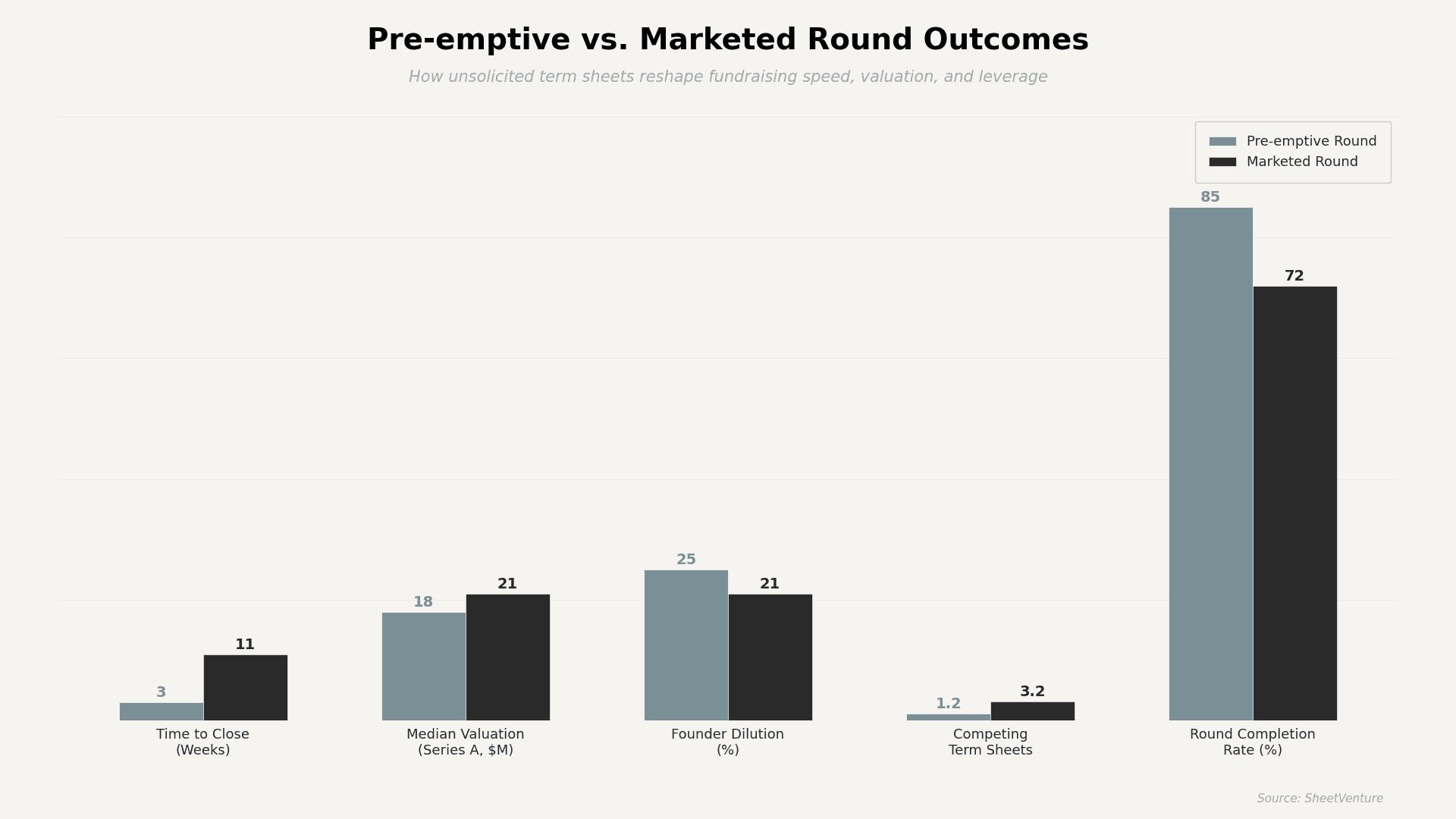
The tradeoff between speed and economics shows up clearly in the data. Here is how pre-emptive rounds compare to fully marketed processes across key outcome metrics.
Metric | Pre-emptive | Marketed | Difference | Founder Impact |
Time to Close | 2 to 4 weeks | 8 to 14 weeks | 60% faster | More building time |
Median Valuation (Series A) | $18M | $21M | 14% lower | Reduced leverage |
Founder Dilution | 22 to 28% | 18 to 24% | 4 to 6% more | Higher ownership cost |
Competing Term Sheets | 1 to 1.5 | 2.5 to 4 | 60% fewer | Less negotiation power |
Round Completion Rate | 85% | 72% | 13% higher | Greater certainty |
What Are the Hidden Risks of Pre-emptive Deals
Accepting too quickly creates downstream problems that many founders overlook until the next round.
Signaling risk: If an existing investor pre-empts, other VCs may interpret it as a sign that no outside firm wanted to lead. This perception makes future rounds harder to close at strong valuations.
Relationship asymmetry: Founders who skip thorough diligence on the investor may end up with a board member whose priorities diverge from their long-term vision.
Compressed negotiation: Short decision windows limit the ability to negotiate governance terms, pro-rata rights, and board composition. Experienced founders extract significant value in these areas during competitive processes.
Reduced market intelligence: Without a full process, founders lose the strategic feedback that competitive fundraising naturally generates. Multiple investor conversations reveal positioning gaps, valuation benchmarks, and market blind spots.
SheetVenture gives founders real-time intelligence on investor activity and deal velocity, making it easier to evaluate whether a pre-emptive offer reflects fair market value.
The Bottom Line
Pre-emptive term sheets accelerate fundraising but reshape the power dynamics between founders and investors. Rounds close 30 to 50% faster, yet valuations often land 10 to 15% below competitive outcomes. The right decision depends on market timing, existing investor interest, and whether the terms genuinely match the startup's trajectory.
Speed matters, but so does leverage. Founders who treat pre-emptive offers as the starting point of a negotiation rather than a final ultimatum consistently achieve better outcomes. The founders who win are the ones who understand exactly what they are trading when they say yes early.
SheetVenture helps founders evaluate investor urgency and deal velocity so pre-emptive offers become strategic advantages, not pressured decisions.
Publication Date:
