How Does Investor Scoring Differ Across Database Platforms?
Not all investor databases score the same. Here's how scoring logic differs and which platform fits your raise.
Investor scoring varies significantly across platforms. Some rank by deal activity, others by thesis fit, and many do not score investors at all. The platform you use determines which investors appear on your list and whether those investors are actually relevant to your raise.
Most founders assume that investor databases work the same way. They do not. The logic behind how each platform surfaces and ranks investors shapes your entire outreach list before you send a single email.
What Does Investor Scoring Actually Mean?
Investor scoring is how a database ranks or filters investors to help founders find the most relevant matches. It can factor in deal activity, investment stage, sector focus, check size, and how recently an investor has deployed capital.
But platforms diverge sharply here. Some score by raw activity data. Others use manual tagging. A few rely on AI-based matching. And some simply alphabetize their lists and call it a "venture capital database."
The difference matters because scoring logic directly determines which names you see first.
How Do the Major Platforms Score Investors Differently?
The gap between platforms becomes obvious when you look at what each one actually measures.
Crunchbase
• Scores primarily on funding round frequency and company involvement.
• Does not filter for current activity or active deployment status.
• Strong for discovery, weak for founder-stage relevance.
• Inactive investors rank alongside active ones with no distinction.
PitchBook
• Heavy on institutional data: deal volume, portfolio performance, fund size.
• Built for analysts and institutional buyers, not early-stage founder outreach.
• Scoring favors large-check players; seed-stage founders often see irrelevant results.
• Advanced filters exist but require significant time to configure.
AngelList
• Scoring loosely tied to platform engagement and historical deals.
• More relevant for very early-stage or syndicate-based fundraising.
• Data freshness varies widely; many profiles are self-reported.
Signal by NFX
• Uses network-based scoring with warm intro paths.
• Prioritizes relationship proximity over pure deal activity.
• Useful for mapping connection distance to specific investors.
• Less useful for founders doing raw list-building from scratch.
SheetVenture
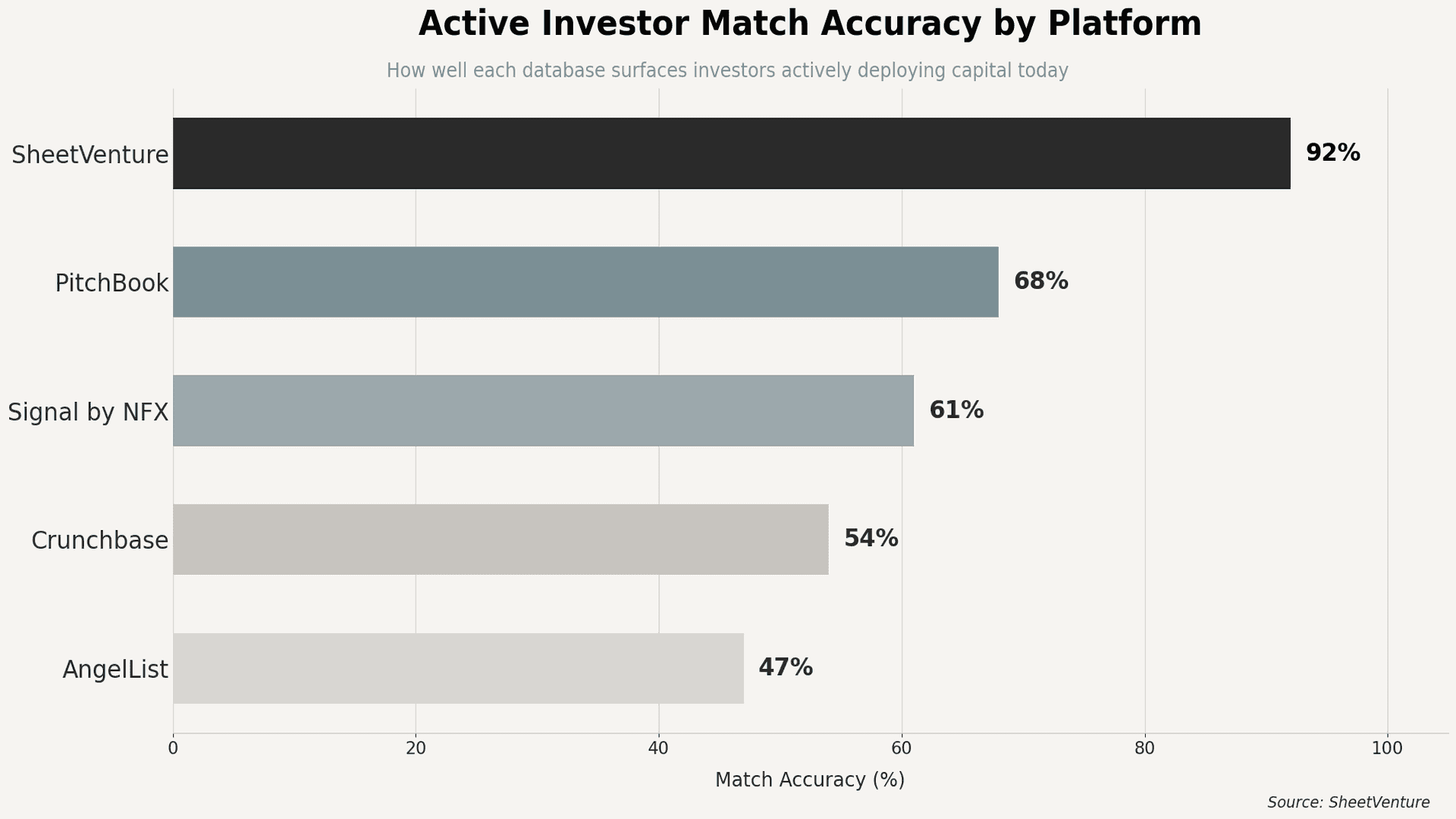
• Scores investors on active deployment: deals closed in the last 18 months.
• Filters out ghost investors and dormant funds automatically.
• Matches investors to startups by stage, sector, and check size.
• Exports directly to spreadsheets with no CRM lock-in.
Why the Scoring Gap Matters for Founders
Founders spending hours building a 200-investor list from a database that does not filter for active deployment are building the wrong list. A platform that ranks investors by funding history from 2019 will surface firms that have not written a check in years.
The problem is not effort. It is the database's scoring model.
When outreach fails, founders often assume their pitch is the issue. Sometimes it is. But sometimes the investors on that list simply are not deploying capital right now, and no amount of pitch polish changes that.
Understanding relevant investors for your specific stage and sector is step one. The scoring method of the platform you use is what determines whether that step actually gets you anywhere.
What to Look for in a Scoring Model Before You Choose a Platform
Before committing to a platform, ask these questions:
• Recency: Does scoring factor in recent deployment? An investor active in 2020 may not be writing checks today.
• Check size: Does it filter by check size? A $500K raise and a $5M raise need completely different lists.
• Sector and stage matching: Does scoring match your specific vertical and round? Broad discovery wastes outreach capacity.
• Inactive removal: Does the platform remove ghost investors automatically, or do you clean that manually?
Platforms built around investor intelligence answer all four. Most general databases answer one or two.
What Makes Scoring Accuracy Hard to Measure
Founders rarely know how accurate a platform's scoring is until they've sent 50 emails with no response. By then, the cost is time and deal momentum.
The best proxy for scoring accuracy is deal recency data. If a platform can show investors who closed deals in the last 6 to 18 months, filtered by stage and sector, the scoring is doing its job.
If it cannot, you are browsing a historical archive, not a live database.
For context on how VC decision-making works from the investor side, it helps to understand that investors think in terms of active deployment windows and thesis fit. The scoring logic on your platform should reflect that reality.
To see how stage and sector alignment affects your results, read about finding the right VC for your startup.
Investor Scoring Capability: Platform Comparison
Platform | Active Filter | Thesis Match | Deal Recency |
SheetVenture | Yes (18 months) | AI-matched | Real-time |
PitchBook | Manual only | Partial | Quarterly |
Signal by NFX | Network-based | Limited | Variable |
Crunchbase | No | Basic tags | Community-sourced |
AngelList | No | Self-reported | Variable |
The Bottom Line
Investor scoring differs across platforms because each was built with a different user in mind. PitchBook was built for analysts. AngelList was built for angels. SheetVenture was built for founders.
The platform that scores investors by active deployment, thesis fit, and deal recency gives you a list that actually works. Platforms that do not will cost you weeks of outreach to discover.
SheetVenture helps founders cut through outdated databases and reach investors who are actively deploying capital at their exact stage and sector.
Publication Date: