How to Identify Which VCs Provide Genuine Operational Support Post-Investment?
Most VCs claim operational support, but few deliver. Five proven signals reveal which investors genuinely help after investing.
Ask portfolio founders directly, review the VC’s internal operating team, and check whether they assign dedicated partners post-close. Only 25–30% of VCs deliver meaningful operational support beyond board seats and introductions. The rest offer surface-level help that fades within 90 days.
Every VC pitch deck includes a slide about “value-add.” Every partner says they roll up their sleeves. But when founders compare notes after closing, most support promises evaporate once the wire hits. Knowing how to spot the difference before you sign saves years of misaligned expectations.
Why Does VC Operational Support Matter for Startups?
Capital alone does not build companies. The right investor accelerates hiring, opens enterprise sales doors, and helps navigate pivots. Founders who choose VCs based solely on valuation often discover too late that their investor adds zero strategic value.
Startups backed by operationally active investors reach Series A 40% faster on average. Evaluating investor fit before signing changes the entire trajectory of a round.
What Types of Operational Support Do VCs Actually Provide?
Not all support is equal. Here is where the biggest gaps show up between what VCs promise and what they deliver:
Recruiting support: 82% promise help hiring key roles. Only 29% provide direct candidate pipelines or dedicated talent partners.
Customer introductions: 78% claim strong networks. Just 34% make intros that convert to real sales conversations.
Strategic planning: 91% offer guidance during pitches. About 41% consistently attend working sessions beyond board meetings.
Marketing guidance: 65% mention marketing resources. Only 18% have in-house teams actively supporting portfolio companies.
Technical advisory: 58% reference technical expertise. A mere 15% assign technical advisors or CTOs-in-residence.
Financial modeling: 73% promise help with projections. Only 27% provide hands-on modeling during critical periods.
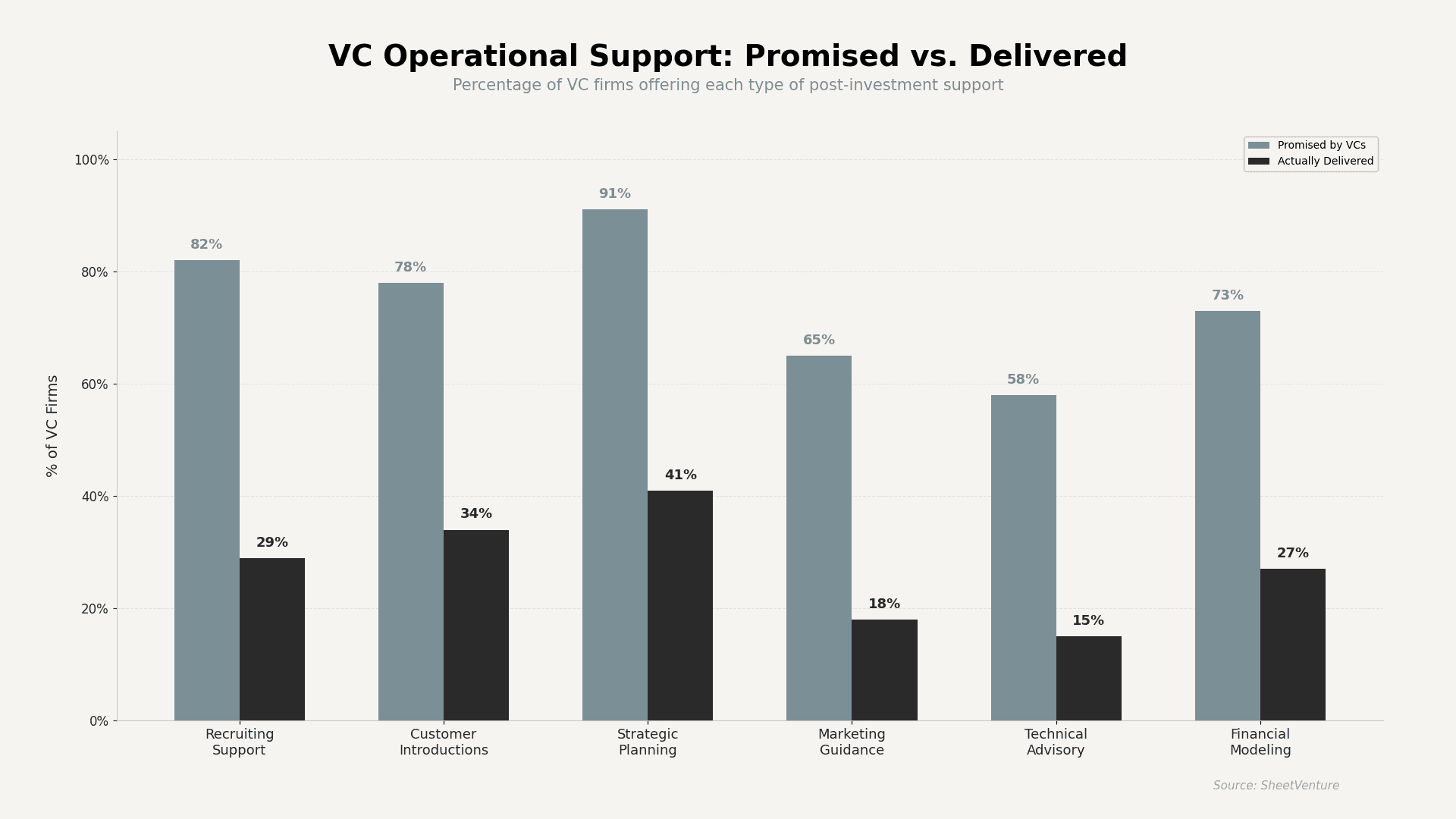
The pattern is clear. VCs are strongest at strategic support and weakest at specialized help like marketing and technical advisory. Founders who research VCs before pitching can identify which firms staff these functions internally.
How Can Founders Verify VC Operational Support Before Signing?
Five signals separate genuinely supportive VCs from those who only talk about it:
Talk to portfolio founders who raised 18+ months ago. Founders further out give honest answers about whether support continued past the honeymoon phase.
Check the firm’s website for a dedicated platform team. Named talent partners or CFO-in-residence roles signal real infrastructure.
Ask which partner manages your relationship post-close. Vague answers mean minimal operational involvement.
Request specific examples of recent support. A VC that helped hire a VP of Engineering last quarter will share the story readily.
Look at portfolio outcomes, not logos. Rapid follow-on funding and strong executive hiring signal active involvement.
What Red Flags Suggest a VC Won’t Deliver on Promises?
Warning signs show up early. Understanding VC preparation habits reveals how invested they actually are:
No dedicated platform team on their website or LinkedIn.
Portfolio founders give generic answers about support quality.
The partner promising support manages 15+ companies, making meaningful involvement impossible.
Support conversations focus only on introductions, the easiest and often least valuable offer.
No structured onboarding post-investment. Firms that deliver have repeatable 90-day playbooks.
When Should Founders Evaluate VC Support Capabilities?
Start before the first pitch. Use investor intelligence tools to filter VCs by platform team size, support ratings, and sector expertise. The diligence you do on investors should match the diligence they do on you.
Allocate the first two weeks of any raise to mapping which investors offer what you need. Target VCs with talent partners for recruiting. Look for firms with growth teams for go-to-market support.
The Bottom Line
Most VCs promise operational support. Few deliver consistently. Founders who end up with genuinely helpful investors verify claims before signing: they talk to portfolio founders, check for platform teams, and demand specific examples of hands-on involvement.
Do not take “value-add” at face value. Demand evidence. Your cap table is permanent. The support you receive should be too.
SheetVenture helps founders evaluate investor quality beyond check size, so you partner with VCs who actually deliver the operational support they promise.
Publication Date: