What Indicates a VC Prefers Data-Driven Pitches vs Narrative-Driven Ones?
68% of VCs are data-driven. Learn the subtle signals that reveal whether investors want numbers or narrative first.
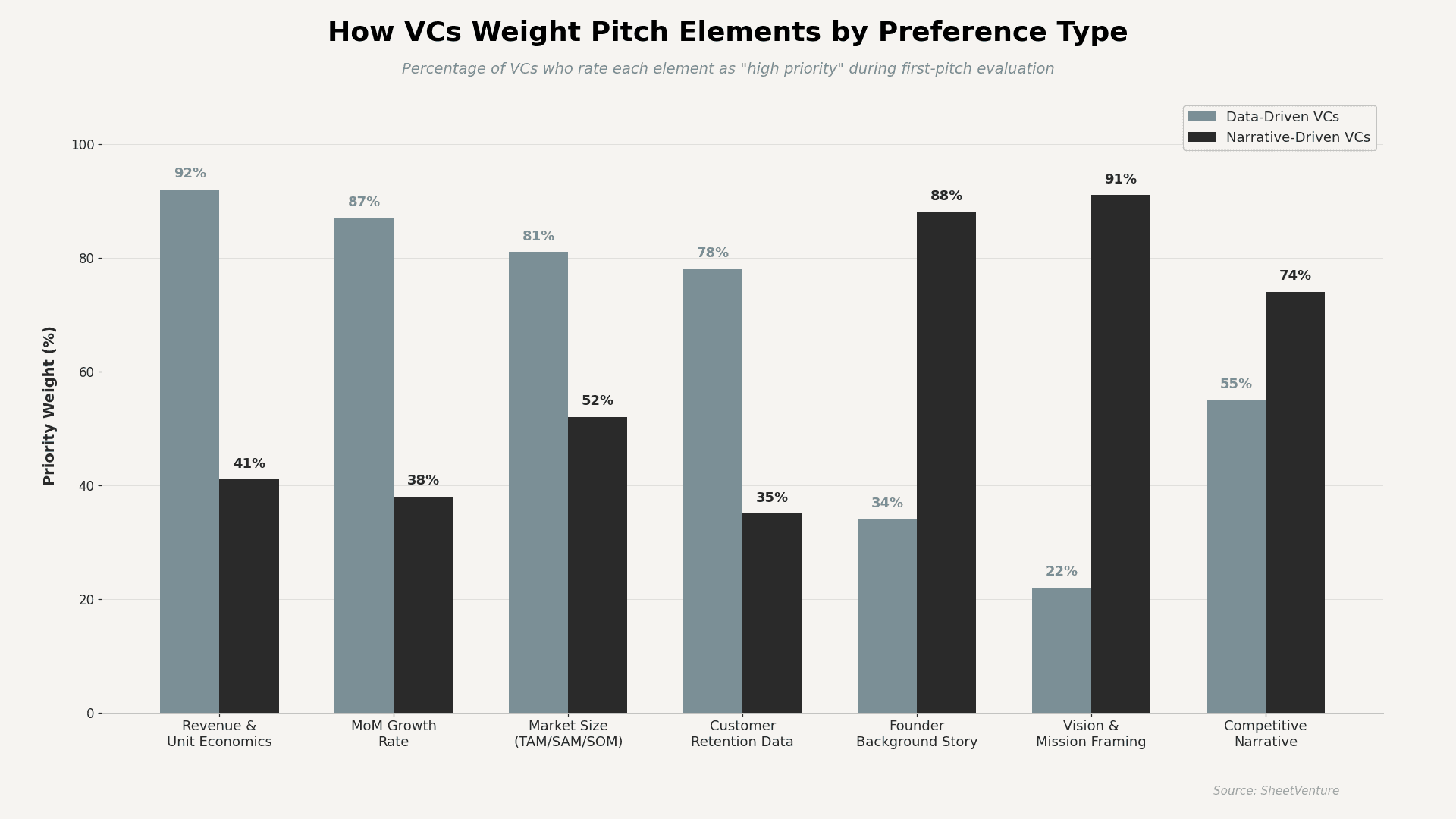
The clearest signal is what a VC asks for before the meeting. Data-driven investors request financials, cohort charts, and unit economics upfront. Narrative-driven investors ask about the founding story, market vision, and why you started. Their follow-up questions during a pitch confirm the pattern: numbers-first VCs drill into margins and CAC within minutes, while story-first VCs probe your market thesis and personal conviction.
How Do VC Pitch Preferences Show Up Before the Meeting
Investor preference leaks through pre-meeting behavior. Founders who pay attention here gain a significant edge.
Data-driven VCs send a list of requested metrics or a data room checklist before agreeing to meet. They want to see deck slides with revenue curves, retention tables, and burn rate projections attached to the calendar invite.
Narrative-driven VCs prefer a short email summary of the problem, the founding insight, and why this team is uniquely positioned. They rarely ask for spreadsheets before a first conversation.
VCs who open with "Walk me through the numbers" are signaling a quantitative filter. Those who open with "Tell me about yourself" are signaling a qualitative one.
Check their portfolio companies and public talks. Investors who write about TAM calculations and SaaS benchmarks almost always prefer data-heavy pitches. Learn how to research VCs before every meeting.
What Questions Reveal a VC's Pitch Evaluation Style
The first three questions an investor asks tell you exactly what they value. Patterns emerge fast.
Data signals: "What's your MRR?" "What does your cohort retention look like at Month 6?" "Walk me through your unit economics." These investors score pitches on quantifiable proof.
Narrative signals: "What problem keeps your customers up at night?" "Why did you leave your last role to build this?" "How do you see this market evolving?" These investors score pitches on clarity of vision and emotional resonance.
Most VCs blend both, but they lead with one. The lead tells you where to anchor. Use tailor pitches strategies to match investor style in real time.
How to Spot the Difference in VC Backgrounds and Content
Investor backgrounds often predict pitch preference before you ever meet.
• Finance or engineering backgrounds (ex-Goldman, ex-Google PM, former CFOs) almost always lean data-driven. They think in spreadsheets and expect founders to speak that language.
• Operator or media backgrounds (former founders, journalists, brand builders) lean narrative. They evaluate conviction, storytelling clarity, and founder resilience.
• Read their blog posts, Twitter threads, and podcast appearances. Data-driven VCs publish benchmarks and frameworks. Narrative-driven VCs publish founder profiles and market theses.
• Use investor intelligence tools to profile VC behavior and content patterns before outreach.
Data-Driven vs Narrative-Driven VC Indicators at a Glance
Signal | Data-Driven VC | Narrative-Driven VC | Where to Check | Founder Action |
Pre-meeting request | Asks for metrics deck, data room access | Asks for a short problem summary email | Intro email thread | Prepare both a data appendix and a story brief |
First question in the meeting | "What is your MRR and growth rate?" | "Why are you building this?" | Meeting notes | Lead with the matching hook in the first 90 seconds |
Follow-up focus | Deeper financial models, cohort exports | Customer case studies, competitive positioning | Follow-up email requests | Send what they ask; don't default to your preference |
Blog/public content | Publishes SaaS benchmarks, market sizing frameworks | Publishes founder spotlights, industry trend pieces | LinkedIn, Substack, firm blog | Mirror their published language in your outreach |
Professional background | Finance, consulting, engineering | Operations, media, and former founders | LinkedIn profile | Reference shared professional context early |
Why Matching Pitch Style to VC Preference Matters
Founders who match the investor's evaluation style see measurably better outcomes. Misalignment is one of the top reasons promising startups get passed on.
Presenting heavy financials to a narrative-driven VC makes you seem disconnected from the customer problem. They tune out.
Presenting a sweeping vision to a data-driven VC without numbers makes you seem unprepared. They lose confidence.
The best founders prepare both versions and read the room within the first two minutes. The investor's opening question is your cue.
Understanding what pitch deck data investors expect helps you prepare the right anchor regardless of style.
The Bottom Line
VC pitch preferences are not hidden. They surface in pre-meeting requests, opening questions, professional backgrounds, and public content. Data-driven investors lead with metrics. Narrative-driven investors lead with vision. The signal is always there if you look for it.
Prepare two versions of your first two minutes. Let the investor's behavior tell you which one to deploy. The founders who do this consistently convert more first meetings into follow-ups.
SheetVenture helps founders profile investor preferences and pitch styles so every outreach is tailored to the person reading it.
Publication Date: