What to Do If a Key Hire Falls Through During Investor Due Diligence?
A key hire falling through mid-diligence threatens your funding round, but founders who move fast usually save it.
When a key hire falls through during due diligence, your first move is to tell investors before they find out for themselves. Transparency handled fast is recoverable. Silence is not. Most rounds that survive this have one thing in common: the founder had a plan within 48 hours.
A hire falling through at the worst possible moment, right when investors are scrutinising every corner of your business, feels catastrophic. It does not have to be.
VCs have seen this before. What they have not seen, and do not forgive, is a founder who goes quiet, stalls, or pretends nothing changed.
Why Does This Threaten Your Funding Round?
Investors are not just backing your product. They are backing the team executing it. When a key hire falls through, a head of engineering, a CMO, a CTO, who is described as already onboarded, it raises questions beyond the role itself:
• Can this team actually close the people they need?
• Is the company as far along as described in the deck?
• What else might change before close?
That third question is the one that kills rounds. Not the departure itself.
What Should You Do in the First 48 Hours?
Speed matters more than polish here. Do not wait until you have a replacement lined up before saying something.
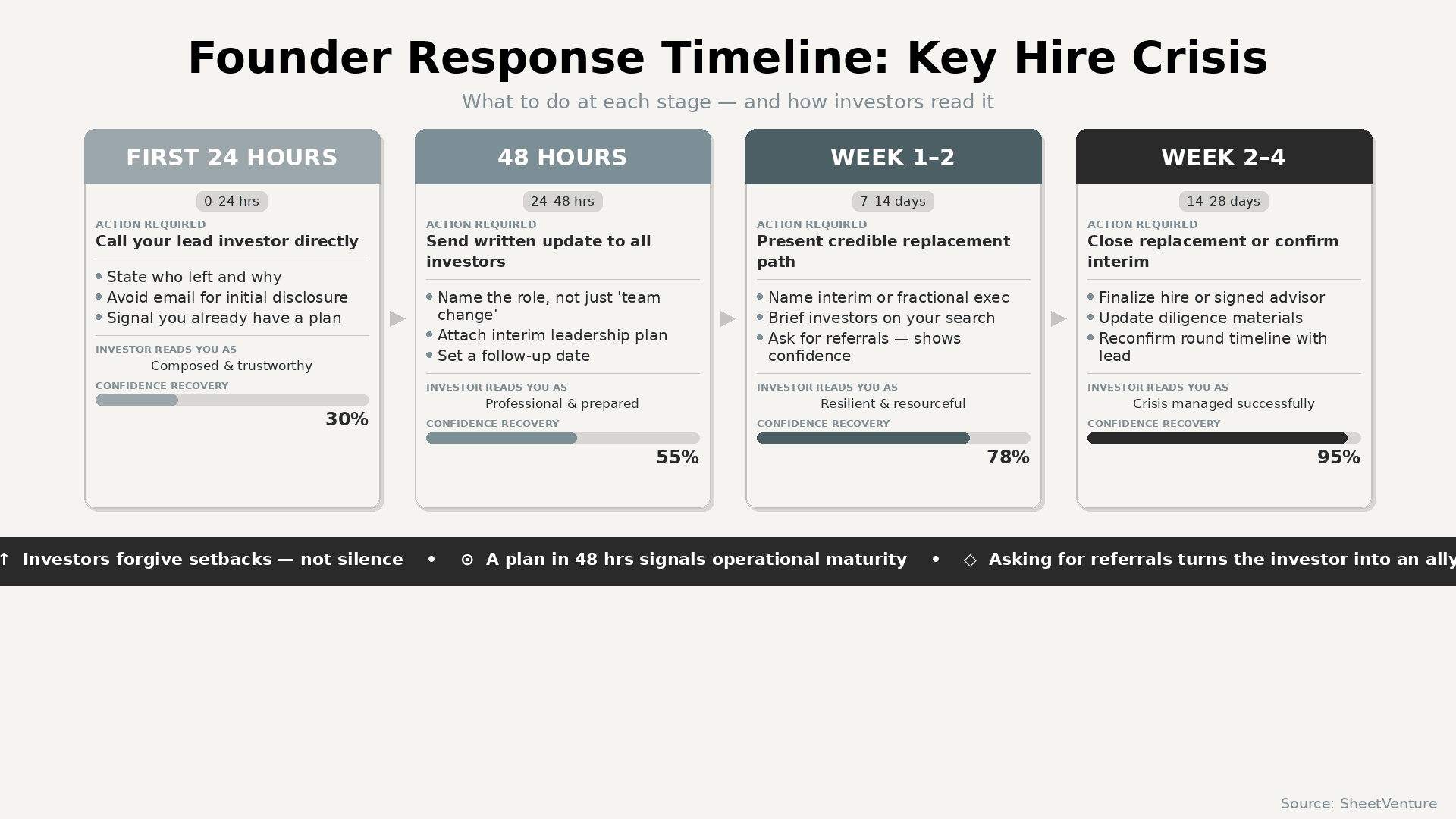
Within 24 hours:
• Call your lead investor directly by phone first, not email.
• State plainly who left, what role they held, and why they pulled out.
• Signal immediately that you are already managing the situation.
Within 48 hours:
• Send a brief written update to all investors currently in process.
• Attach or reference an interim plan; leadership cover, active search, or advisor in place.
• Set a clear date when you will have a resolution or next update.
Investors respond to composure. A structured update two days after a hire falls through does not look like a crisis. It looks like a founder who handles pressure well, which is exactly the signal you need to send right now.
How Do You Tell Investors Without Losing Their Confidence?
Framing matters. Most founders either over-explain with apologies or under-explain with vague language. Both are mistakes.
What works:
• Lead with facts, not the apology.
• Show you anticipated this as part of a longer search process.
• Commit to a specific next step with a date attached; not 'we're evaluating options.'
If you have backups already moving, strong referrals, an advisor willing to step in, or a second-choice candidate in late-stage conversations, say so. Do not make investors ask.
Understanding what triggers investor hesitation is half the battle. See investor delays for the full picture of what causes rounds to stall mid-process.
How Do You Replace a Key Hire Quickly During Diligence?
You need a credible path to filling the role, not a filled role. There is a difference, and experienced VCs know it.
Interim options that hold credibility with investors:
• A named advisor with directly relevant experience willing to be referenced on calls.
• A fractional executive from your sector with a documented track record.
• A second-choice candidate already in your pipeline, even at early-stage conversations.
Bring your investor into the search. It sounds counterintuitive, but asking for referrals signals confidence, not weakness. 'We are replacing [Name] and would value your network for [Role]' is a strong move. It also gives the investor a personal stake in your recovery.
For context on how introductions and network access affect investor decisions, read " The Role of Introductions.
How Investors React Based on What Founders Do
Founder Action | Investor Perception | Impact on Round |
Proactive call within 24 hours | Composed, trustworthy | Low disruption |
Written update with a clear plan | Professional, prepared | Process continues |
Silent for 1+ week | Hiding problems | Likely pause or pass |
Blaming the departed hire | Poor judgment | Confidence drops |
Replacement plan within 2 weeks | Resilient, resourceful | Round often recovers |
The pattern is clear: founders who act quickly recover at a much higher rate than those who wait. Investors are not looking for perfection. They are looking for how you handle imperfect situations.
This links directly to how investors read strong founder signals throughout a fundraising process; the hire crisis is just one test.
How Do You Prevent a Key Hire From Derailing Your Round?
Prevention is always cleaner than recovery. Before entering due diligence, a few habits protect you:
• Never present any hire as locked in until the paperwork is fully signed.
• Maintain a short backup list for every critical role before fundraising begins.
• Brief your team leads on what due diligence involves; surprises cause cold feet.
Review your founding team strategy before entering any active fundraising process. Investors are evaluating the whole picture, not just the hire that just left.
Use SheetVenture's intelligence tools to identify which investors prioritise team resilience versus pure traction; knowing your audience changes how you frame this conversation.
The Bottom Line
A key hire falling through during due diligence is recoverable. Silence is not. Act within 48 hours, frame it clearly, show a credible replacement path, and bring your investor into the solution rather than keeping them at arm's length.
Most rounds that survive this are not saved by finding someone fast. They are saved by how the founder handles the gap.
SheetVenture helps founders identify active investors who back resilient teams, so your fundraise stays on track even when the unexpected happens.
Publication Date: