What Triggers Should Make Founders Pause Outreach and Focus on Traction?
Most founders pitch too early. Six traction triggers reveal exactly when to pause outreach and build investor proof.
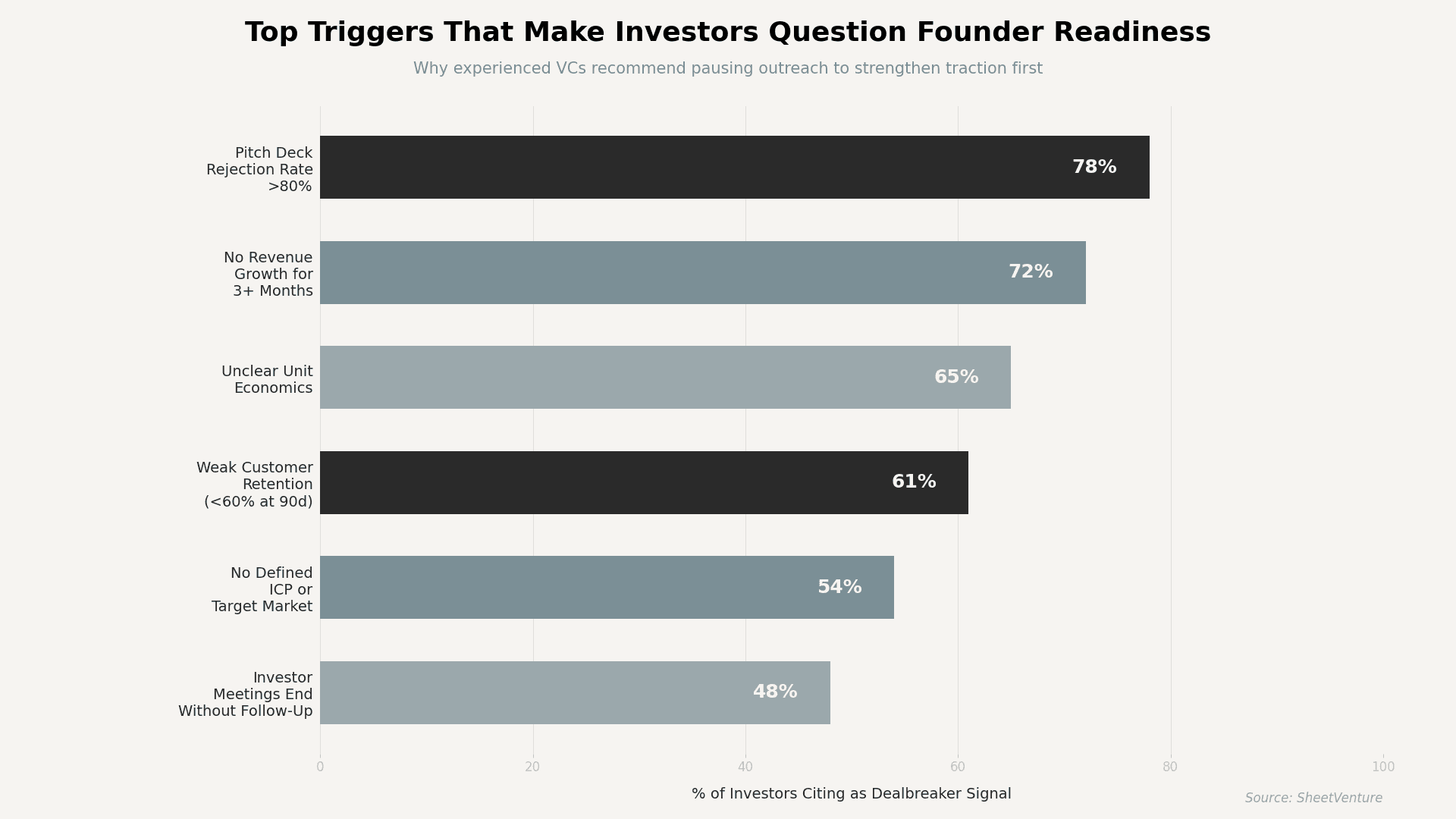
Founders should pause investor outreach when rejection rates exceed 80%, revenue has flatlined for three or more months, unit economics remain unclear, or customer retention is below 60% at 90 days. These signals tell investors the startup is not ready, and continuing to pitch wastes credibility and time.
Every cold email sent before your numbers support the story burns a contact you may never recover. Most founders reach out 2 to 4 months too early. Recognizing these triggers is one of the highest leverage decisions in early-stage fundraising.
What Are the Key Triggers That Signal You Should Stop Pitching
Not every slowdown means you should quit. But these six signals consistently indicate that outreach is premature:
Pitch deck rejection rate above 80%. If 4 out of 5 investors pass, the problem is not volume. It is the story or the metrics.
Revenue flat or declining for 3+ months. Investors want trajectory. Flat revenue tells them the growth engine is broken.
Unit economics are unclear or negative. If you cannot explain CAC, LTV, and payback period, investors assume the model is unproven.
Customer retention below 60% at 90 days. High churn signals weak product-market fit. No investor funds a leaky bucket.
No defined ICP or target market. 'Everyone is our customer' is a red flag. VCs need a specific, reachable segment.
Investor meetings end without follow-up. If no one asks for a second call, your pitch lands but does not compel action.
Knowing what signals make investors lose confidence during a raise helps founders catch these patterns early.
How Should Founders Decide Between Pausing and Pushing Through
The decision is not binary. It depends on the type of feedback you are getting and how quickly you can close specific gaps.
Trigger Signal | What It Tells Investors | Recommended Action | Time to Fix |
Rejection rate >80% | Story or metrics are unconvincing | Rework deck, reframe narrative | 2 to 4 weeks |
Flat revenue 3+ months | The growth engine is stalled | Test new channels, optimize funnel | 6 to 12 weeks |
Unclear unit economics | The business model is unproven | Map full CAC/LTV, prove payback | 4 to 8 weeks |
Retention <60% at 90d | Product market fit is weak | Improve onboarding, talk to churned users | 8 to 16 weeks |
No defined ICP | The market approach is scattered | Narrow focus, validate one segment | 3 to 6 weeks |
No follow-up after meetings | Pitch is interesting but not compelling | Sharpen the ask, add urgency proof | 2 to 4 weeks |
Sending 50 more emails with the same deck and same metrics is not fundraising. It is broadcasting weakness. The common mistakes founders make when raising capital almost always trace back to pitching before the numbers are ready.
What Traction Benchmarks Should Founders Hit Before Resuming Outreach
Before restarting outreach, make sure you can answer yes to at least four of these:
• Monthly revenue has grown for at least two consecutive months.
• You can clearly state CAC, LTV, and payback period.
• 90-day customer retention is above 65%.
• You have 3 to 5 referenceable customers or pilots.
• Your pitch deck tells a metric-backed story in under 3 minutes.
• You can name 20+ investors matching your stage, sector, and check size.
Building a targeted list matters as much as the traction itself. SheetVenture gives founders a live investor database filtered by stage, sector, and recent activity, so outreach only goes to investors deploying capital right now.
How Do Investors Respond When Founders Come Back Stronger
Investors respect founders who recognize gaps and close them. A second email saying 'we grew 40% MoM, signed 3 enterprise pilots, and reduced churn by half' proves self-awareness, execution speed, and coachability.
The founders who close rounds fastest are the ones who build proof traction will scale and re-enter from a position of strength. Keep investors warm with short monthly updates. When you are ready to pitch again, they already know you are executing.
The Bottom Line
Outreach without traction is noise. If your rejection rate is above 80%, revenue is flat, unit economics are foggy, or retention is weak, stop pitching and start building. Fix the gaps, stack real proof, and return with a story the numbers can back up. Founders who pause and rebuild close rounds faster than those who pitch through weakness.
SheetVenture helps founders track which investors are actively deploying capital, so when your traction is ready, your outreach targets the right people at the right time.
Publication Date: