Investor databases lag behind real VC partner changes. Learn how often moves happen and what founders miss entirely.
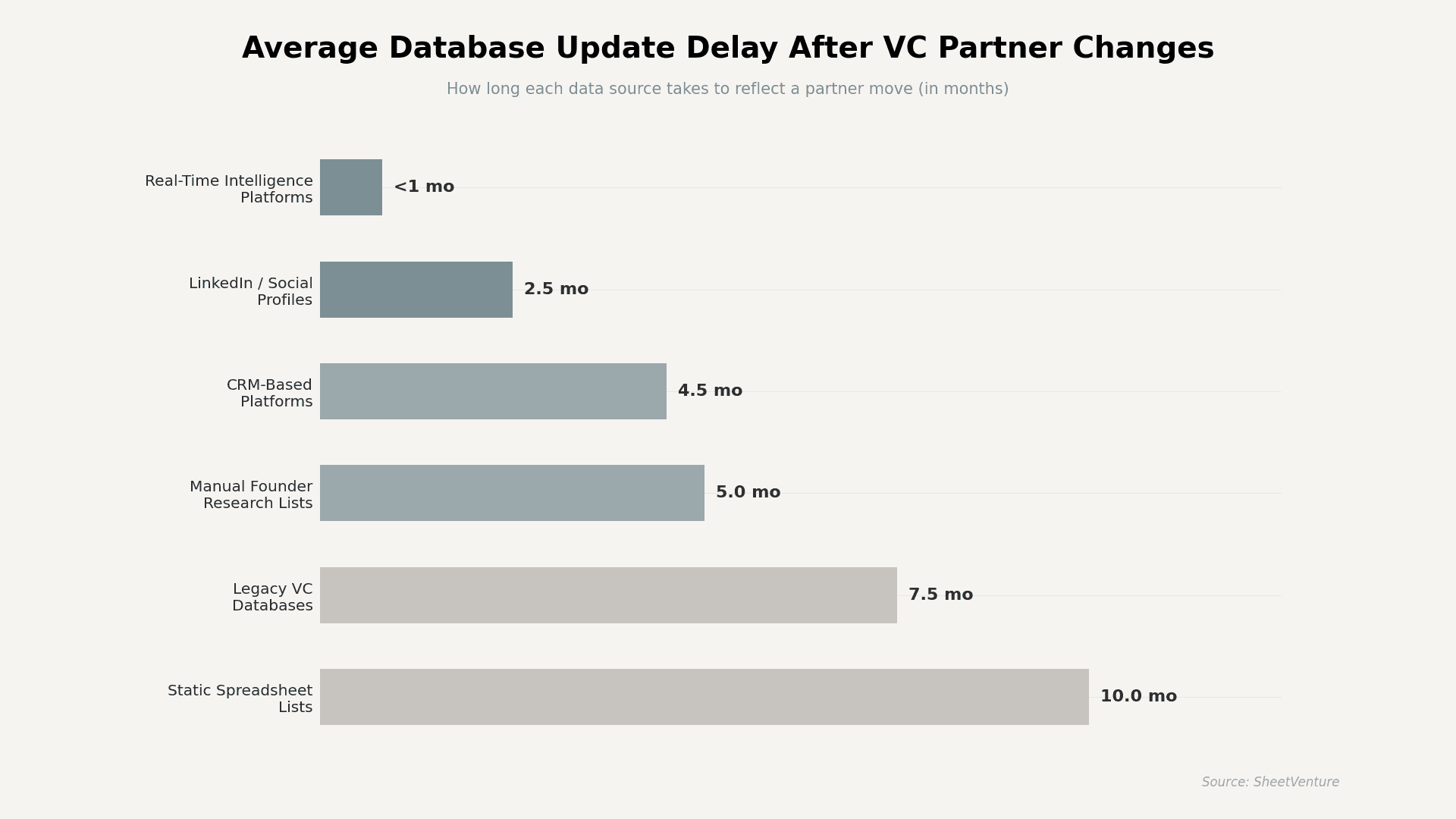
Around 15 to 25% of VC professionals change firms, roles, or fund affiliations each year, but most investor databases take 3 to 9 months to reflect these moves. That means founders regularly pitch the wrong person at the wrong firm, wasting entire weeks of outreach on contacts that no longer exist.
The venture capital industry runs on relationships, but those relationships shift constantly. Partners leave to start their own funds. Associates get promoted and switch firms. GPs move between established funds. Every one of these moves creates a data gap that static databases rarely close in time.
Why Do VC Databases Fall Behind Partner Moves
Investor databases rely on periodic scraping, manual entries, and self-reported profiles. None of these methods captures real-time movement consistently.
• Most databases refresh quarterly at best, leaving 3 to 6 months of blind spots after every departure.
• Partner exits often go unannounced for weeks or months while firms manage transitions internally.
• New fund formations take even longer to appear in legacy directories because they launch quietly.
• Associates and principals who change roles rarely update external profiles immediately.
• Firms themselves may delay public announcements until replacement hires close.
The problem compounds at smaller funds. Micro VCs and solo GPs change structures, merge, or wind down without press coverage. If nobody writes about it, the database never learns about it. Founders end up treating stale listings as live opportunities and wondering why their response rates keep falling.
Understanding what an active investor means helps founders distinguish between real prospects and outdated listings before they ever hit send.
How Often Do Venture Capitalists Actually Change Firms
Movement in venture capital is more frequent than most founders realize. The industry structure encourages mobility, especially at junior levels and during market corrections.
• 15 to 25% of VC professionals change roles or firms annually across the industry.
• Junior investors like analysts and associates turn over at 30 to 40% per year.
• Partner-level moves happen at 10 to 15% annually, often tied to new fund launches.
• Fund closures and new fund formations create additional churn every cycle.
• Post-downturn years see sharp spikes in movement as firms restructure or downsize teams.
In a typical 50-person VC firm, 8 to 12 professionals may shift roles within a single 12-month window. Multiply that across thousands of active firms globally, and the scale of outdated data becomes staggering. A database that was accurate in January could be wrong about hundreds of investors by July.
What Happens When Founders Use Outdated Investor Data
Stale data does not just waste time. It damages your credibility with firms you may want to approach later.
• Emails bounce or reach someone who left the firm months ago, creating dead outreach.
• Pitching an investor who no longer covers your sector signals poor preparation and research.
• Following up with the wrong partner at a firm creates internal confusion and leaves a bad impression.
• Founders lose confidence after repeated dead ends that were never real leads to begin with.
• Warm intro requests fail when the mutual connection's contact has already moved on to another fund.
Every email sent to the wrong person is an email not sent to the right one. At scale, this kind of pipeline rot turns a focused 3-month raise into a 6-month grind with declining morale and shrinking options.
Founders who find active VCs before outreach avoid the most common and most preventable source of pipeline waste.
How Can Founders Verify Investor Data Before Outreach
Checking data freshness before sending a single email saves entire weeks of wasted effort and protects your reputation with target firms.
• Cross-reference any investor database with LinkedIn before reaching out to confirm current roles.
• Look for recent portfolio announcements tied to the specific partner, not just the firm overall.
• Check if the investor has posted, spoken at events, or been quoted in the last 90 days.
• Verify fund status by looking for SEC filings or recent fund launch announcements.
• Use platforms that track deal activity in real time rather than relying on static quarterly snapshots.
Knowing which investors are actually active now prevents founders from building outreach lists full of ghost contacts that burn time and energy.
SheetVenture provides real-time intelligence that tracks investor movements as they happen, not months after the fact.
The Bottom Line
VC professionals change firms far more often than databases can keep up with. With 15 to 25% annual turnover and update delays stretching 3 to 9 months, founders using static lists are pitching ghosts more often than they realize.
The fix is straightforward. Verify before you send. Use sources that refresh continuously. Build your outreach around confirmed activity, not archived profiles sitting in a spreadsheet from last quarter.
Your fundraiser is too important to run on stale data. Every dead email is a lost opportunity to reach someone who could actually write the check.
SheetVenture helps founders with outreach with verified, real-time investor data so every email lands with the right partner at the right firm.
Last Update:
Everything you need to understand private markets
Understand your market in real-time.
Filter by stage, sector, and exact geography.
Access 30,000+ verified, daily-updated active