How to Automate Email Outreach Using SheetVenture: A Step-by-Step Guide
Learn how to use sheet venture lists to organize your contacts, save time, and boost outreach success. Simplify your workflow with these easy steps.
Last Update:

10 Minutes Read
Email outreach to investors can feel overwhelming when founders need to talk to 60+ prospects during a fundraise. Tracking conversations, follow-ups, and investor responses manually becomes a time sink that takes you away from building your business.
You need a smarter approach. Automated email outreach solves this by streamlining your cold email outreach process. You can focus on meaningful conversations rather than administrative tasks. Email outreach tools like SheetVenture help you implement an effective email outreach strategy while maintaining the personalization investors expect.
This piece will walk you through how to set up and optimize your outreach funding campaigns using SheetVenture.
Understanding Automated Email Outreach with SheetVenture
What Makes Email Outreach Automation Effective
Automated email outreach transforms the fundamental math of fundraising. Manual outreach caps you at around 30 to 50 emails per day [1]. That volume sounds reasonable until you realize that 80% of sales require five or more follow-ups to close, and nearly 48% of salespeople never follow up at all [1]. The numbers expose the problem: manual outreach collapses under the weight of consistent follow-up requirements.
Automation handles what humans struggle with at scale. The delivery system manages warmup protocols, inbox rotation, sequence logic and follow-up timing without manual intervention. This creates steady sending rhythms rather than erratic spikes that trigger spam filters [1]. Your email provider sees consistent activity patterns instead of suspicious bursts that resemble spam behavior.
Response rates tell the story. Cold emails can achieve open rates as high as 60%, with response rates between 1% and 5% [2]. The key lies in treating your outreach infrastructure as two distinct layers: the delivery system runs on automation while the creative payload stays with humans [1]. Automation handles volume and consistency. Humans handle conversion.
How SheetVenture Simplifies Investor Outreach
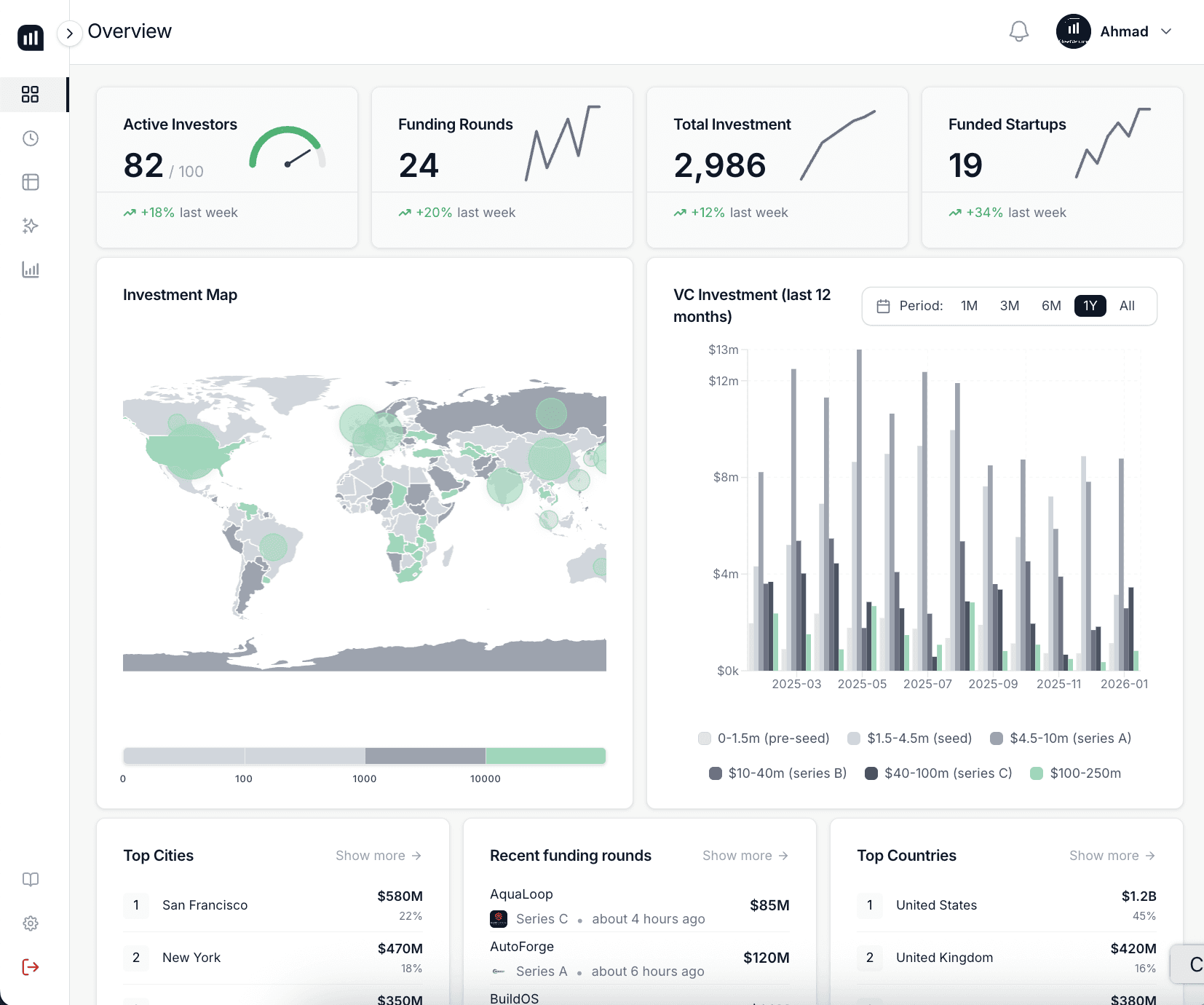
SheetVenture solves the broken fundraising system by providing a live intelligence platform rather than static spreadsheets. The platform tracks only investors who have written checks in the last 18 months and gives you a direct line to active capital [3]. This cuts research time from months to minutes.
The database tracks over 150,000 investors worldwide, with 30,000 verified as investing in the past 12 to 18 months. This global coverage spans North America, Europe, LATAM, MENA and Asia. You can filter investors by stage, geography, sector and check size in a Google Sheet format [1].
Live deal tracking shows where capital flows by industry, stage and geographic region. An AI-powered scoring system analyzes your startup's profile, industry, business model and funding stage, to rank the best-fit investors [3]. The algorithm assigns scores from 1 to 100 based on recency, momentum and thesis match [1]. This transforms a massive list into a prioritized, useful outreach plan.
When to Use Automated vs Manual Outreach
The decision hinges on deal economics and pipeline stage. High-value, low-volume account-based plays justify manual research when a single contract exceeds the time cost by 10x or more. Reading recent earnings calls and referencing specific initiatives makes sense for deals worth USD 100K or more [1].
Automation excels in different scenarios. Speed of learning matters more than individual personalization when testing a new market segment or entering a new vertical [1]. You can send structured tests to multiple contacts per segment and gather response data faster than manual methods allow.
Mid-funnel nurturing becomes impossible without automation [1]. Managing 400 to 500 mid-funnel contacts, each needing 5 to 7 touches over 8 weeks, equals 2,000 to 3,500 touchpoints to coordinate [1]. Automation handles the cadence while you focus on conversations that progress.
The winning approach combines both methods. Use automation for outreach and consistent follow-up sequences, then trigger manual effort when a prospect signals intent [1]. This composable execution delivers scale without sacrificing relevance when conversion opportunities appear.
Preparing Your Email Outreach Strategy Before Using SheetVenture
Defining Your Outreach Goals and Metrics
Success metrics determine whether your email outreach strategy works or wastes time. Vanity metrics like total opens or raw send volume fail to reflect actual business effect. Focus on goal-specific performance instead. A welcome series prioritizes unique open rate and list growth. Post-purchase emails get judged by repeat conversion rate or revenue per email [4]. Matching metrics to purpose keeps reporting focused and insights relevant.
Track conversion rates over open rates. The conversion rate measures how many recipients took the desired action, such as scheduling a meeting or responding with interest [5]. Meetings booked and deal pipeline created matter more than email opens for investor outreach funding. Segment your reporting by investor type and lifecycle stage to spot friction points faster [4]. Breaking reports down by cohort helps identify where people drop off and where to double down.
Researching Your Target Investor Profile
Investors operate under strict mandates that exclude most startups. Angels invest based on past experience and background. They seek early exits within 5 to 7 years. VCs follow specific investment theses determined by geography, stage, sector and revenue criteria. They prioritize 100x returns for Seed to Series A and 10x returns for Series B to C [6].
Research these parameters before sending cold email outreach:
Check sizes they issue and fund timeline arrangement
Investment philosophy, thesis and past portfolio companies
Stage focus (pre-seed, seed, Series A+) and sector priorities
Geographic constraints and whether they invest in your region
Ownership patterns in companies like yours
Build a target list of 30 to 50 investors who fit your profile [7]. Warm introductions through accelerators or mutual connections outperform cold outreach. Response rates jump from 2% for a single email to 18% with three follow-ups, and 42% when adding phone touchpoints over four weeks for campaigns that begin with cold emails [8].
Crafting Your Value Proposition
A strong value proposition answers one question investors ask: "How can you help me?". Business buyers say they purchase from companies when their goals are understood, according to 86% of them. Yet 59% report salespeople don't take time to do this [9].
Steve Blank created a formula to distill your value proposition: "We help (X) do (Y) by doing (Z)" [9]. Start with the jobs to be done theory. Customers hire products to solve problems rather than purchasing based on attributes. Identify what job your startup addresses and how you fill this need [2].
Answer these questions: What is my offering? What job does the customer hire my brand to do? What companies compete to do this job? What sets my brand apart? Distill your points into a clear statement under 150 words. Run it by people unfamiliar with your business. Edit to address those points if confusion arises [2].
Gathering Required Materials and Documents
Investors need validation before committing time to meetings. Have every document ready that proves your claims. Your pitch deck, executive summary and a hook paragraph summarizing the investment opportunity should be included. External parties should review these materials for feedback before sending [10].
Prepare proof points that show traction: revenue growth, customer acquisition metrics, team credentials from top-tier companies, press coverage or prominent angel investors. Lead with strength in your materials. One or two core metrics create more effect than walls of text [11]. Make materials easy to view with one click and keep pitch decks concise enough to review in three to five minutes [6].
Step-by-Step: Setting Up Automated Email Outreach in SheetVenture
Step 1: Access SheetVenture's Investor Database
Go to SheetVenture's platform and connect your Google account to access the investor database within Google Sheets. The interface displays over 150,000 global investors with filters for stage, geography, sector and check size built into the spreadsheet format. Search by investor name, fund type or location using the built-in search fields.
Step 2: Build and Refine Your Target List
Apply filters to narrow your database view. Select your funding stage (pre-seed, seed, Series A+) and target geography by city names rather than countries for better accuracy. Choose relevant sector tags. Add multiple sector tags to expand results, then layer location filters to narrow focus. SheetVenture's AI scoring system ranks investors from 1 to 100 based on thesis alignment and recent activity. Export investors scoring above 70 to create your qualified outreach list of 30 to 50 prospects.
Step 3: Create Your Email Templates
Write Email templates between 75 to 200 words that include personalization variables for investor name, firm and recent portfolio activity. Structure each template with a personalized opening line referencing a specific signal and your value proposition in 2 to 3 sentences. Include one clear call-to-action. Avoid multiple CTAs, as single-CTA emails increase clicks by 371% and sales by 1,617%. Prepare 3 to 4 templates for your sequence: original outreach, first follow-up, second follow-up and final touch.
Step 4: Configure Email Sequences
Set up your email cadence with specific triggers and timing intervals. A proven schedule sends the original email on Day 1, first follow-up on Day 4, second follow-up on Day 11 and final follow-up on Day 21. Configure each email to deploy based on the previous email's send date and recipient behavior. Sequences with 2 emails and one follow-up generate 6.9% reply rates.
Step 5: Set Up Automation Rules
Define trigger conditions that launch your sequence, such as "investor added to target list" or "investor opened previous email." Set daily sending limits between 30 to 50 emails per inbox to maintain deliverability. Create exclusion rules to prevent sending to investors who replied, unsubscribed or are in another active sequence.
Step 6: Launch Your Campaign
Test your sequence by sending to your own email address first. Verify all personalization variables populate correctly and links function properly. Check that formatting displays across devices. Once confirmed, activate the campaign for 10 to 15 investors. Monitor delivery rates above 98% and open rates for 3 to 5 days before scaling to your full target list.
Best Practices for SheetVenture Email Campaigns
Personalization Techniques That Increase Response Rates
Personalization transforms cold email outreach from generic broadcasts into relevant conversations. Emails with personalized subject lines generate 29% higher unique open rates and 41% higher unique click rates [12]. Static subject lines don't capture attention very well in crowded investor inboxes. A simple adjustment like adding the recipient's name or referencing their recent portfolio activity increases open likelihood by 26% [4].
Subject line personalization creates the first impression, but deeper tactics get responses. Dynamic content allows you to send mass emails while tailoring specific sections to individual interests based on behavioral data or demographics [5]. Segmentation groups investors by stage preference, sector focus, or geographic region and ensures your message addresses their actual investment criteria. Behavior-triggered emails respond to specific actions, such as sending follow-ups when investors open your deck link but don't reply.
Timing Your Outreach for Maximum Effect
Send investor emails on Tuesdays for 16% higher open rates compared to other weekdays [13]. Mid-morning windows between 10:00 AM and 11:00 AM EST work well, but send at irregular times like 10:07 AM instead of on the hour [6]. Emails sent at the top of the hour face delivery delays and inbox competition from other scheduled campaigns.
Space your follow-up sequence with care. Send your first follow-up within 24 to 48 hours after the original email when your pitch remains fresh in their minds. Subsequent touches should land 5 to 7 days apart to maintain presence without overwhelming recipients [14].
Avoiding Spam Filters and Deliverability Problems
Organic email lists built through opt-ins achieve open rates 5 times higher than purchased lists and receive 4 times fewer spam complaint. Authenticate your sending domain using SPF, DKIM, and DMARC protocols to signal legitimacy to inbox providers [16]. 68% of recipients base their decision to open an email on the From name [15]. Use a personal sender address instead of generic addresses like noreply@ or info@.
Keep spam complaint rates below 0.3%, as Gmail and Yahoo will route your messages to spam folders above this threshold [16].
Following Up Without Being Pushy
Each follow-up should offer new value rather than repeating the same request. Share milestone updates, relevant market insights, or fresh views that advance the conversation [14]. Space follow-ups 3 to 4 days after the first email, then extend to a week, and a few weeks later for a final nudge [8]. Given busy investor schedules, giving recipients an easy out with phrases like "totally okay if now's not the right time" increases response rates paradoxically [8].
Measuring Success and Improving Your Outreach Funding Results
Key Metrics to Track in SheetVenture
Your second most important deliverability metric is open rate, with 42.35% representing the average across industries in 2025. Click-through rate measures overall campaign effectiveness and combines deliverability with content performance. Anything above 2% is strong [2]. Conversion rate ties email to business outcomes and shows how many recipients completed your desired action [9].
Your deliverability rate should fall between 97% to 99%. Rates below 95% signal serious issues. Bounce rate should stay under 5%. Higher rates damage sender reputation [2]. Keep unsubscribe rates below 0.5% and spam complaint rates under 0.3% to maintain inbox placement [17].
Interpreting Your Campaign Data
You should segment your metrics by investor type and lifecycle stage rather than viewing total numbers [18]. Opens by email client and device type help you understand how recipients participate [19]. Revenue per email shows financial effect of each campaign [17]. Click-to-open rate reveals content effectiveness after the open [18].
Making Informed Adjustments
A/B testing requires you to test one variable at a time: subject lines, send times, CTAs or layout. Tests must reach statistical significance before you declare winners [17]. Your historical data works better as a standard than chasing industry averages [2].
Scaling Successful Campaigns
You need to scale campaigns gradually to maintain consistent sending volumes with inbox providers [6]. Successful patterns from tested campaigns can be applied across new segments [17]. Active audience trends should be monitored to catch declining engagement early [2].
Conclusion
You now have everything needed to automate your investor outreach and raise funds faster. SheetVenture handles the heavy lifting of tracking, personalization, and follow-ups while you focus on building relationships that matter.
A small batch of 10 to 15 investors makes a good starting point. Test your templates and monitor your metrics. Your response rates will improve with each iteration as long as you maintain consistent personalization and avoid spam triggers.
Fundraising remains challenging, but automation reshapes the scene from overwhelming to manageable. Your first campaign is the beginning. Track what works and scale your successful patterns. The investors are out there, and you now have the system that reaches them.
Key Takeaways
Master automated email outreach to transform your fundraising from overwhelming manual work into a systematic, scalable process that reaches the right investors efficiently.
• Automation handles volume while humans handle conversion - Use SheetVenture to manage follow-ups and delivery while focusing your energy on meaningful investor conversations that progress deals.
• Target 30-50 qualified investors with AI scoring above 70 - Filter SheetVenture's 150,000+ investor database by stage, geography, and sector to build focused lists of actively investing prospects.
• Personalize beyond names with behavioral triggers and recent portfolio activity - Reference specific investments or thesis alignment to achieve 29% higher open rates than generic outreach.
• Follow proven timing: initial email, then follow-ups on days 4, 11, and 21 - This cadence maintains presence without overwhelming recipients while allowing time for consideration between touches.
• Track conversion rates over vanity metrics - Monitor meetings booked and pipeline created rather than just opens, keeping deliverability above 97% and response rates above 2%.
When executed properly, automated email outreach becomes your competitive advantage in fundraising, allowing you to maintain consistent investor communication while building your business.
FAQs
Q1. How can startups effectively demonstrate traction to investors?
Combine revenue indicators (MRR/ARR for subscription models) with engagement and retention metrics, customer validation feedback, and strategic partnerships that build credibility. The strongest case pairs revenue growth with high retention and customer testimonials proving real market demand.
Q2. What revenue metrics do investors expect at each funding stage?
Pre-seed: $0–$100K ARR, often zero. Seed: $100K–$1M+ ARR with 10–20% month-over-month growth. Series A: $1M-$3M+ ARR, 100%+ year-over-year growth, and solid unit economics like CAC payback under 18 months.
Q3. When is the optimal time to begin fundraising?
When you have roughly 9–12 months of runway left. That buffer covers the typical 3–6 month raise without signaling desperation. Starting too early wastes investor goodwill and costs you leverage; waiting too long forces you to accept worse terms.
Q4. What are the most important financial ratios for startup health?
An LTV-to-CAC ratio of 3:1 or higher, annual customer retention above 90%, gross margins above 80% for SaaS, and CAC payback under 12 months. Together they show your model creates value rather than burning capital.
Q5. What should pre-revenue startups focus on with investors?
Customer discovery insights from extensive interviews, signed contracts or letters of intent (even unpaid), waitlists, active pilot programs, and product milestones. The goal is proving deep market understanding and execution capability — not revenue you don't have yet.
Published Date
Related articles




Everything you need to understand private markets
Understand your market in real-time.
Filter by stage, sector, and exact geography.
Access 30,000+ verified, daily-updated active