Most founders pitch mismatched VCs. These five portfolio pattern signals reveal whether an investor will actually engage.
Founders match a VC’s recent portfolio pattern when their stage, sector, check size, investment thesis, and geography align with the last 12–18 months of that fund’s closed deals. The fastest way to check is by analyzing a VC’s three to five most recent investments and comparing them against your startup’s profile. If at least three of the five pattern signals overlap, your outreach has a significantly higher chance of getting a response.
Pitching a VC who closed a fintech seed deal last quarter is a different conversation than pitching one who hasn’t touched fintech in two years. Portfolio patterns reveal what investors are actively buying, not just what their website says they like. Here’s how to read those patterns before you send the first email.
What Signals Show a VC’s Active Portfolio Pattern?
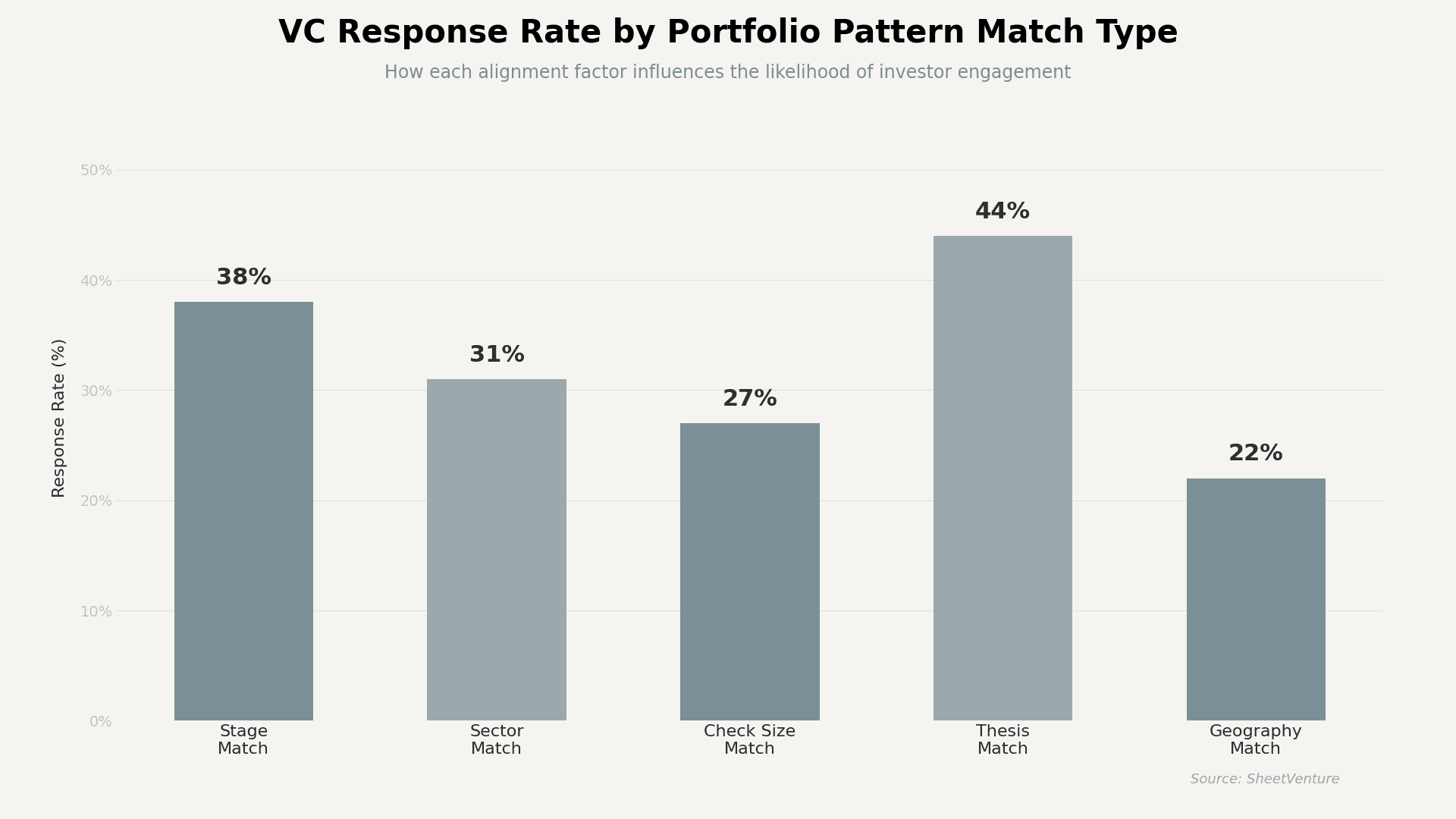
A VC’s portfolio pattern is not their stated thesis. It’s the observable behavior from recent deals. Five signals matter most:
Stage concentration: Are their last 5–10 deals pre-seed, seed, or Series A? If 80% are seed, pitching them at pre-seed is an uphill battle.
Sector clustering: Two or more deals in the same vertical within 18 months signals active interest. One deal could be opportunistic.
Check size consistency: A fund writing $500K checks is unlikely to lead your $3M round. Match your ask to their recent average.
Thesis alignment: Does the VC’s recent deal flow suggest a specific conviction area (e.g., developer tools, vertical SaaS, climate)?
Geographic preference: Some funds have shifted entirely to remote-first investing. Others still cluster deals within specific metros.
Use a venture capital database to pull these signals faster than manual research.
How Do Recent Deals Compare to Stated Investment Thesis?
Most VC websites list broad mandates. Their actual deal activity tells a tighter story. This table shows how stated focus often differs from recent behavior:
Signal | What Website Says | What Recent Deals Show | What Founders Should Do |
Stage | Seed to Series B | 85% of the last 12 deals were seed | Pitch only if raising seed |
Sector | Enterprise software | 6 of 8 deals in vertical SaaS | Highlight vertical SaaS fit |
Check size | $250K–$5M | Average recent check: $750K | Ask within the $500K–$1M range |
Geography | US and Europe | 90% US-based founders only | Prioritize if US-based |
Thesis | Future of work | Recent focus: AI productivity tools | Position as an AI productivity angle |
This gap between stated and actual behavior is exactly why founders need to invest thesis research beyond a fund’s homepage.
How Many Pattern Signals Need to Match?
Not every signal carries equal weight, but overlapping matches compound your odds:
Signals Matched | Response Likelihood | Meeting Conversion | Outreach Priority | Recommended Action |
1 of 5 | Under 5% | Under 1% | Low | Skip or deprioritize |
2 of 5 | 8–12% | 2–4% | Moderate | Include in wider list |
3 of 5 | 18–25% | 6–10% | High | Personalize outreach |
4 of 5 | 30–40% | 12–18% | Very high | Custom email + warm intro |
5 of 5 | 40–50% | 20–28% | Top tier | Treat as primary target |
Three matching signals are the tipping point. Below that, your email competes with hundreds of misaligned pitches. Above it, you enter a much smaller pool of relevant founders.
Where Do Founders Find Recent Portfolio Data?
The challenge is not knowing what to look for. It’s finding reliable, current data. Most public databases lag by months. Here’s where to look:
VC firm’s portfolio page: Check the “recent investments” section. If the page hasn’t been updated in six months, the data is unreliable.
Press releases and deal announcements: These confirm timing and round size. Cross-reference with Crunchbase or PitchBook.
LinkedIn activity: Partners often post about new investments. Their feed reveals real-time portfolio moves.
Private market intelligence platforms: Tools like SheetVenture aggregate recent deal activity, investor scoring, and thesis alignment into filterable datasets.
What Mistakes Do Founders Make When Reading Portfolio Patterns?
Pattern matching only works if the data is interpreted correctly. Common mistakes:
Relying on old deals: An investment from 2021 does not reflect a fund’s 2025 strategy. Focus on the last 12–18 months only.
Ignoring fund cycle timing: A fund that just closed Fund III may have a different thesis than Fund II. New fund, new mandate.
Confusing one deal with a pattern: A single AI deal doesn’t make an AI-focused fund. Look for two or more deals in the same category.
Overlooking anti-patterns: If a VC has three portfolio companies in your exact space, they may avoid you to prevent conflict, not embrace you.
Understanding how investors compare startups in the same market can help you avoid pitching directly into a competitor conflict.
How Should Founders Use Portfolio Patterns in Outreach?
Once you confirm pattern alignment, reference it directly in your email. Investors notice when a founder has done real homework:
Name a recent deal: “I noticed you led [Company X]’s seed round last quarter” immediately signals you’ve researched beyond the homepage.
Connect thesis to traction: “Your focus on developer tools aligns with our 40% MoM growth in the DevOps space,” ties your metrics to their pattern.
Acknowledge stage fit: “Your recent checks in the $500K–$1M range match our current raise” removes ambiguity about fit.
Targeted outreach built on pattern research outperforms bulk email every time. Learn more about finding the right VC for your startup’s stage and sector.
The Bottom Line
Matching a VC’s portfolio pattern is the difference between a cold email that gets read and one that gets deleted. Analyze a fund’s last 12–18 months of deals across five signals: stage, sector, check size, thesis, and geography. If three or more align, you have a strong basis for outreach. If fewer than two match, move on.
The data exists. The question is whether you’re willing to do the research before hitting send.
SheetVenture helps founders match with investors whose recent deal activity aligns with their stage, sector, and raise, so every outreach email lands with the right fund at the right time.
Last Update:
Everything you need to understand private markets
Understand your market in real-time.
Filter by stage, sector, and exact geography.
Access 30,000+ verified, daily-updated active