Series B investors now expect 8 to 15 times ARR, but growth rate and margin quality decide yours.
Series B investors typically expect revenue multiples between 8x and 15x ARR in 2026, with median SaaS rounds landing near 10x forward revenue. Your actual multiple depends on growth rate, net revenue retention, gross margin, and how your sector trades in public markets.
The multiple is not a sticker price; it is the output of how investors read your growth, retention, and margin profile together. Most Series B deals land between 8x and 15x trailing or forward ARR, but variance inside that band is huge. A company growing 120% year-over-year often commands triple the multiple of one growing 40% at identical revenue.
Current 2026 benchmarks reflect the reset that began in late 2022, when multiples of 30x to 50x collapsed toward long-run norms. What has not changed is the underlying logic: investors pay for rate of change, capital efficiency, and durability. Walking into the room knowing how they triangulate your number lets you defend a valuation instead of accepting one.
Current Benchmark Ranges
Where real 2026 Series B rounds are pricing this cycle:
• Median SaaS Series B round: 9x to 12x forward ARR
• Top quartile performers: 15x to 25x forward ARR
• Bottom quartile: 4x to 7x forward ARR
• AI-native companies: 20x to 40x premium bands
• Vertical SaaS with high NRR: 12x to 18x forward ARR
• Consumer subscription models: 3x to 6x forward ARR
Compare this with valuation math, where multiples behave very differently.
What Moves Your Multiple Up or Down
Investors weigh these inputs before anchoring on a number:
• Year-over-year growth rate: the single strongest driver above all else
• Net revenue retention: above 120% unlocks premium multiples
• Gross margin: 75% or higher signals durable software economics
• Burn multiple: under 1.0 is efficient, above 2.0 gets punished
• Rule of 40 score: growth rate plus profit margin, with 40 as the floor
• Sales efficiency (CAC payback): under 18 months is healthy
• Logo concentration: top-10 customer exposure should stay under 30%
• Market narrative: whether the story scales past $1B in revenue
• Founder-market fit: prior exit track record and domain depth
• Syndicate quality: strong Series A investors continuing into B
Series B Revenue Multiple Ranges by Company Profile (2026)
The ranges below reflect live 2026 Series B deal data for SaaS and adjacent categories, sorted by how fundamentals map to investor appetite.
Company Profile | YoY Growth | NRR | Expected Multiple (Forward ARR) |
Top-tier SaaS | 100% or more | 130% or more | 18x to 25x |
Strong performer | 70% to 100% | 115% to 130% | 12x to 18x |
Median Series B | 50% to 70% | 105% to 115% | 9x to 12x |
Below expectations | 30% to 50% | 95% to 105% | 5x to 8x |
Recovery story | Under 30% | Under 95% | 3x to 5x |
AI-native leader | 150% or more | 125% or more | 25x to 40x |
How Investors Actually Calculate It
The back-of-envelope logic inside partner meetings:
• Pull public SaaS comparables trading at current forward multiples
• Apply a 20% to 40% private-market discount for illiquidity
• Adjust upward for growth premium versus peer median
• Adjust downward for concentration, churn, or single-channel risk
• Cross-check against recent comparable Series B deal prints
• Stress-test against a 30% revenue miss scenario
• Benchmark against the Series B playbook used by similar funds
Most firms run this math in under 20 minutes. The number is rarely a guess; it is the midpoint of a defended range.
Common Mistakes Founders Make
What quietly compresses the multiple before negotiation even starts:
• Anchoring on last-cycle comps from 2021
• Presenting ARR without net revenue retention context
• Missing a clear path to Rule of 40 within 18 months
• Confusing bookings, billings, and recognized revenue
• Ignoring burn multiple times inside the fundraising narrative
• Over-indexing on TAM without bottom-up GTM proof
• Treating the first term sheet multiple times as the final print
Founders who have already hit growth expectations during Series A have a structural edge entering B.
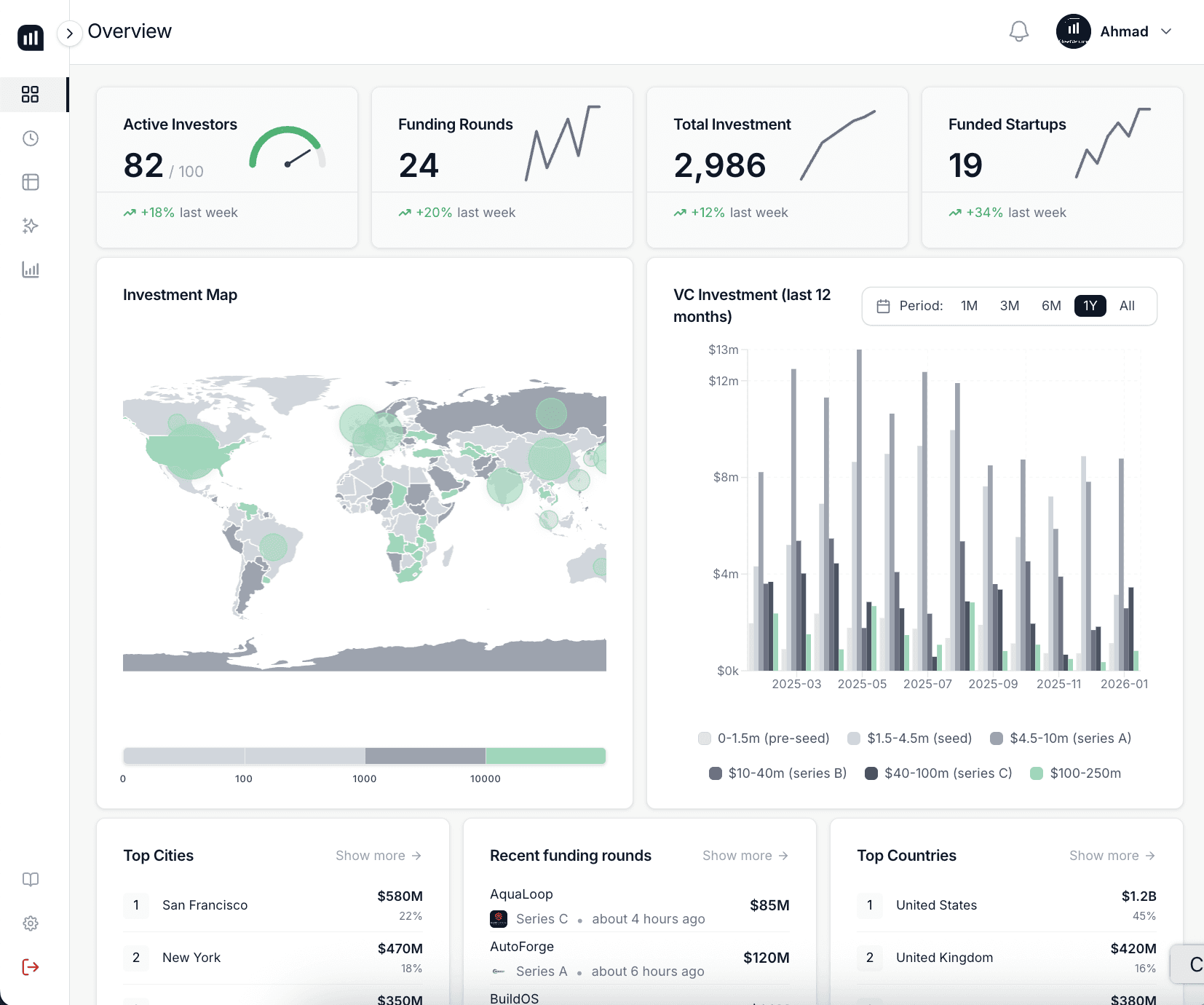
For a sharper view of which investors are actively writing Series B checks at specific multiple bands, SheetVenture maps the live venture capital database to deal activity in the last 18 months.
The Bottom Line
Series B revenue multiples in 2026 cluster between 8x and 15x forward ARR, with medians near 10x and top performers clearing 20x. The number is never about revenue alone; it is the compound score of growth rate, retention, margin quality, and market narrative. Defend the inputs and the multiple defends itself.
SheetVenture helps founders benchmark Series B revenue multiples against live deal data, so you walk into partner meetings with a defensible number, not a hopeful one.
Last Update:
Everything you need to understand private markets
Understand your market in real-time.
Filter by stage, sector, and exact geography.
Access 30,000+ verified, daily-updated active