Investors requesting vesting acceleration can stall deals. Learn exactly how to respond, negotiate, and protect your equity position.
When an investor requests founder vesting acceleration, negotiate before you sign anything. Most founders can secure double-trigger acceleration, which only kicks in after both an acquisition and a forced exit, without surrendering meaningful control.
Single-trigger acceleration, where unvested shares vest on acquisition alone, is a harder ask at later stages but worth pushing for in small doses at seed. Knowing what each structure means before you enter term sheet talks is the difference between protecting your equity and giving it away quietly.
Why Investors Request This
Investors request acceleration clauses because the exit value depends partly on founder retention. If you walk away fully vested the moment your company is acquired, the acquirer loses its primary reason to keep you. That makes your startup harder to sell at a premium, which directly affects investor returns.
Common reasons the clause appears:
• They have watched acquisitions collapse when founders left before integration was complete.
• Their fund model depends on high-value exits where retained founders command better deal multiples.
• The clause is standard in their term sheet template and was added without specific intent.
• They have a real concern about your long-term commitment after a close.
Single-Trigger vs. Double-Trigger Acceleration
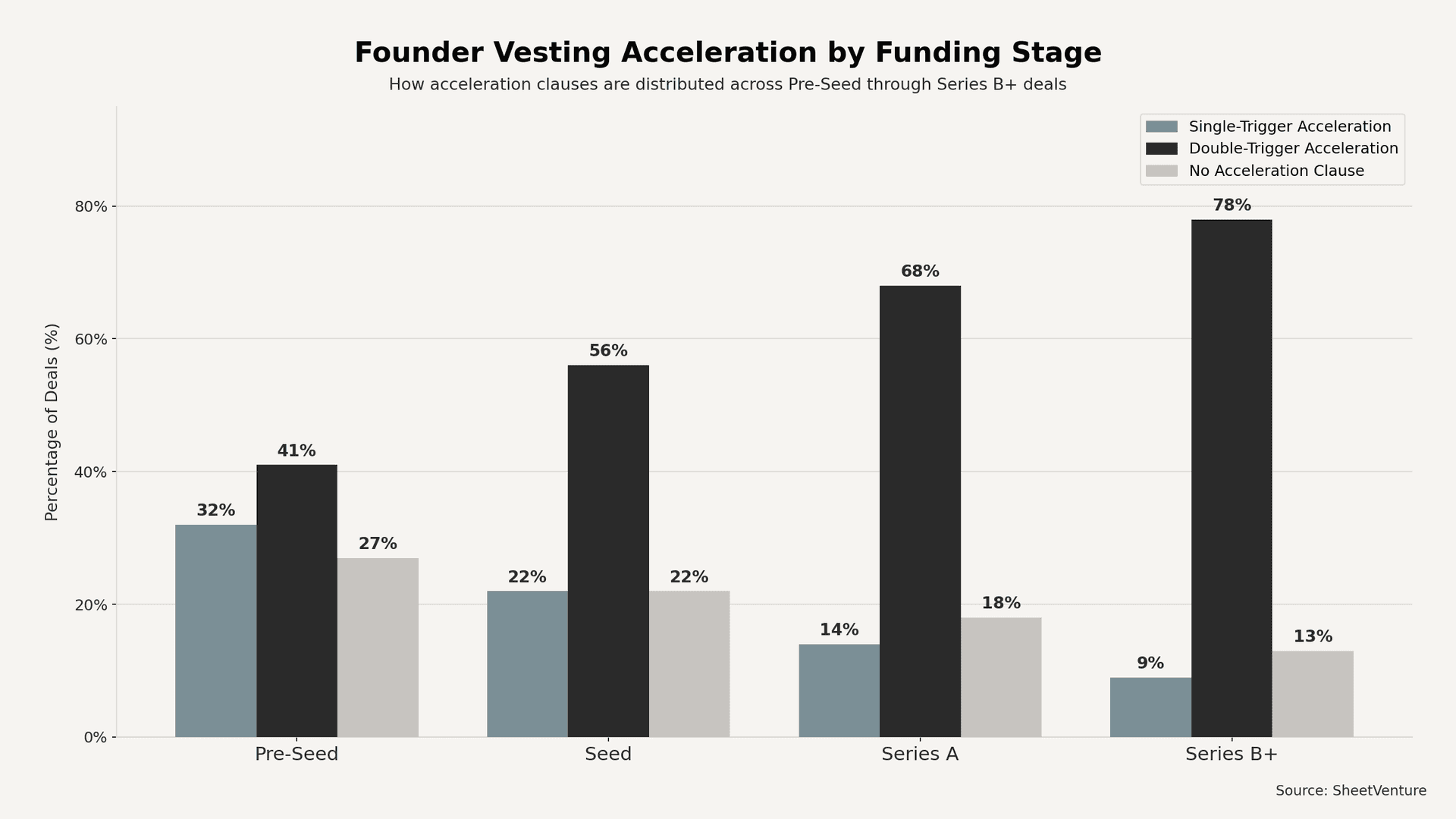
Single-trigger acceleration vests your remaining shares automatically on one event, usually a sale. Founders prefer it. Acquirers hate it because it eliminates their ability to use equity as a retention tool. Investors at Series A and beyond rarely agree to full single-trigger terms.
Double-trigger acceleration requires two events: the acquisition, and then a qualifying termination, meaning you are let go, or your role is materially changed against your will. This is the structure investors will almost always accept and the right place to start every negotiation.
The chart below shows how these structures are distributed across funding stages, based on SheetVenture deal data.
How to Negotiate Acceleration Terms
Before responding to the specific language, ask what is driving the request. If it is a template clause pulled from their standard term sheet, you have real room to reshape it. If the investor has a genuine concern about founder dependency after a sale, address that concern directly before arguing over clause language.
Steps that work in most negotiations:
• Open with double-trigger acceleration on 100% of unvested shares as your baseline.
• If they push for single-trigger, offer 25% single-trigger on acquisition and full double-trigger on the rest.
• Define "qualifying termination" explicitly: involuntary termination without cause, constructive dismissal, or material role reduction.
• Set a clear window: typically 12 months before a change of control and 18 months after.
For context on how equity structure affects these conversations, the post on startup equity decisions is worth reading before you sit down at the table.
What Founders Typically Win and Lose
Common wins at negotiation:
• Double-trigger acceleration covering 100% of unvested shares.
• Clearly defined termination language that removes ambiguity at exit.
• A 12 to 18 month post-acquisition window for the second trigger.
Common losses:
• Single-trigger on a large share percentage, especially at Series A and later.
• Immediate full vesting on acquisition with no retention component.
Reviewing VC ownership decisions helps you understand what investors are protecting on their side. Also, watch for investor red flags if the push on vesting terms feels unusually aggressive early in conversations.
Knowing which investors historically accept double-trigger terms without extensive back-and-forth saves time. SheetVenture tracks VC behavior across deal stages. Investor intelligence helps you identify which funds are flexible on term structure before negotiations begin.
The Bottom Line
Vesting acceleration requests are normal and negotiable. Double-trigger protection on 100% of unvested shares, with a defined termination window, is the realistic outcome for most founders. Single-trigger terms are worth pushing for in small percentages at early stages. Define every clause precisely, especially what counts as a qualifying termination, and do not leave any term open to interpretation.
SheetVenture helps founders identify which investors negotiate flexible vesting terms, so you enter every term sheet discussion knowing exactly where there is room to move.
Last Update:
Everything you need to understand private markets
Understand your market in real-time.
Filter by stage, sector, and exact geography.
Access 30,000+ verified, daily-updated active