
How Do I Recover Credibility After a Botched Investor Presentation?
On this page
You can recover from a bad investor presentation, but the window is narrow. Act within 48 hours, address the exact gap that hurt you, and follow up with something concrete. Most founders go quiet after a rough meeting; that silence is what closes the door, not the stumble itself.
A bad pitch doesn't end a deal on its own. Investors see dozens of presentations a month and have watched founders freeze, fumble metrics, and lose the thread under pressure. What stays with them isn't the stumble; it's what comes next.
The credibility gap after a rough meeting isn't permanent. How you handle a bad moment tells investors more about your execution instincts than the pitch itself. Understanding why investors disengage after meetings frames exactly what you're working against.
What "Botched" Actually Means to an Investor
Not every rough meeting carries the same damage. Investors tend to sort bad pitches into a few buckets:
• Weak delivery: Nerves, pacing problems, or unclear structure. Recoverable quickly.
• Flawed data: You cited wrong numbers or couldn't defend a key metric. Needs immediate correction.
• Credibility gap: You stumbled on questions about your own business. Takes more work, but fixable.
• Trust break: Something was misrepresented. Much harder to come back from.
Most bad meetings fall into the first two categories. That matters because the recovery path is direct.
The 48-Hour Follow-Up Window
Speed signals self-awareness. Waiting a week after a rough meeting implies you either didn't notice how it went or you're avoiding it. Both impressions make things worse.
What to do within 48 hours of the meeting:
• Acknowledge what didn't work, without over-apologizing or manufacturing excuses.
• Address the specific question or topic where you lost ground.
• Send corrected data, a cleaner slide, or a relevant proof point that fills the gap.
A short, direct email beats a long, defensive one every time. Three tight paragraphs, a subject line that names the meeting, and a signal that you've come back with something new. When you understand how fundraising updates get read during an active round, it changes how you frame this note.
What the Recovery Email Should Do
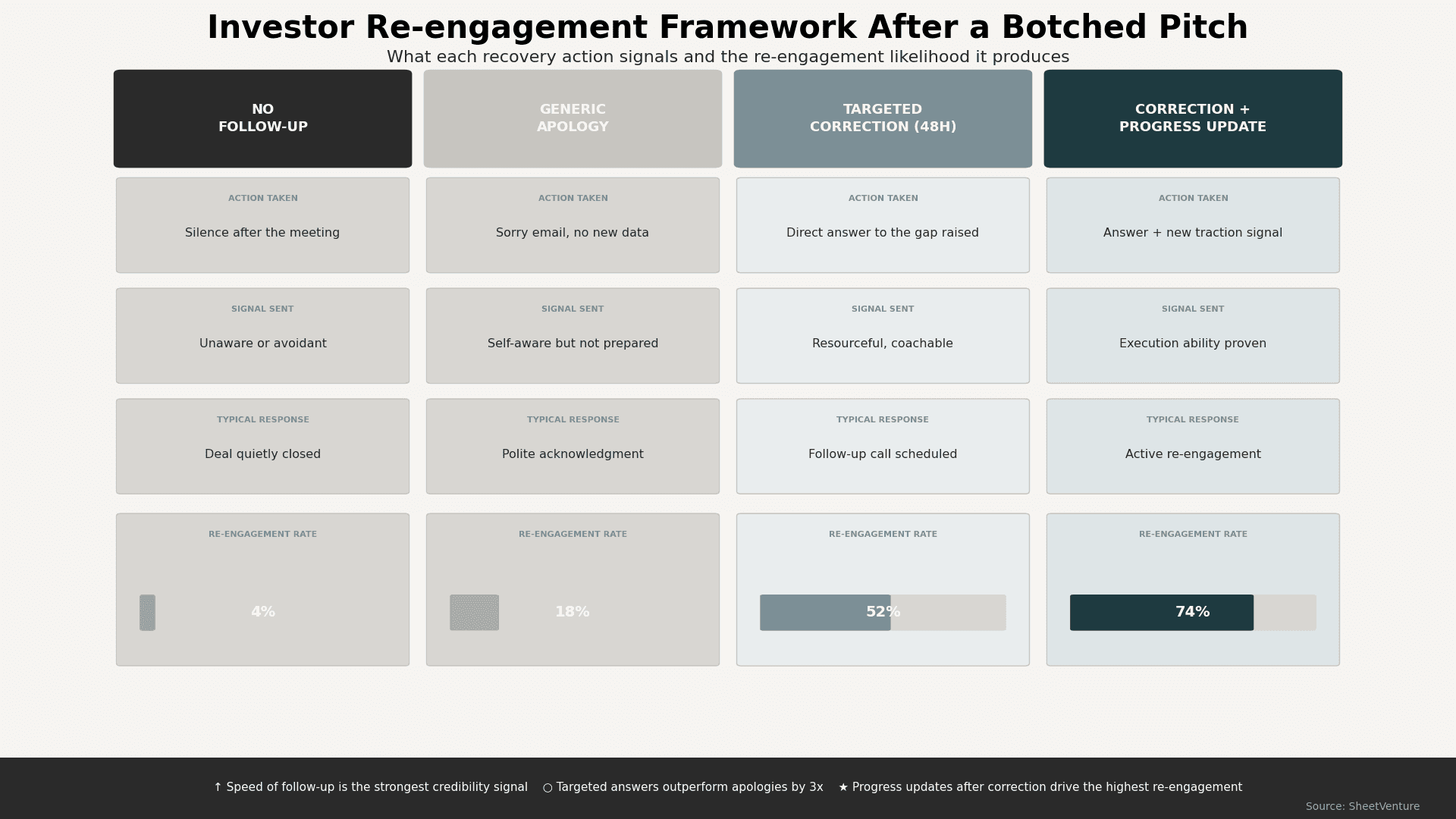
The follow-up isn't an apology tour. It's a demonstration of how you operate when things go sideways. Write it like someone who identified the real answer and came back clearly.
Your recovery email should:
• Open on the specific gap you're addressing, not a general sorry.
• Deliver the missing answer directly, without padding.
• Include one forward-looking signal: a metric update, a new customer, or a product milestone.
• Close with a low-pressure ask: a 15-minute call or permission to send a short update in two weeks.
Avoid phrases like "I just wanted to circle back" or "I hope this helps clarify." After a messy meeting, directness reassures investors far more than politeness.
When One Email Is Not Enough
If the investor doesn't respond, that's not automatically a no. Some investors wait to see what you do next. Two or three substantive updates over the following months, each showing real progress against the concern they raised, can bring a cold conversation back to life.
This is the long game, and it works because most founders don't play it. Knowing how to handle rejections productively separates founders who build durable investor relationships from those who exhaust their pipeline early.
What to include as you rebuild:
• Metric improvements and new customers since the meeting.
• Key hires or team additions.
• Concrete proof that the specific concern they raised is now addressed.
What Investors Actually Notice
Investors talk to each other. A clean recovery, handled fast and without drama, builds its own reputation. You're showing you can take a hit and come back with information rather than excuses.
Use investor intelligence to identify which investors are still active in your sector and worth following up with. Not every name on your list has the capital or thesis fit to revisit a deal, and targeting the right ones is what makes the recovery effort land.
The Bottom Line
A bad pitch is a data point, not a verdict. The 48-hour follow-up with direct answers is where credibility starts to recover. Investors who pass on a stumbled pitch and later fund the same founder aren't rare; they were watching how the founder handled what came after.
SheetVenture helps founders identify which investors are still open to re-engagement, so follow-up outreach reaches the right people at the right time.
Find investors who are actually writing cheques
Explore live coverage, or book a walkthrough of the product.