Investors instantly sort cold emails into three priority tiers before responding. Learn the exact signals that decide yours.
Investors sort every incoming founder email into one of three mental tiers: respond now, save for later, or delete; within 5 to 10 seconds. The sorting happens automatically, driven by subject line strength, sender credibility, and thesis fit signals visible before the email body is fully read.
Most founders assume their email either gets read or ignored. The reality is more structured. VCs processing 50 to 100+ emails daily develop an unconscious triage system that categorizes outreach into priority levels instantly. Understanding these tiers changes how you write, structure, and target every email you send.
What Are the Three Email Priority Tiers Investors Use?
Investors rarely describe this system formally, but behavioral patterns across firms reveal three consistent tiers. Tier 1 emails, roughly 3 to 5% of all incoming pitches, earn responses within 24 to 48 hours because they stack multiple signals: a warm referral, a specific metric, and obvious thesis alignment. Tier 2 emails, about 10 to 20%, have potential but lack urgency. They get bookmarked, archived, or forwarded to an associate, and then often forgotten. Tier 3, the vast majority at 75 to 85%, fail the first-glance test entirely and are deleted or never opened.
The gap between tiers often comes down to three or four word choices in the subject line. Learn how VCs filter emails before they ever type a response.
What Signals Push Emails Into Higher Priority Tiers?
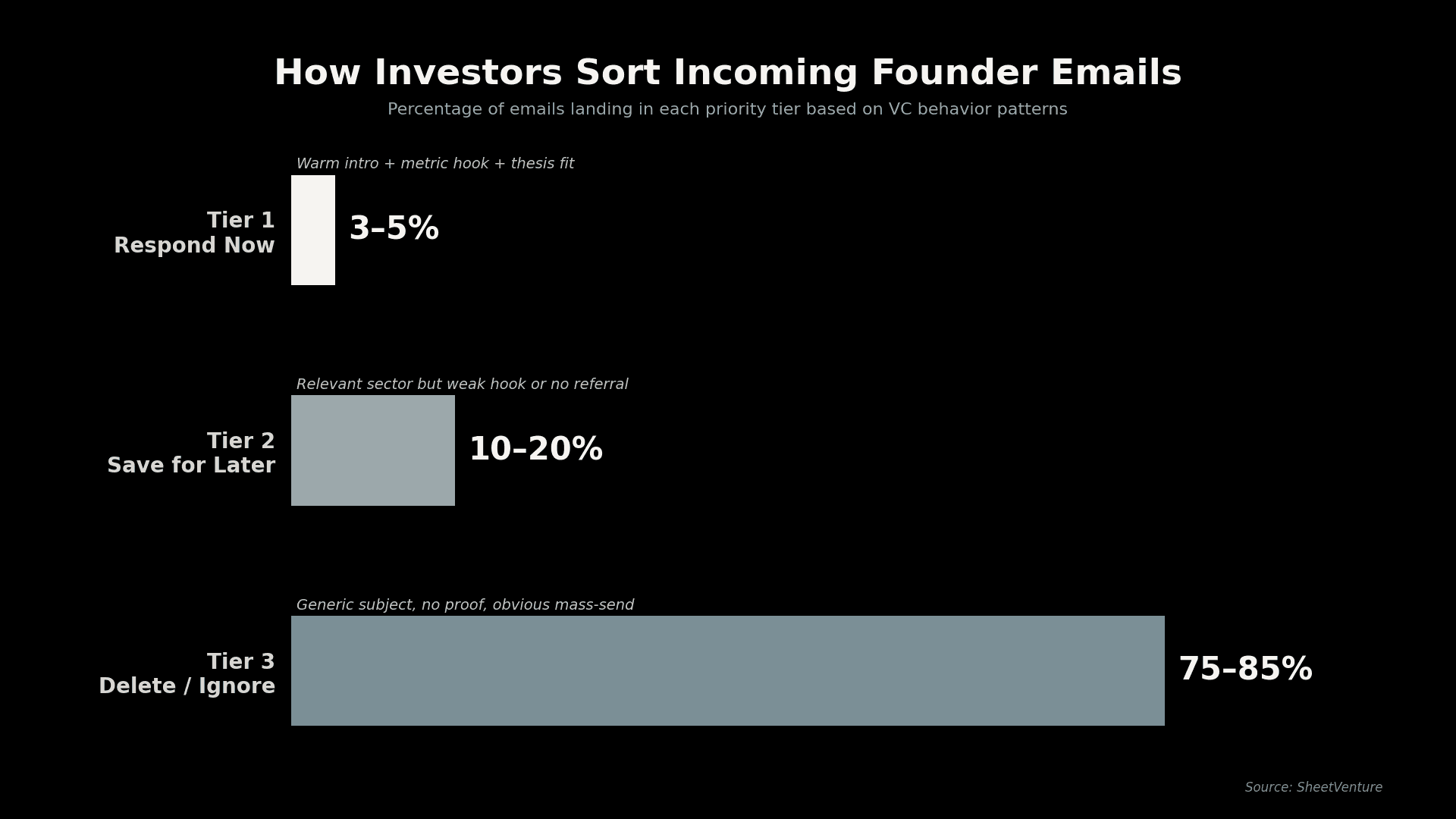
Investors use rapid pattern recognition, not careful reading, to assign tier levels. The signals they scan for operate in a fixed sequence:
• Subject line (1-2 seconds): A specific revenue metric, mutual connection name, or portfolio company reference triggers Tier 1. Generic phrases like “Investment Opportunity” trigger Tier 3.
• First sentence (3-5 seconds): An exceptional number, a recognizable customer name, or a clear thesis fit statement holds attention. Pleasantries like “I hope this finds you well” signal low priority.
• Sender credentials (2-3 seconds): Recognizable company background, a notable existing investor, or a visible LinkedIn profile with relevant experience raises the tier.
• Email format and length: Scannable emails under 100 words signal professionalism. Dense paragraphs signal a founder who does not respect investor time.
What Makes a Tier 1 Email Different From a Tier 3 Email?
The difference between earning a response and being deleted often comes down to five signal categories. Here is what separates the top and bottom tiers:
Signal Category | Tier 1: Respond Now (3–5%) | Tier 3: Delete / Ignore (75–85%) |
Subject Line | "$2M ARR, 15% MoM [Company]" | "Investment Opportunity" or "Exciting Startup" |
First Sentence | Exceptional metric or named customer. | "I hope this finds you well." |
Referral Signal | Trusted mutual contact named in the subject. | No referral, no context, no warm signal. |
Thesis Fit | Portfolio alignment is stated in the first 20 words. | No visible sector or stage match. |
Email Format | Under 100 words, scannable, professional signature. | Long, dense, obvious mass-send template. |
The most common Tier 3 triggers are mass-send formatting visible in the greeting, no metric in the first 50 words, a subject line that could apply to any startup, and no visible thesis fit. Investors who see 50+ pitches weekly develop near-instant classification reflexes. A single generic phrase can override otherwise strong content because the investor never reads far enough to find it. Understanding why most VC cold emails fail helps founders avoid patterns that guarantee the lowest tier.
How Can Founders Move Their Emails Up a Tier?
Moving from Tier 3 to Tier 1 requires stacking signals, not just fixing one:
Lead with your strongest number. Put your best metric in the subject line or first sentence. “$2M ARR, 15% MoM growth” works; “Exciting SaaS startup” does not.
Name the connection. If you have any mutual contacts, mention them in the subject line. This alone can jump an email from Tier 3 to Tier 1.
Show thesis fits in 10 words. Reference a recent portfolio investment or the investor’s published thesis, so the fit is obvious at first glance.
Keep it under 100 words. Brevity signals confidence. Every sentence beyond the core pitch reduces the chance of a response.
Make your identity verifiable. Link your LinkedIn, include a professional signature, and ensure your online presence supports your claims.
Comparing cold vs. warm outreach approaches helps founders choose the right strategy for each investor type. Use SheetVenture to identify which investors have higher cold email response rates and active thesis alignment with your sector.
The Bottom Line
Investors categorize incoming emails into three priority tiers: respond, save, or delete; in under 10 seconds. Subject line specificity, first-sentence proof points, sender credibility, and thesis fit determine which tier your email lands in. Tier 1 emails stack multiple signals; Tier 3 emails fail at the first glance. Write for the triage, not the read. Front-load your strongest signal, show fit immediately, and keep every word earning its place.
SheetVenture helps founders identify which investors respond to cold outreach, so every email targets the right inbox at the right time.
Last Update:
Everything you need to understand private markets
Understand your market in real-time.
Filter by stage, sector, and exact geography.
Access 30,000+ verified, daily-updated active
