Announcing a lead investor shifts power, speeds decisions, and changes how every other investor responds to your round.
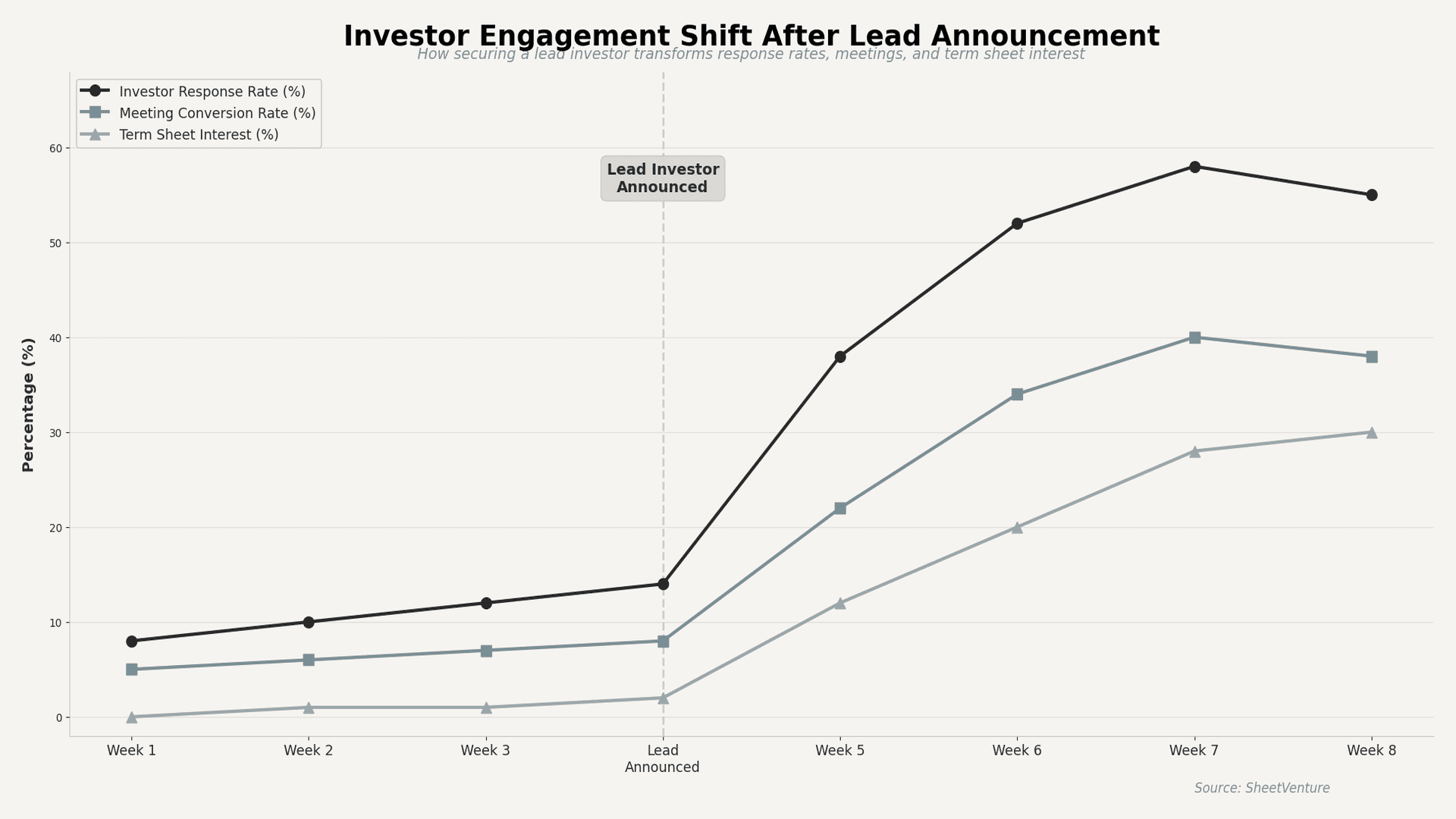
Announcing a lead investor transforms your fundraising from cold outreach into a competitive process. Response rates jump 3-4x, meetings convert faster, and investors who ignored you suddenly want in.
A lead investor is the single most powerful signal in fundraising. Once other investors know someone credible has committed to setting terms, the round shifts from “should we look at this?” to “can we still get in?” This dynamic shift affects every conversation, timeline, and negotiation you have with remaining investors.
Why Does a Lead Investor Change How Others Respond?
Investors use social proof as a shortcut for due diligence. When a credible lead commits, it tells other investors three things:
• Someone has done deep diligence and decided the risk is worth it.
• The round has structure, terms, and a real timeline to close.
• The remaining allocation is finite, creating scarcity that they can’t ignore.
Before a lead, most investors treat your raise as exploratory. After a lead, it becomes transactional. The conversation moves from “tell me more” to “what’s left and how fast do I need to move?” This shift is why founders who understand round momentum close faster and on better terms.
How Do Investor Behaviors Change After a Lead Is Announced?
The shift is measurable across every stage of the funnel:
• Response rates increase from 8-12% to 35-55% within days.
• Meeting-to-follow-up conversion jumps from single digits to 30-40%.
• Time to decision compresses from weeks to days.
• Term negotiation intensity drops as investors accept lead-set terms.
• Inbound interest from investors who previously passed often appears.
The pattern is consistent: investors who delay decisions before a lead accelerate once one is locked.
What Types of Investors React Differently to a Lead Announcement?
Not all investors respond the same way. The reaction depends on their type, fund structure, and how much social proof drives their process.
Investor Type | Before Lead | After Lead | Typical Reaction Speed |
Tier-1 VCs | Slow to engage, heavy diligence | May co-lead or request allocation | 3–7 days |
Mid-market VCs | Moderate interest, long timelines | Accelerate diligence, commit faster | 5–10 days |
Angels / Syndicates | Waiting for an institutional signal | Move quickly to fill remaining spots | 1–5 days |
Strategic Investors | Evaluate on your own timeline | FOMO-driven acceleration | 7–14 days |
Previous Passers | Declined or went silent | Re-engage with renewed interest | 3–10 days |
The most dramatic shift comes from angels and syndicates. They often wait for an institutional lead as validation before committing their own capital.
What Happens to Round Negotiations After a Lead?
Once a lead sets terms, other investors face a binary choice: accept the terms and participate, or walk away. This simplifies the process significantly:
• Valuation debates shrink because the lead has already anchored the price.
• Due diligence requests have reduced since investors lean on the lead’s work.
• Legal review accelerates as most followers adopt the lead’s term sheet.
• Allocation competition can emerge, giving founders leverage to select strategic partners.
Founders who understand decision timelines can use this window to drive the round to close within 2–4 weeks of announcing the lead.
How Should Founders Time the Lead Announcement?
Timing the announcement matters as much as having one. Announce too early, and you lose negotiating leverage. Announce too late, and investors may have moved on.
• Announce when the term sheet is signed, not when it’s verbal.
• Notify your warmest prospects first to give them priority access.
• Create a clear deadline for remaining allocation, typically 2–3 weeks.
• Share specific details like lead name, round size, and allocation left.
• Follow up within 48 hours with investors who express interest.
The goal is to convert the lead announcement into a closing mechanism. Every day after announcing, should move the round closer to being done. Use market intelligence to identify which investors respond fastest to lead announcements.
The Bottom Line
Announcing a lead investor fundamentally changes your fundraising dynamics. Response rates jump 3–4x, investors who ignored you re-engage, and negotiations simplify because the lead has set terms. The shift from exploratory to competitive happens within days. Once the announcement of a signed term sheet, notify warm prospects first, and create a closing deadline. A lead doesn’t just fill part of your round; it accelerates everything that follows.
SheetVenture helps founders track which investors are actively deploying capital so your lead announcement reaches the right co-investors at the right time.
Last Update:
Everything you need to understand private markets
Understand your market in real-time.
Filter by stage, sector, and exact geography.
Access 30,000+ verified, daily-updated active