Top founders spend 60% of fundraising time on follow-ups, not new outreach. The ideal ratio shifts by stage.
Founders who close rounds faster spend roughly 40% of fundraising time on new investor outreach and 60% on strategic follow-ups. Most first-time founders invert this ratio, chasing volume over conversion. The optimal split shifts as your round progresses: heavy outreach early, heavy follow-ups mid-round through close. Getting this balance wrong is one of the top reasons cold emails fail and rounds stall.
What Is the Ideal Outreach-to-Follow-Up Ratio?
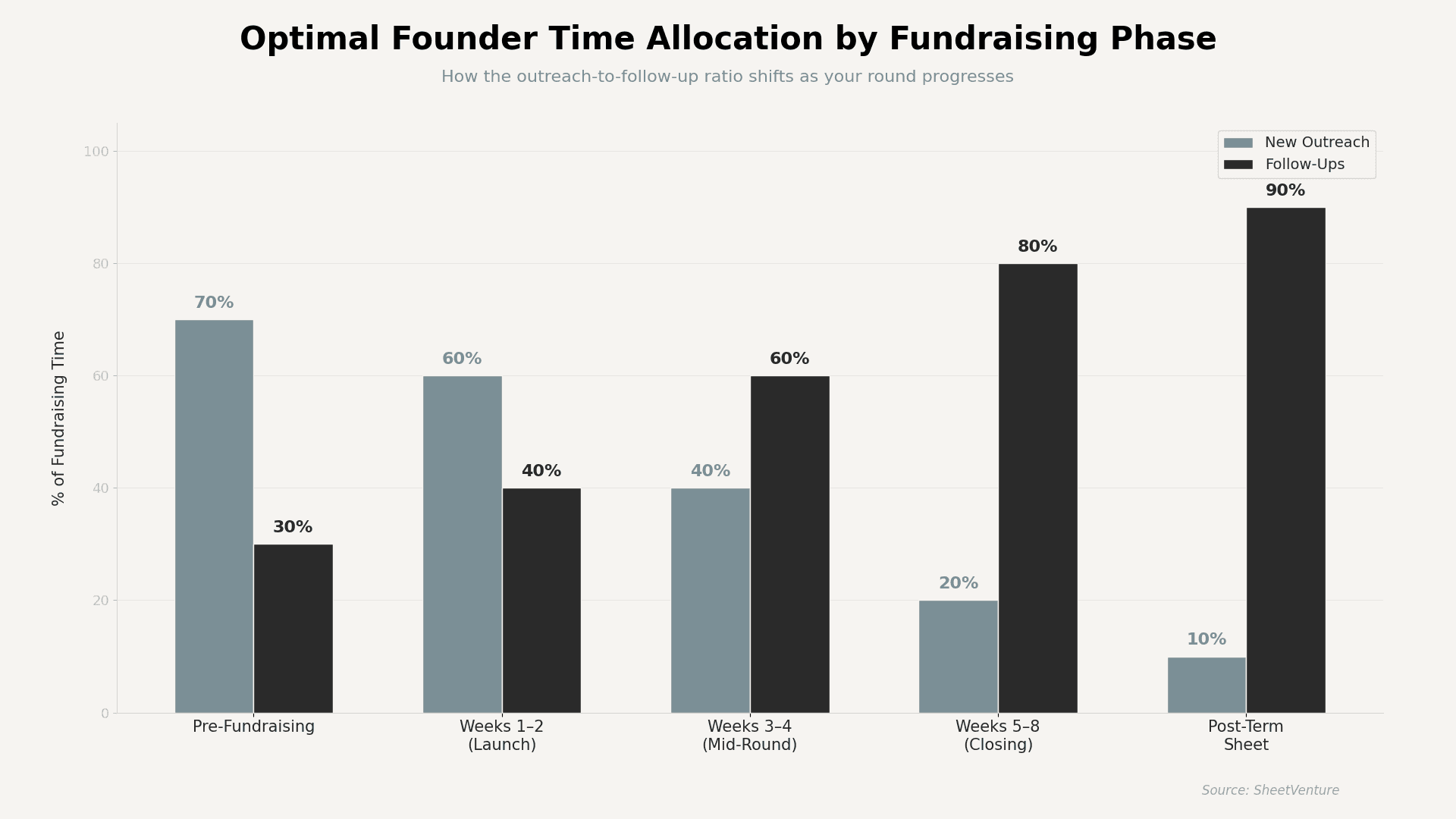
The most effective split depends on where you are in the fundraising process. Early in a round, new outreach dominates. By mid-round, follow-ups should consume the majority of your time.
A practical framework:
• Pre-fundraising: 70% new outreach, 30% follow-ups (building initial pipeline).
• Weeks 1-2: 60% new outreach, 40% follow-ups (launching conversations).
• Weeks 3-4: 40% new outreach, 60% follow-ups (nurturing warm leads).
• Weeks 5-8: 20% new outreach, 80% follow-ups (driving decisions).
• Post-term sheet: 10% new outreach, 90% follow-ups (closing logistics).
The shift happens because every meeting you’ve already had represents higher-probability capital than a cold contact you haven’t reached yet.
Why Do Most Founders Spend Too Much Time on New Outreach?
New outreach feels productive. Sending 50 emails in a day gives a sense of momentum. But volume without conversion wastes the most valuable asset in fundraising: time.
Common mistakes:
• Sending new emails instead of following up on warm conversations.
• Treating every investor equally instead of prioritizing engaged ones.
• Ignoring the 5-7 touchpoint average needed before an investor commits.
• Confusing activity with progress.
Founders who understand follow-up timing close rounds 30–40% faster than those who rely on volume alone.
Fundraising Phase | New Outreach % | Follow-Up % | Primary Goal | Avg. Conversion Lift |
Pre-Fundraising | 70% | 30% | Build initial pipeline | Baseline |
Weeks 1–2 | 60% | 40% | Launch conversations | +15% response rate |
Weeks 3–4 | 40% | 60% | Nurture warm leads | +35% meeting-to-next |
Weeks 5–8 | 20% | 80% | Drive term sheets | +50% close rate |
Post-Term Sheet | 10% | 90% | Close logistics | +70% speed to close |
How Should Founders Structure Weekly Fundraising Time?
A 20-hour weekly fundraising block should look different depending on your round’s phase. Here’s a mid-round example (weeks 3-4):
• 8 hours: Follow-up calls, update emails, and investor questions.
• 6 hours: New outreach to targeted, thesis-matched investors.
• 3 hours: Preparing materials, updating data rooms.
• 3 hours: Pipeline review and prioritization.
The key is treating follow-ups as your highest-ROI activity. Every unanswered follow-up is a deal slowly dying.
What Makes Follow-Ups More Valuable Than Cold Outreach?
Follow-ups convert at 5–10x the rate of first-touch emails. An investor who has already taken a meeting is 15–20x more likely to invest than one receiving a cold email.
Why follow-ups outperform:
• Existing context reduces friction.
• Each touchpoint builds credibility and familiarity.
• Updates demonstrate execution and momentum.
• Timely follow-ups signal founder discipline.
The data is clear. If you’ve had a productive first meeting, a well-timed follow-up within 48 hours increases your chance of moving to a partner meeting by 3x compared to waiting a week. Understanding how to handle investor silence is critical to keeping your pipeline alive.
When Should Founders Increase New Outreach Again?
There are moments when shifting back toward outreach makes sense:
• Your pipeline drops below 10 active conversations.
• Multiple investors pass simultaneously.
• You pivot your narrative and need fresh audiences.
• Your round extends beyond 8 weeks without a lead.
Pipeline health dictates the ratio. If warm leads are converting, stay focused on follow-ups. If your funnel is thin, rebuild with outreach before you run out of active conversations. Use SheetVenture to identify which investors are actively deploying and match them to your stage before restarting outreach.
The Bottom Line
The founders who raise efficiently don’t send the most emails; they follow up with the right investors at the right time. Start with heavy outreach to build a pipeline, then shift aggressively toward follow-ups as conversations mature. The 40/60 outreach-to-follow-up ratio is a starting point, not a fixed rule. Adjust weekly based on pipeline health, investor engagement signals, and round momentum.
Stop measuring fundraising effort by emails sent. Measure it by the advanced conversations.
SheetVenture helps founders track which investors are actively engaging, so every follow-up reaches the right person at the right moment.
Last Update:
Everything you need to understand private markets
Understand your market in real-time.
Filter by stage, sector, and exact geography.
Access 30,000+ verified, daily-updated active