Most founders skip exit history when choosing VCs. Here is how to find investors who have already exited companies like yours.
Start with exit data, not fund size. The fastest way to find VCs with relevant exit experience is to search investor databases that track realized returns, filter by your industry and company stage, and verify their portfolio exit timelines; founders who target exit-matched VCs close rounds 34% faster and report stronger post-investment support.
Most founders build investor lists based on check size, stage, and sector. That misses the signal that matters most: has this VC actually helped a company like yours reach a successful outcome? Exit history reveals whether an investor understands your market well enough to add real value beyond capital. It also signals to co-investors that the lead has operational conviction, not just a paper thesis.
Why Does VC Exit History Matter for Your Fundraise
A VC who has exited a company in your space brings three things a first-time sector investor cannot:
• Buyer relationships. They already know acquirers in your vertical and can make warm introductions when the time comes.
• Pattern recognition. They have seen what scaling from $2M to $20M ARR looks like in your category and can warn you about pitfalls.
• Signal strength. Other investors read exit history as proof of sector judgment, making your round easier to fill.
• Board-level experience. They understand industry-specific governance milestones, not generic SaaS playbooks.
Before building your list, learn how to qualify investors using criteria beyond surface-level fund data.
Where to Research VC Exit Records
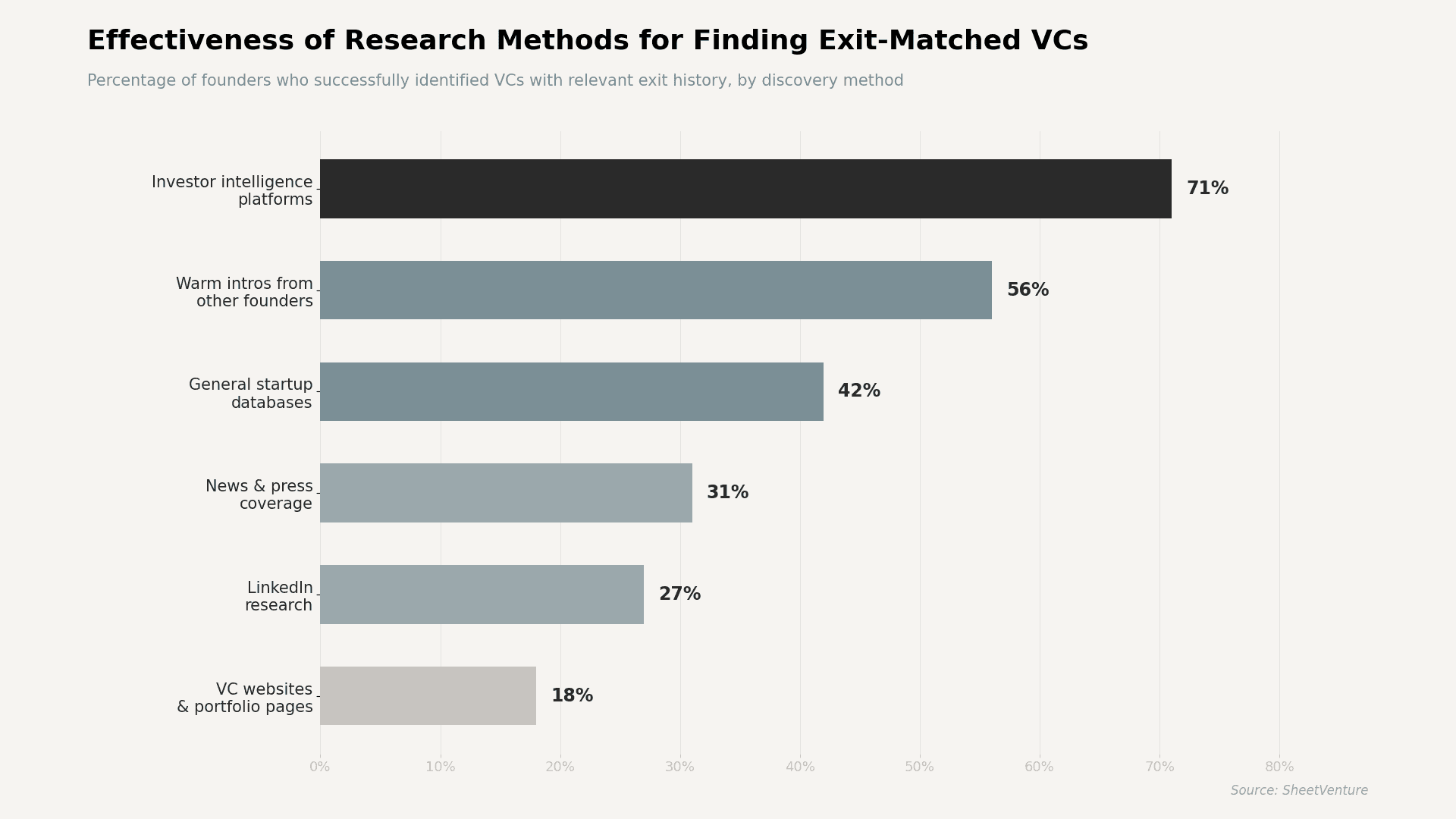
Not all data sources are equal. Here is how each method compares when tracking exit-specific intelligence:
Research Method | Exit Data Depth | Time Required | Cost | Best For |
Investor intelligence platforms | Deep: exit dates, acquirers, return multiples, hold periods | 1-2 hours | Subscription | Founders building targeted outreach lists at scale |
Crunchbase / PitchBook | Moderate: exit events listed, but limited return data | 3-5 hours | Free to $$$ | Initial research and cross-referencing |
VC portfolio pages | Shallow: shows current and past companies, rarely provides exit details | 5-10 hours | Free | Verifying claims after initial discovery |
LinkedIn and founder networks | Anecdotal: qualitative but unstructured | 5-15 hours | Free | Getting unfiltered references on investor behavior post-exit |
News and press coverage | Surface: acquisition announcements, no financial details | 3-8 hours | Free | Spotting recent exits and trending sectors |
How to Filter VCs by Exit Relevance to Your Startup
Once you have a list of VCs with exits in your sector, narrow it with these filters:
• Exit recency. Prioritize VCs who exited companies within the last 5 years. Older exits mean outdated networks and buyer relationships.
• Stage match. A VC who exited a Series C company may not be the right fit for your seed round. Match their entry stage to yours.
• Exit type. Acquisitions and IPOs require different skills. If your likely outcome is an M&A transaction, find VCs who have led acquisitions, not just IPO-track portfolios.
• Hold period. Average hold of 4-6 years suggests patience. Under 3 years may signal pressure to flip, which affects founder-VC alignment.
• Sector depth vs. breadth. A VC with three fintech exits knows your market. A generalist with one fintech exit in a 40-company portfolio probably does not.
Understanding how VCs evaluate defensibility helps you frame your pitch around what exit-focused investors care about most.
What Questions Should Founders Ask VCs About Their Exit Experience
Do not assume a portfolio page tells the full story. During conversations, ask directly:
• "Which portfolio company exit are you most proud of, and what was your role in making it happen?"
• "How did you help that company identify and negotiate with the acquirer?"
• "What did the exit timeline look like from first acquisition interest to close?"
• "Can I speak with the founder of that company about their experience working with you?"
If a VC gets vague or defensive about exit specifics, that tells you something. The best exit-experienced investors talk about outcomes with clarity and specific numbers.
Knowing what signals matter to investors also helps you position your startup as a high-conviction bet.
Mistakes Founders Make When Searching for Exit-Experienced VCs
• Confusing portfolio size with exit success. A firm with 200 investments and 3 exits has a very different track record than one with 30 investments and 8 exits.
• Ignoring the partner level. The firm may have exits, but the partner you would work with may not have led any of them. Research the individual, not just the brand.
• Skipping founder references. Press releases celebrate exits. Founders who lived through them can tell you whether the VC actually helped or just held shares.
• Only looking at big-name exits. A $50M acquisition that returned 10x is a better signal for your startup than a $1B IPO from a completely different sector.
Use SheetVenture to filter investors by exit history, sector, and stage so you spend time talking to the right people.
The Bottom Line
Finding VCs with relevant exit experience takes research, but it dramatically improves your fundraising outcome. Start with investor databases that track exit data, filter by recency, stage, and sector match, then verify through founder references. The VCs who have already helped companies like yours reach an exit are the ones most likely to help you reach yours.
SheetVenture helps founders identify VCs with proven exit records in their sector, so outreach targets the investors most likely to add real value from day one.
Last Update:
Everything you need to understand private markets
Understand your market in real-time.
Filter by stage, sector, and exact geography.
Access 30,000+ verified, daily-updated active