30 investor passes feel like failure. Discover exactly what the data reveals and what founders should fix now.
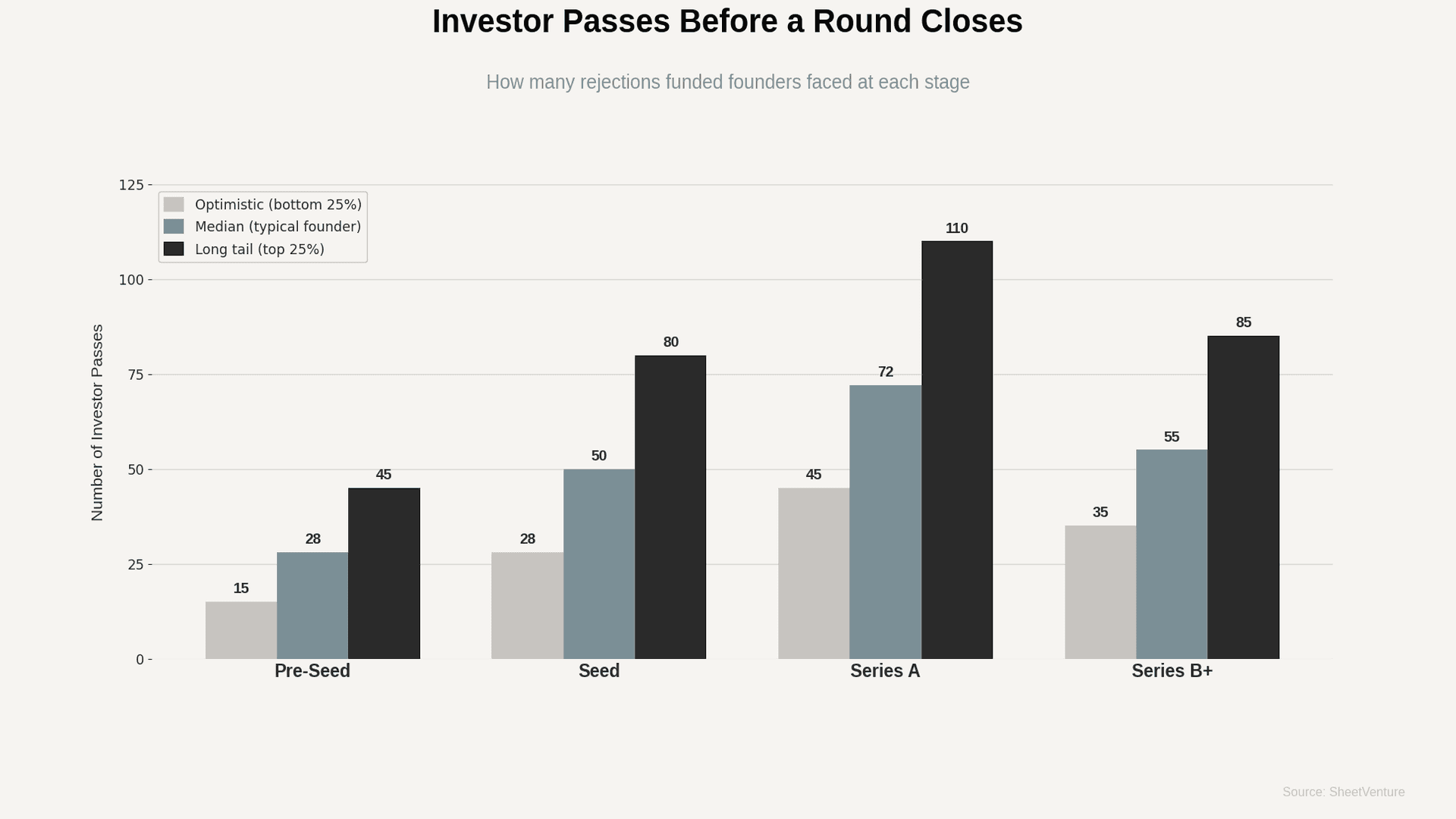
Yes, 30 investor passes are completely normal, and most founders who eventually raised were sitting in the same position. Research across funded startups shows that 30 to 100 rejections before a round closes is standard at every stage. The feeling is real, but the number is not a verdict on your company.
By pass 15, you start questioning your pitch. By pass 30, you start questioning the company itself. That is the pattern almost every founder goes through. It is also exactly when most founders either make the adjustments that get them funded, or slow down and let the round quietly die.
What the Numbers Actually Show
Investors pass on the vast majority of deals they see, regardless of quality. The math works against every founder from day one.
• Top-tier VC firms fund fewer than 1% of companies they review each year.
• The average VC sees 1,000 or more deals annually and writes only 5 to 10 checks.
• Seed-stage founders typically contact 50 to 150 investors before closing a round.
• First-time founders average 40 to 60 passes before receiving a first term sheet.
• Second-time founders with prior exits still average 20 to 40 passes.
Getting rejected 30 times puts you squarely inside the normal distribution. Use investor intelligence to understand which investors fit your profile before burning outreach on the wrong targets.
Why 30 Passes Might Mean You Are Getting Closer
Here is something most founders miss when they are in the middle of rejection: the pattern of passes shifts as you get closer to a yes.
Around the age of 20 to 40, three things tend to happen:
• Feedback gets more specific. Instead of 6 different objections, you start hearing 1 or 2 consistent ones.
• Investors take longer to pass. That delay means the pitch is generating real internal interest, even when the answer is still no.
• The quality of conversations rises, even when the conversion rate has not improved yet.
That shift is a genuine signal. Most founders are too buried in the rejection count to notice it.
What the Reason for Passing Actually Tells You
Not every rejection carries the same weight. The reason behind a pass matters far more than how many you have received.
• Thesis mismatch: This investor was never going to say yes regardless of pitch quality. Move on and protect your time.
• Stage mismatch: Your traction puts you too early or late for their fund cycle. Adjust timing, not the idea.
• Market skepticism: They do not believe in the space. Use SheetVenture to filter these investors before you pitch them.
• Team concern: If you hear this from three or more investors, ask for specifics before dismissing it.
• "Not right now": These are soft yeses waiting for a trigger event. One short monthly update keeps you on their radar.
When 30 Passes Should Make You Rethink Strategy
Thirty rejections with no feedback pattern is a problem worth solving. Thirty rejections with the same feedback you have not acted on is a bigger one.
Common things worth adjusting at this point:
• Targeting: Pitching generalist funds for a niche product is not rejection; it is irrelevance.
• Story clarity: If investors cannot explain your business back to you after the meeting, the narrative is not landing.
• Traction timing: Some passes are about the stage, not the quality of the company.
• Round structure: Valuation expectations and check size sometimes kill deals, but the pitch did not.
Learn how to handle rejections without losing momentum between pitches.
How Fundraising Pace Changes the Psychology
Thirty passes spread over 18 months feels demoralizing. Thirty passes inside 60 days is a sprint. Both are common, but a compressed timeline is actually a better strategy. It forces faster iteration and creates the kind of urgency that investors respond to.
Founders who understand fundraising pace use rejection velocity as a signal, not a punishment. The worst version of 30 passes is when founders slow down between each one to recover emotionally instead of adjusting and moving quickly.
The Bottom Line
Thirty investor passes is the median experience for founders who eventually close a round. What matters is not the number. It is whether you treat each pass as a data point or a personal verdict. Stop counting rejections. Start categorizing the feedback behind each one.
SheetVenture helps founders identify which investors are actively deploying capital right now, so your next 30 outreach conversations start with names that actually fit.
Last Update:
Everything you need to understand private markets
Understand your market in real-time.
Filter by stage, sector, and exact geography.
Access 30,000+ verified, daily-updated active