Most founders get rejected over TAM. Here is whether a $500M market is actually too small to fund.
A $500M TAM is not automatically too small for venture funding. It depends on which fund tier you target and how much of that market you can credibly capture. Micro-VCs, nano-funds, and sector-focused investors regularly back $500M TAM startups when the return math works.
The $1 billion threshold gets repeated so often that founders with a $500M market quietly assume they are disqualified before sending a single email. That assumption is wrong, but it is wrong in a specific and important way. TAM expectations are set by fund size, not some universal VC standard.
The reason top-tier firms insist on billion-dollar markets is pure portfolio math. A $500M fund targeting 3-5x returns needs its winners to generate hundreds of millions in value, which requires markets large enough to support $1B+ exits. Smaller funds do not carry that math, and that is exactly where a $500M TAM becomes fundable.
Why the $1B Rule Is Not a Universal Law
The billion-dollar TAM benchmark comes from large VC portfolio math, not from some agreed-upon definition of a viable business. A fund with $300M under management needs roughly $900M back to return 3x. When a fund assumes only 1 in 10 portfolio companies will return meaningful capital, each winner needs to return $90M or more. That demands large markets.
A $30M nano-fund has a completely different math problem. A single exit at $80M can meaningfully move the fund. In that context, a $500M market with 15% capture gives you exactly that kind of outcome, and it is the kind of investment a smaller fund actively wants.
What the TAM Thresholds Actually Look Like
The table below maps fund size to TAM expectations. Before pitching, match yourself to the right tier. Learn how investors approach market size to frame your numbers correctly.
Fund Size | Stage Focus | Min. TAM Expected | What Drives the Threshold |
Under $25M (Nano-VC) | Pre-seed | $200M+ | Small fund; smaller exits are fundable |
$25M - $100M (Micro-VC) | Pre-seed / Seed | $500M+ | $50M revenue targets are achievable |
$100M - $500M (Seed / Series A) | Seed to Series A | $1B+ | Needs $100M+ revenue potential |
$500M+ (Large VC) | Series A and beyond | $5B+ | Portfolio math demands category leaders |
The Capture Rate Argument Investors Respond To
TAM alone does not close investments. What closes them is a founder who can show, precisely, how much of that market they will own and by when.
The math that gets meetings:
• 10% capture of $500M = $50M in revenue
• 20% capture = $100M in revenue
• $100M ARR at 5-8x exit multiple = $500M to $800M outcome
• That return profile works cleanly for nano-VCs and micro-VCs
That story works for the right fund. It never works if you are pitching a $500M firm whose portfolio math demands $5B+ exits. The market is not too small. You are pitching the wrong room.
How to Frame a $500M TAM Without Apologizing
Most founders get defensive about TAM. The better approach is precision.
• Lead with your SAM, not the full TAM. A tighter, credible number beats an inflated top-down figure every time.
• Show adjacent markets. If your core TAM is $500M but an adjacent segment adds $400M by Year 4, your real opportunity is closer to $900M over time.
• Use bottom-up modeling. Show exactly how many customers exist, what they pay, and how you reach them.
• Use investor intelligence tools to identify which active funds have written checks in comparable $500M-market startups. Pattern-match before outreaching.
Matching TAM to the right fund tier means understanding which investors are actively deploying capital right now. A fund in year 5 of a 10-year life may be less likely to commit, regardless of market size. Check the deployment status before outreaching.
Targeting the Right Investors for Your Market
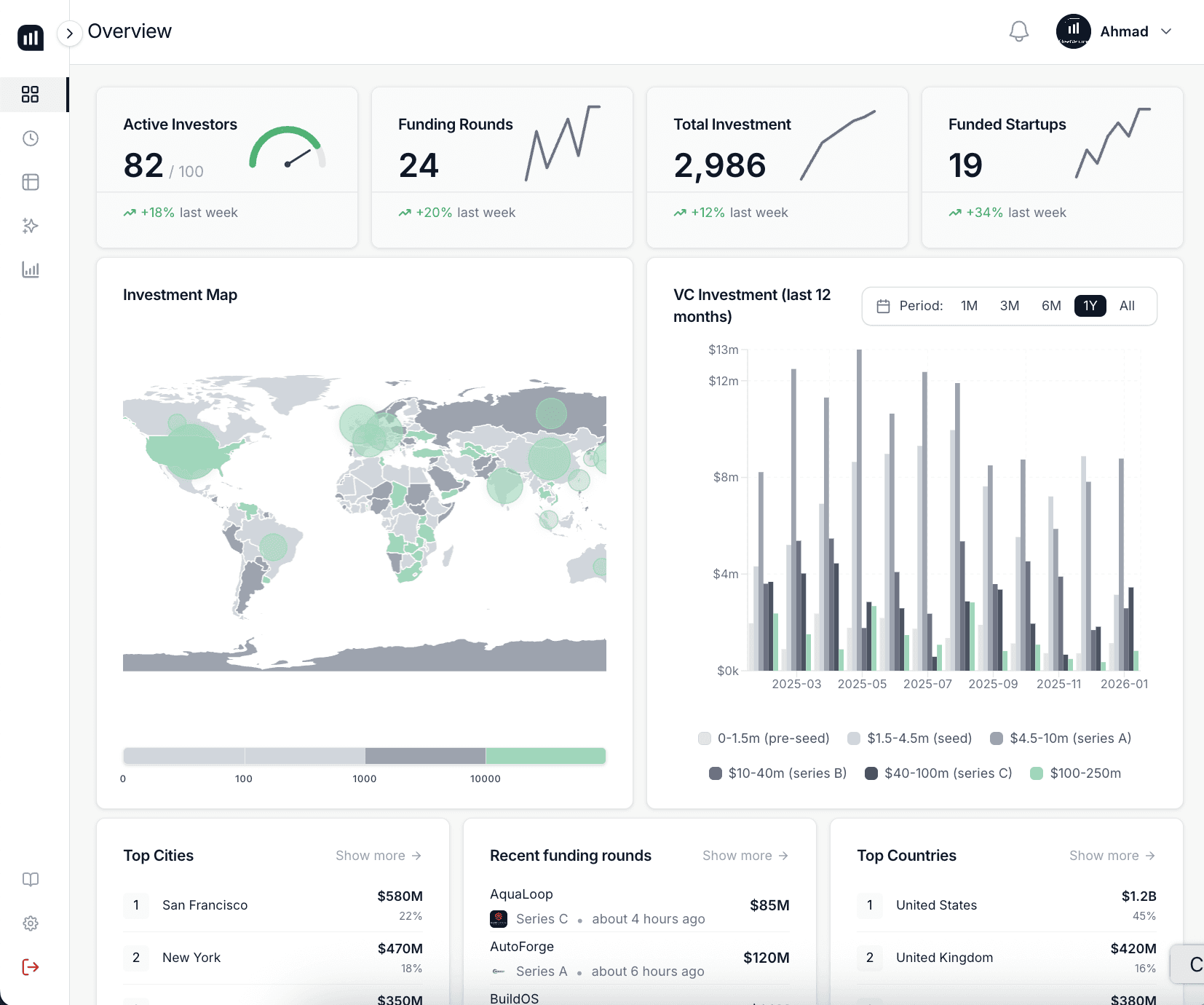
Pitching large-cap VCs with a $500M TAM signals you have not done your homework. SheetVenture gives you access to active investor data filtered by fund size, stage, and check size, so you target only funds where your numbers fit.
Understanding what makes attractive markets to investors goes beyond size. Growth rate, competitive dynamics, and timing all affect whether $500M feels exciting or limiting.
Read the guide on finding the right VC for your stage and sector before building your target list.
The Bottom Line
A $500M TAM is not a disqualifier. It is a filter. It filters out the wrong investors and points you directly toward the ones whose fund math supports your market size. Stop apologizing for the number and start targeting funds where the math actually works in your favor.
SheetVenture helps founders filter the entire investor landscape by fund size, stage, and TAM expectations so outreach lands with investors whose math aligns with your market from day one.
Last Update:
Everything you need to understand private markets
Understand your market in real-time.
Filter by stage, sector, and exact geography.
Access 30,000+ verified, daily-updated active