Most founders pitch too technically without realizing it. These five signals reveal when jargon is costing you meetings.
Yes, and most founders do not realize it until a third meeting falls flat. If non-technical investors keep asking "but what does it actually do?" or go quiet when you explain the product, the pitch is not landing. The problem is rarely the technology itself. It is that the business case gets buried under the explanation of how it works.
Investors without engineering backgrounds are not evaluating your code or architecture. They are evaluating the market, the team, and the upside. When a pitch spends too long on the stack, the feature set, or the technical differentiation without tying any of it to revenue or customer behavior, it loses the room. Not because they are unsophisticated. Because the business signal disappeared.
5 Signs Your Pitch Is Too Technical
This is where most founders self-diagnose incorrectly. They assume that if investors nod along, they are following. Nodding often means they have stopped asking questions because they have stopped engaging.
• They stop asking follow-up questions mid-pitch. Non-technical investors disengage quietly. If the room turns polite but passive, the jargon crossed a line.
• Every question redirects to "how does it work?" Investors asking about mechanics instead of growth or unit economics means the business case never came through.
• You have used acronyms three or more times without defining them. API, ML, NLP, and infrastructure mean different things in different rooms. Assume nothing.
• Your deck spends more time on the product than the market or the customer. If slide four is still explaining features, the business case arrives too late.
• You find yourself explaining the same concept twice. Once is necessary context. Twice is a signal that the first explanation did not land.
Founders who have pitched to technical co-founders or engineers often forget to recalibrate when the audience changes. The pitch that works in a Y Combinator session can fall flat in a generalist fund's conference room. To understand what causes investors to disengage mid-pitch, see pitch disengagement.
What Non-Technical Investors Actually Need to Hear
They are not asking you to remove the technology from the pitch. They want to understand why it matters before hearing how it works. The order changes everything.
• Problem first. What is broken, who feels it, and how costly is it? Dollar figures and customer pain points land better than technical bottlenecks.
• Business outcome second. What does your technology make possible that was not possible before? Frame it in customer behavior or revenue terms.
• Technical differentiation third. One or two sentences on what makes this defensible. Patents, data moats, speed advantages. Not the full architecture.
• Social proof last. A paying customer who renewed, a pilot that expanded, and a notable design partner. These close the loop faster than any technical explanation.
Investors evaluating startups without strong revenue data follow this same framework. Understanding revenue-free evaluation helps you see what investors are actually scoring when the numbers are thin.
How to Recalibrate Without Dumbing It Down
The goal is not a simpler pitch. It is a pitch where the business case is obvious before the technical case needs to be made.
One practical test: record yourself pitching, then remove every sentence that uses a technical term. What remains should still tell a coherent story about the market, your solution, and the upside. If the story falls apart when the jargon is gone, those missing pieces are exactly where investors get lost during the real pitch.
Another test: read your deck's slide titles only. Do they form a complete narrative? If the story collapses, a non-technical investor is already lost by slide three.
The most common pitching mistakes at this stage almost always come down to sequence, not substance. Fix the order, and the pitch reads as confident and clear, not simplified.
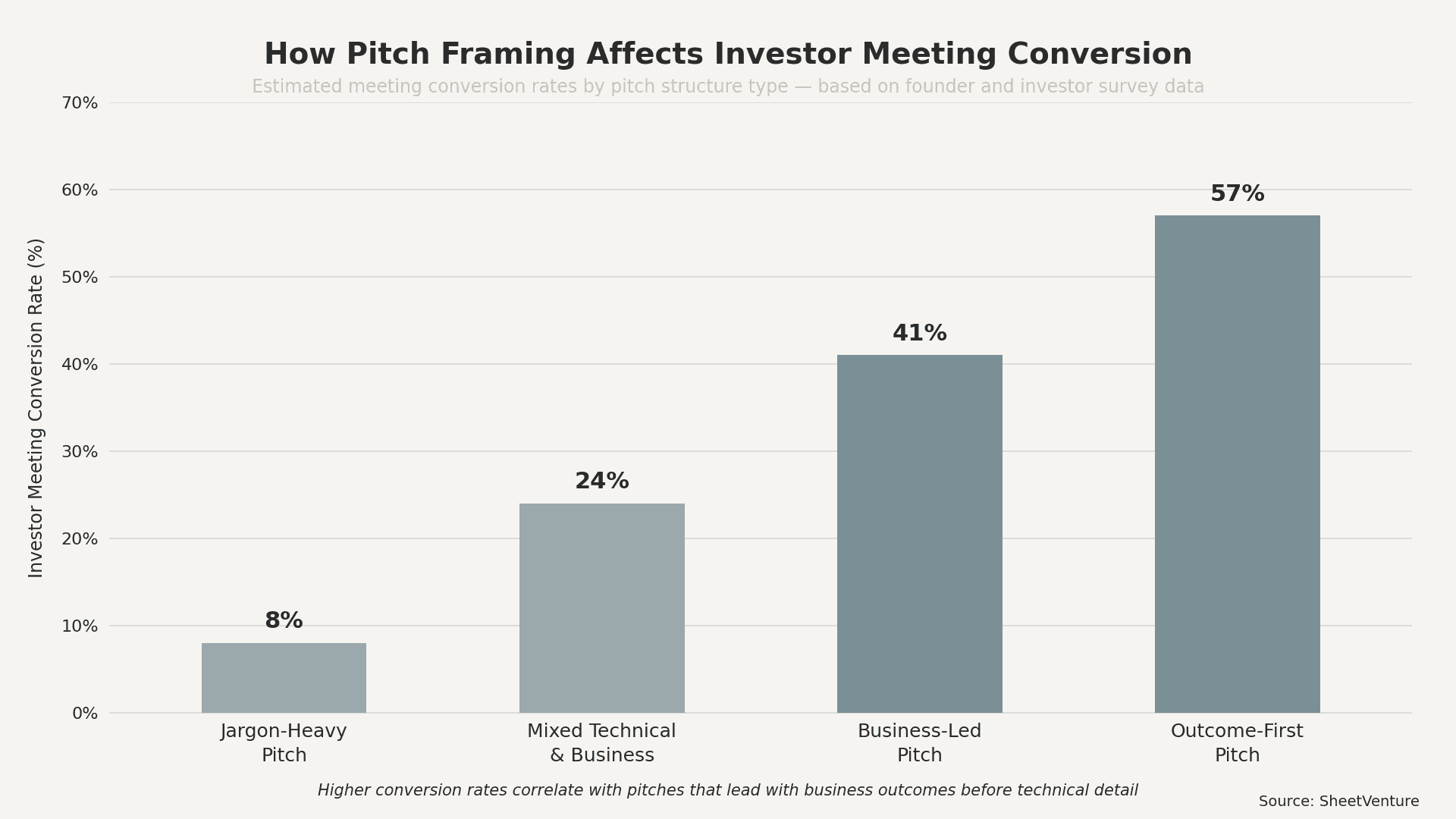
Use investor intelligence from SheetVenture to research which investors in your sector have technical backgrounds and which do not, so you can tailor pitch depth before the meeting rather than improvise during it.
The Bottom Line
Most pitches are not too technical because the founders are wrong about the product. They are too technical because the sequence is wrong. Lead with the business problem, follow with the outcome, and place the technical explanation where it supports the story rather than drives it. Non-technical investors do not need less information. They need it in a different order.
SheetVenture helps founders match their pitch approach to the specific investment style and background of each investor, so the right story reaches the right room every time.
Last Update:
Everything you need to understand private markets
Understand your market in real-time.
Filter by stage, sector, and exact geography.
Access 30,000+ verified, daily-updated active
