Inconsistent growth rarely kills a raise. Discover exactly what investors actually check when judging your traction story numbers.
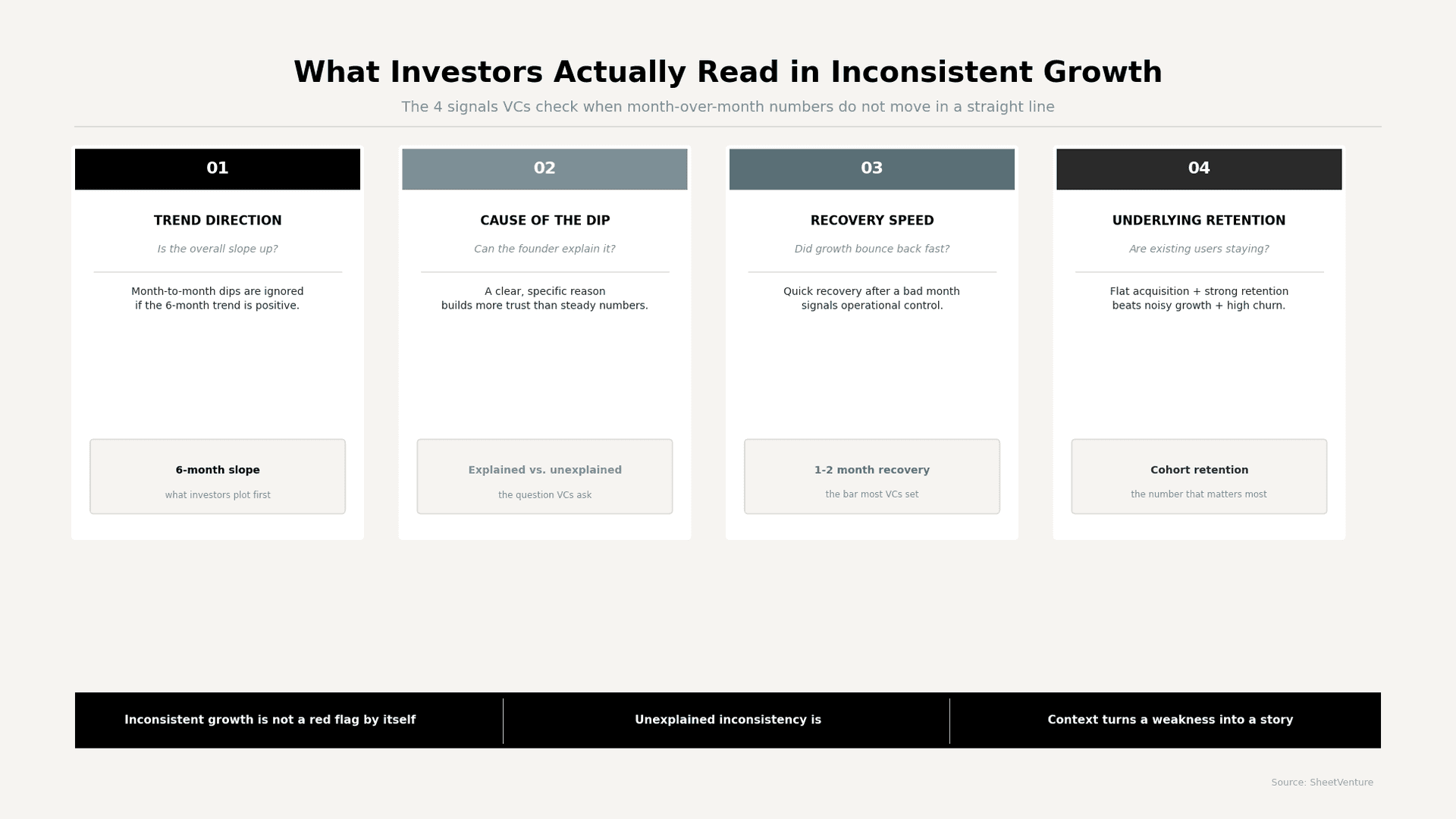
Inconsistent month-over-month growth does not automatically weaken your traction story. Investors expect variance at early stages. What they actually judge is whether you can explain the dips, whether retention holds, and whether the 6-month direction is up.
Three bad months after four great ones can feel fatal. It is not. Investors have seen enough early-stage companies to know that growth is rarely a straight line. The question is not whether your numbers dipped. The question is what the dip tells them about you.
Before assuming your story is broken, understand what VCs are actually reading when they look at your month-over-month data.
What Do Investors Actually Look for in Monthly Growth Data?
Investors do not expect a perfect upward slope. They do expect a coherent pattern.
• They plot your 6-month trend first, not individual months.
• A dip followed by a fast recovery reads as operational competence.
• Two or three unexplained flat months in a row read as a stall.
• Negative growth with no context reads as loss of control.
The strongest traction stories are not the ones with no bad months. They are the ones where the founder can explain every outlier. Investors are checking whether you understand your own business, not whether your spreadsheet is clean.
Does Month-Over-Month Variance Signal a Weak Business?
Not on its own. Variance is normal. What it can signal, if left unexplained, is a founder who is not paying close attention.
• Seasonal verticals naturally have slow months.
• Enterprise sales cycles create lumpy revenue by design.
• A single large churn event can flatten an otherwise healthy cohort.
• A channel that stopped performing explains a dip better than silence does.
Investors who back early-stage companies know this. What makes them nervous is not the variance. It is a founder who presents inconsistent numbers without any narrative around them. That silence reads as a disconnection from the business, and that is a harder problem to fund through.
For more on seed-stage metrics investors use when evaluating early growth, the context behind their expectations matters as much as the benchmark numbers.
How Should Founders Present Inconsistent Growth Without Losing Credibility?
The framing matters more than the numbers themselves.
• Lead with the trend: show the 6-month or 12-month picture first.
• Name the specific cause: one sentence is enough for a single anomalous month.
• Show what changed: if you fixed the problem, say what you did.
• Let retention carry the story: cohort data is harder to argue with than top-line growth.
Timeframe | Trend Direction | Churn Risk | Investor Read |
6 months | Positive trend | Minor | Strong signal |
6 months | Flat trend | High | Weak signal |
3 months | Positive trend | Minor | Needs context |
3 months | Flat trend | High | Red flag |
Founders who walk investors through their numbers confidently, including the rough months, build more trust than founders who show only the clean slides. Trying to hide a bad month is far more damaging than the month itself.
Is Retention More Important Than Growth Rate at Early Stages?
Yes, in most cases. Retention is proof that what you built is working. Growth without retention is acquisition, and acquisition can be bought.
• Strong cohort retention with flat new-user growth is a fundable story.
• High growth with 60-day churn over 30 percent is not.
• Net revenue retention above 100 percent, where existing customers expand, reframes the entire narrative.
• Retention shows whether you have product-market fit. Growth shows whether you have distribution. Both matter, but retention is harder to fake.
Read about proving traction at scale to understand which signals actually move from early traction into fundable proof.
When Does Inconsistent Growth Actually Become a Problem?
Some patterns genuinely raise concern, separate from normal variance.
• Three or more consecutive months of flat or declining revenue with no clear cause.
• Growth that came from a single channel that is now gone, with no replacement pipeline.
• Inconsistency in multiple metrics at the same time: revenue, retention, and engagement all moving against you.
• Founders who cannot explain the dips at all, or who explain them differently in each meeting.
If your inconsistency falls into one of those categories, analyzing your outreach strategy before pitching more investors will save time. Fixing the underlying story matters more than adding to the investor list.
How Do Investors Separate Genuine Traction From Noise?
Experienced investors have seen enough traction decks to read between the lines.
• They compare the story you tell with the data you share.
• They ask what drove the best month to see if it was repeatable.
• They ask what caused the worst month to see if you know.
• They look at whether acquisition cost is rising or falling as growth fluctuates.
Use SheetVenture to find investors whose portfolio history shows they back companies at your exact stage, including the ones who have funded founders with messy early numbers.
The Bottom Line
Inconsistent month-over-month growth is not a traction problem by itself. It becomes one when you cannot explain it, when retention is breaking down alongside it, or when the overall trajectory has stopped moving up. Investors expect variance. They fund founders who understand what drove it. Frame the trend, name the cause, and let your retention data do the heavy lifting.
SheetVenture helps founders identify which investors have backed companies with similar growth profiles, so your pitch lands in front of the right people at the right time.
Last Update:
Everything you need to understand private markets
Understand your market in real-time.
Filter by stage, sector, and exact geography.
Access 30,000+ verified, daily-updated active