Investors pass for reasons that change. Learn when re-pitching 6 months later actually makes sense and gets results.
Yes, but only if something real has changed. A re-pitch without new evidence is just repeating yourself. With a clear milestone update, new revenue, a lead investor, or market proof, your odds improve significantly.
Six months feels like a long time. For a startup, it can be. That gap is either an opportunity or a waste of everyone's time, depending on what you do with it.
Most investors who pass aren't saying no to you forever. They're saying no to the version of your company they saw at that moment. It means the door isn't closed; it's just not open yet.
What Actually Changes an Investor's Mind
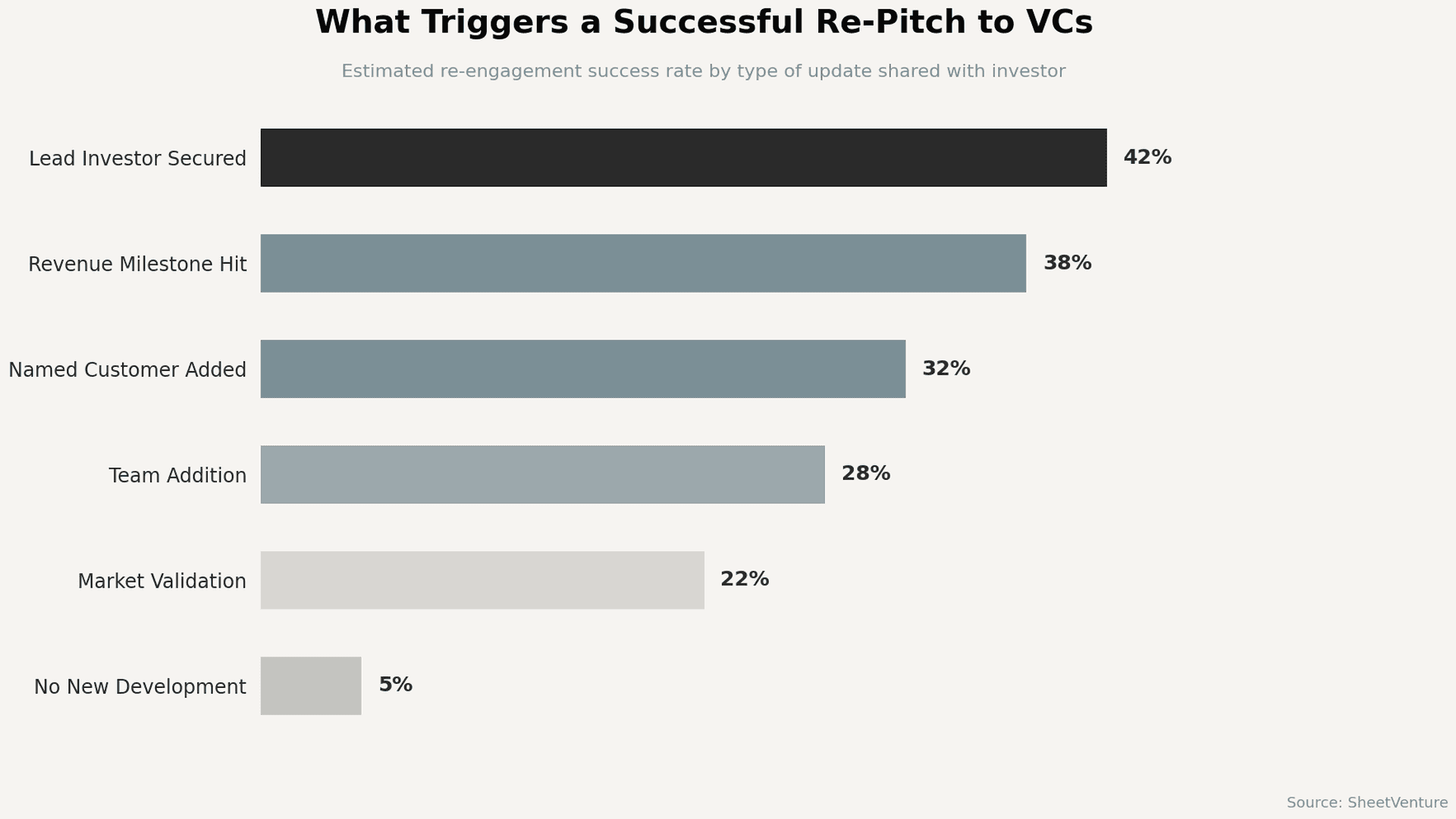
Investors don't change their minds because time has passed. They change their mind because your company has changed. The six months between your first pitch and a re-pitch are only valuable if they contain real proof.
Here's what actually moves the needle:
• Revenue growth: moving from $0 to $50K MRR, or from $50K to $150K, is a concrete signal that the business works.
• A lead investor in the round: if a credible firm has already committed, it de-risks the decision for the investor who passed.
• Named customers: a recognizable brand using your product changes the conversation entirely.
• Team additions: bringing on a strong CTO or VP Sales addresses the gaps they flagged.
• Market validation: a competitor raising a large round, or an acquisition in your space, proves the market is real.
If none of these apply, hold off. Reaching out without a milestone update reads as desperation, not persistence.
When 6 Months Is the Right Window
Six months is a solid re-engagement window for most investors. Here's why it works:
• Early concerns about traction have had time to be addressed.
• Their fund cycle may have shifted; some investors who said "too early" are now ready.
• The relationship hasn't gone cold enough to feel like a cold outreach.
• You've had enough time to build something worth showing.
For investors who said, "come back when you have X," six months is often exactly long enough to hit that X.
Check investor fundraising pace, timing your re-pitch to a momentum window matters more than founders expect.
How to Frame the Re-Pitch Email
Don't start with "I wanted to follow up." Start with the update.
The re-pitch email should do three things, in order:
• Lead with the milestone ("Since we spoke in September, we've grown from $20K to $85K MRR").
• Reference their specific concern ("You mentioned you wanted to see retention data; here it is").
• Keep it short, two paragraphs maximum, then a clear ask.
Investors remember founders who come back with receipts. They don't remember the ones who just check in. Use SheetVenture's investor intelligence to identify which investors in your vertical are actively deploying capital right now, so your re-pitch lands when they're actually looking.
When Not to Re-Pitch
Some passes are real no's. Not every investor is worth pursuing twice.
Skip the re-pitch if:
• They passed because of thesis mismatch; that doesn't change.
• They've closed their fund or paused investing.
• The meeting ended badly, or they gave no feedback at all.
• Your numbers haven't moved in six months.
Understanding investor confidence signals helps you read whether a pass was soft or hard before you decide to go back.
If a VC passed because your market was too small for their fund size, that's structural, not something that six months fixes.
Reading the Original Pass
Go back to the notes from your first pitch. Look for the exact objection they gave. Generic passes ("not the right fit right now") are softer and more re-pitchable. Specific passes ("we don't invest in consumer hardware") are rarely worth retrying.
For founders unsure how to decode these signals, handling investor rejections breaks down how to use a pass as a data point rather than a dead end.
The Bottom Line
Re-pitching an investor who passed 6 months ago works when your progress makes the answer obvious. Lead with the milestone, reference their original concern, and keep it tight. Without new evidence, it's not a re-pitch; it's just follow-up noise.
SheetVenture helps founders track which investors have passed and which are ready to re-engage, so re-pitch timing is based on real signals, not guesswork.
Last Update:
Everything you need to understand private markets
Understand your market in real-time.
Filter by stage, sector, and exact geography.
Access 30,000+ verified, daily-updated active