Multi-stage VCs offer continuity but less specialization. Learn which fund type actually matches your fundraising stage and growth.
Multi-stage VCs invest across multiple funding rounds from seed through growth, while stage-specific funds concentrate capital and expertise within a single stage. The core difference affects follow-on funding, board dynamics, and how much operational support founders receive at each phase of growth.
A multi-stage VC can lead your seed round and double down at Series A, reducing the friction of finding new investors. A stage-specific fund brings deep expertise at one inflection point but leaves you rebuilding investor relationships for every subsequent raise.
How Do Multi-Stage VCs and Stage-Specific Funds Operate Differently
The operational differences come down to capital allocation, decision-making, and the kind of help each fund is built to provide.
Multi-stage VCs typically manage larger funds ($500M to $5B+) and reserve 40 to 60% of capital for follow-on investments. Their partners evaluate deals not just on current traction but on whether the company can scale into a Series B or C opportunity.
Stage-specific funds operate differently:
• Seed funds ($30M to $150M) deploy smaller checks ($500K to $3M) across more companies.
• They specialize in early-stage pattern recognition and founder evaluation.
• Their networks are tuned to the specific challenges of one growth phase.
• They rarely lead follow-on rounds because their fund economics do not support it.
Finding the right VC for your stage requires understanding this structural difference first.
Why Does Fund Structure Matter for Fundraising Strategy
Fund structure directly determines three things founders care about most: speed of decision-making, depth of support, and follow-on probability.
Multi-stage firms often move more slowly at early stages because the check size is small relative to their fund. But when they commit, the signal to other investors is powerful. Stage-specific funds move faster because a $1.5M check from a $100M seed fund represents meaningful capital deployment.
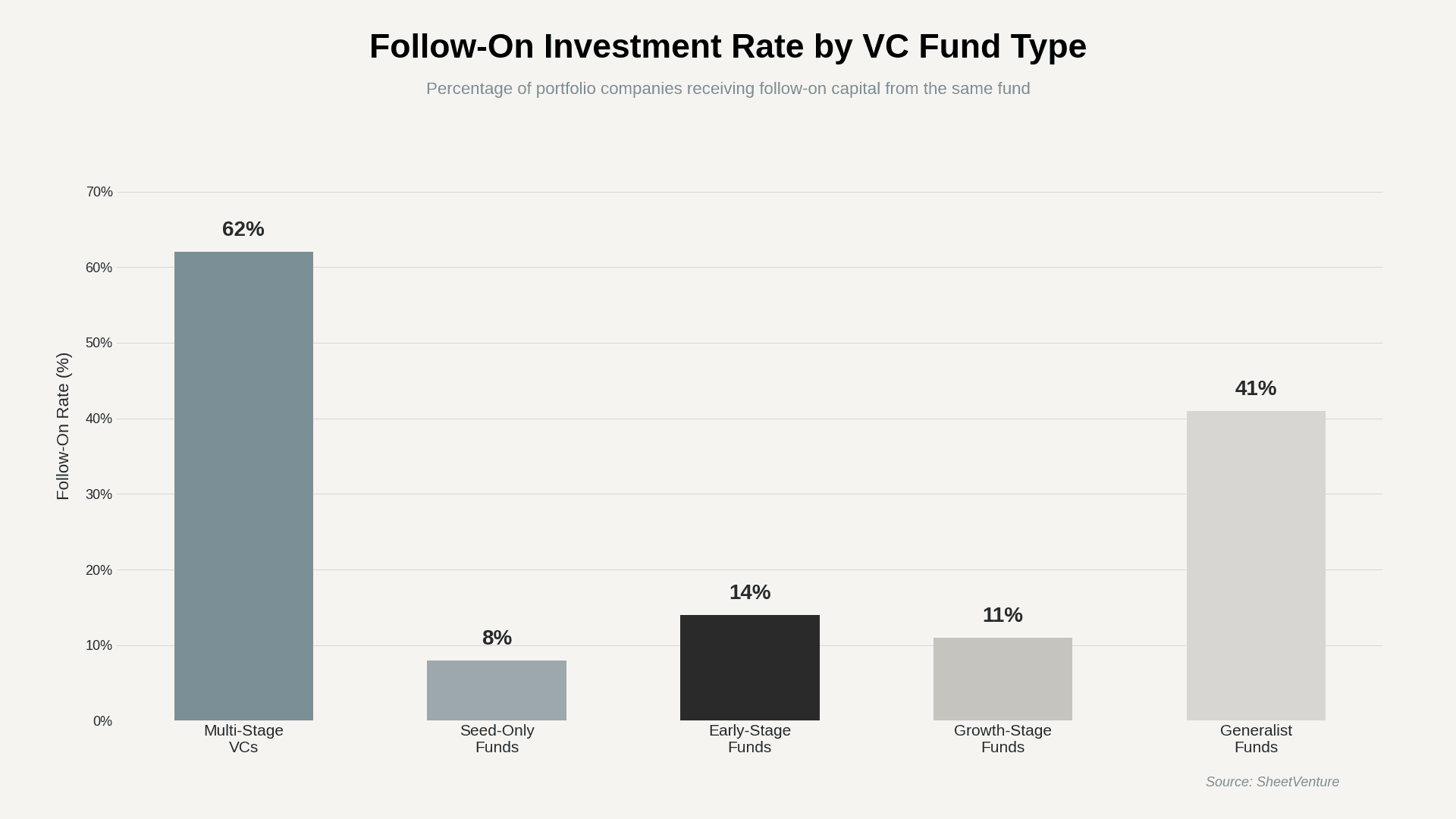
The follow-on dynamic matters most. Multi-stage VCs provide follow-on capital to roughly 62% of portfolio companies. Stage-specific seed funds follow on in only 8% of cases, usually through small pro-rata investments.
Understanding investor stages helps founders plan which fund structures fit each phase of growth.
When Should Founders Choose Multi-Stage VCs Over Stage-Specific Funds
The right choice depends on where you are and what you need most.
Choose multi-stage VCs when:
• You want a single investor relationship across multiple rounds.
• Your market requires large capital deployment to win.
• Reducing fundraising cycles is a priority.
Choose stage-specific funds when:
• You need deep operational expertise for one specific growth phase.
• Higher partner attention matters more than follow-on certainty.
• You are building in a niche where specialized networks unlock deals.
Most successful raises combine both. A stage-specific lead investor paired with a multi-stage participant gives founders specialized guidance now and capital continuity later.
Use SheetVenture's investor database to filter funds by stage focus, check size, and deployment activity.
Multi-Stage vs Stage-Specific Funds: Side-by-Side Comparison
Factor | Multi-Stage VCs | Stage-Specific Funds |
Typical Fund Size | $500M to $5B+ | $30M to $500M |
Average Seed Check | $2M to $5M | $500K to $3M |
Follow-On Rate | 62% of the portfolio | 8 to 14% of the portfolio |
Decision Speed (Seed) | 4 to 8 weeks | 2 to 4 weeks |
Partner Attention | Divided across stages | Concentrated at one stage |
Board Involvement | Active through later rounds | Often steps back after the exit stage |
Network Depth | Broad but general | Deep and specialized |
What Are the Risks of Each Fund Type
No fund structure is universally better. Each carries trade-offs that founders should evaluate carefully.
Risks with multi-stage VCs:
• Lower partner attention at early stages when you need it most.
• Signaling risk if they decline to follow on (other investors notice).
• Slower decision timelines that can stall momentum.
Risks with stage-specific funds:
• No guaranteed follow-on, forcing a full fundraise every round.
• Smaller networks outside their target stage.
• Less brand signaling power with downstream investors.
Knowing whether an investor is a good fit means evaluating these structural trade-offs against your specific needs.
The Bottom Line
Multi-stage VCs provide capital continuity and powerful signaling but spread attention across stages. Stage-specific funds deliver concentrated expertise and faster decisions but leave founders rebuilding investor relationships every round. The smartest strategies use both types, pairing specialized leads with multi-stage participants.
Your fund type decision shapes your entire fundraising arc. Choose based on what your startup needs now and in the next two rounds from today.
SheetVenture helps founders identify which fund type is in active deployment at every stage, so outreach strategy matches both timeline reality and capital quality.
Last Update:
Everything you need to understand private markets
Understand your market in real-time.
Filter by stage, sector, and exact geography.
Access 30,000+ verified, daily-updated active