Tier 1 VCs deliver 2x higher follow-on rates. Learn what truly separates top seed funds from the rest.
Tier 1 VCs provide 2x higher follow-on funding rates, stronger hiring networks, and faster paths to Series A compared to tier 2 funds. The difference is not just the check size. It is the compounding value of brand, network access, and operational support that shapes a startup’s trajectory after the seed round closes.
Understanding these differences helps founders make better decisions about which investors to prioritize during fundraising.
Why Does VC Tier Matter at the Seed Stage
The fund that leads your seed round sets the ceiling for what happens next. Tier 1 VCs carry a brand signal that attracts future investors, top talent, and enterprise customers. Tier 2 VCs may write checks at similar valuations but lack the ecosystem pull that accelerates growth between rounds.
Key differences that impact seed stage outcomes:
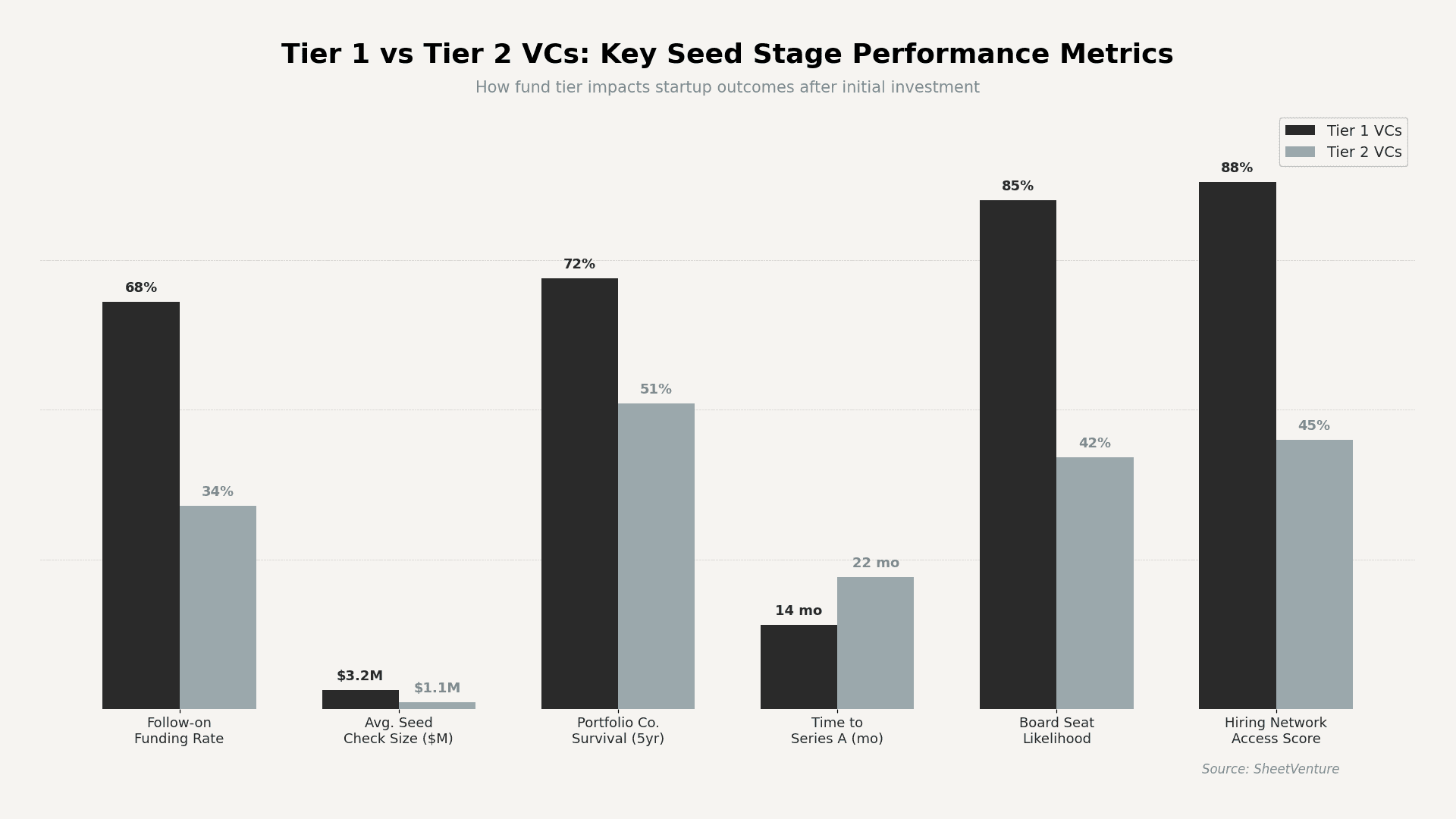
• Follow-on funding rate: 68% for tier 1 vs 34% for tier 2.
• Average time to Series A: 14 months (tier 1) vs 22 months (tier 2).
• Portfolio company 5-year survival: 72% (tier 1) vs 51% (tier 2).
• Board seat likelihood: 85% (tier 1) vs 42% (tier 2).
• Hiring network access score: 88/100 (tier 1) vs 45/100 (tier 2).
These metrics show the gap widens most in areas beyond capital: network effects, talent access, and signal value.
How Do Tier 1 VCs Add Value Beyond Capital
Tier 1 funds invest more than money. Their operational support infrastructure includes dedicated talent partners, go-to-market advisors, and portfolio community platforms.
What tier 1 VCs typically offer at seed:
• Dedicated recruiting support with executive-level talent pipelines.
• Direct introductions to enterprise customers and design partners.
• Portfolio founder communities for peer learning.
• Marketing and PR amplification through the fund brand.
• Active board participation with strategic planning input.
Tier 2 VCs may offer some of these services, but with less depth and consistency. The difference compounds over 18 to 24 months as startups scale from seed to Series A. Founders should evaluate investor fit based on post-investment value, not just terms.
What Are the Tradeoffs of Targeting Tier 1 VCs
Tier 1 funds are harder to access and more selective. Founders should weigh these tradeoffs:
• Competition: Tier 1 funds see 3,000+ deals per year and invest in fewer than 1%.
• Dilution: Tier 1 VCs often require larger ownership stakes (15 to 20%).
• Pace: Decision timelines can stretch 6 to 10 weeks at tier 1 firms.
• Attention: Large portfolios mean less partner time per company at some funds.
• Thesis rigidity: Tier 1 funds are stricter about sector and stage fit.
Tier 2 VCs may offer faster decisions, more flexible terms, and hands-on founder relationships. For startups outside traditional tier 1 sectors (enterprise SaaS, fintech, AI), a well-aligned tier 2 fund may deliver stronger results. Finding the right VC fit matters more than chasing brand names.
How Do Tier 1 and Tier 2 VCs Compare Across Key Factors
Factor | Tier 1 VCs | Tier 2 VCs | Impact on Seed Startup |
Avg. Check Size | $2.5M to $4M | $500K to $1.5M | Longer runway, fewer co-investors needed |
Follow-on Rate | 68% | 34% | Higher Series A conversion probability |
Decision Speed | 6 to 10 weeks | 2 to 4 weeks | Faster close vs stronger signal tradeoff |
Talent Network | Dedicated recruiting team | Ad hoc introductions | Executive hiring speed and quality |
Brand Signal | Strong downstream pull | Limited external signal | Customer and investor trust acceleration |
Ownership Target | 15 to 20% | 8 to 12% | Dilution vs value-add balance |
How Should Founders Decide Between Tier 1 and Tier 2
The best choice depends on what your startup needs most in the next 12 to 18 months.
Choose tier 1 when:
• Your startup needs a strong signal to attract enterprise customers.
• You are in a competitive hiring market and need a talent brand.
• Your fundraising timeline allows for a longer closing process.
• You can demonstrate clear fundable signals that match tier 1 expectations.
Choose tier 2 when:
• You need faster capital deployment.
• Your sector or geography is underserved by top-tier funds.
• You want a more accessible, responsive investor relationship.
• Your priority is flexibility over brand signal.
Use SheetVenture investor intelligence to compare fund performance data before outreach.
The Bottom Line
Tier 1 VCs offer higher follow-on rates, faster Series A timelines, and deeper operational support. Tier 2 VCs provide faster decisions, more flexibility, and often stronger personal involvement. The right tier depends on your startup’s stage, sector, and what kind of support accelerates your next milestone.
Fund tier is a signal, not a verdict. The best investor is the one whose network, expertise, and engagement match what your startup needs right now.
SheetVenture helps founders compare VC fund performance and investor activity so you target the right tier with the right pitch at the right time.
Last Update:
Everything you need to understand private markets
Understand your market in real-time.
Filter by stage, sector, and exact geography.
Access 30,000+ verified, daily-updated active