Only 3% of cold emails get replies. Discover which specific details make investors hit reply instead of archive.
Specific revenue metrics, mutual connections, and a clear thesis fit are the three elements that make VCs click reply. Emails missing these signals get archived in under 5 seconds, which is why only 1 to 5% of cold emails earn a response.
Investors process 50 to 100+ cold emails daily. They are not reading for pleasure. They are scanning for pattern matches against their current thesis, fund stage, and portfolio gaps. The difference between reply and archive comes down to whether your email contains the right information in the right order within the first 50 words. Understanding what triggers each decision gives founders a measurable advantage.
What Email Elements Make VCs Hit Reply
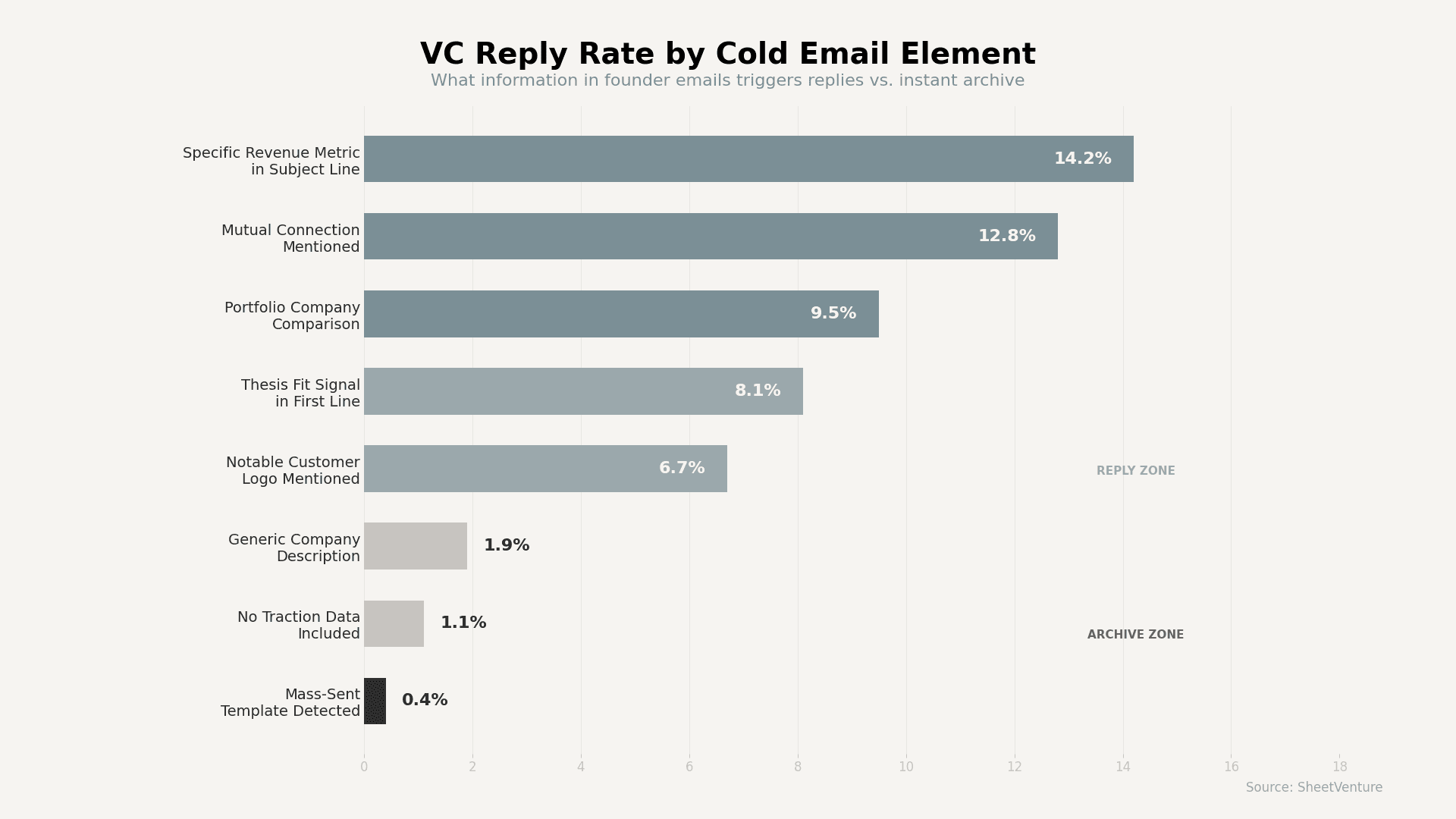
Emails that earn replies share a consistent pattern. They contain verifiable signals that reduce the investor's evaluation effort. The most effective elements ranked by reply rate impact:
• Revenue or growth metric in the subject line. Emails with specific ARR, MRR, or MoM growth in the subject line see 3x higher open rates. A subject like "$1.8M ARR, 22% MoM growth" immediately signals traction.
• Mutual connection named in the first line. Mentioning a shared contact in the opening sentence shifts the email from cold to lukewarm. This alone can boost reply rates from 2% to 12%.
• Portfolio company comparison. Referencing a company already in the VC's portfolio shows you researched their thesis. Investors respond to "[Your Company] for [adjacent vertical]" framing.
• Clear thesis fit signal. Demonstrating you know their investment focus in the first sentence shows intentionality. Generic mass sends get archived instantly.
• Notable customer or logo. Recognizable brand names serve as social proof. A single enterprise customer name can outperform a paragraph of product description.
Learn why most cold emails fail before reaching the reply threshold.
What Causes VCs to Archive Cold Emails Immediately
The archive decision happens faster than the reply decision. Most investors identify disqualifying patterns within 2 to 3 seconds:
• No traction data anywhere in the email. If an investor cannot find a single metric within 5 seconds of scanning, the email gets archived. Descriptions without numbers signal an early stage without validation.
• Obvious mass send indicators. Generic greetings, no fund name mentioned, and one-size-fits-all pitches signal zero research effort. Investors delete these without guilt.
• Thesis mismatch visible from the subject line. A consumer social pitch to a B2B SaaS fund gets archived before the first sentence. Understanding subject lines that match investor focus prevents this.
• Long, dense paragraphs with no formatting. Walls of text signal a founder who cannot communicate concisely. Investors treat email structure as a proxy for thinking clarity.
How VCs Decide Reply vs Archive in 10 Seconds
The decision follows a rapid sequential filter. Each second narrows the outcome:
Time Window | Reply Trigger | Archive Trigger | What Investor Checks |
Second 1 to 2 | Metric or name in subject | Generic or vague subject | Subject line relevance to current thesis |
Second 3 to 5 | Traction hook in the first line | "I hope this finds you well." | First sentence for exceptional signal |
Second 6 to 8 | Recognizable logos or names | No credentials or proof points | Sender background and social proof |
Second 9 to 10 | Clear ask with low friction | Vague CTA or long pitch deck attached | Effort required to respond or evaluate |
Compare how cold vs. warm outreach performs across these same decision windows.
How to Structure Cold Emails for Maximum Reply Rate
Optimizing for the reply decision means front-loading your strongest signals:
• Subject line: Lead with your best metric or mutual connection. Keep it under 8 words. Avoid exclamation marks or all caps.
• First sentence: State your most compelling traction signal. Not your company description. Not a greeting. Your best number.
• Body: Maximum 75 words. One sentence on the problem. One on traction. One of the reasons why this specific investor.
• Ask: Request a specific 15-minute call. Do not ask them to "review the deck" or "let me know your thoughts." Low-friction asks get more replies.
• Sender profile: Ensure your LinkedIn is current, your email domain is professional, and your signature includes one line of credibility.
Use investor intelligence tools to identify which investors are actively deploying capital and match your thesis before reaching out.
The Bottom Line
VCs click reply when cold emails contain specific revenue metrics, mutual connections, portfolio company comparisons, or clear thesis alignment. They archive when emails lack traction data, show no research effort, or mismatch their investment focus. The decision happens in under 10 seconds and depends entirely on whether your strongest information appears in the first 50 words.
Ready to send emails that land in the reply pile? Front-load metrics, name mutual connections, reference portfolio fit, and keep your ask specific and low friction. Every word before the fold either earns attention or loses it.
SheetVenture helps founders identify which investors are actively deploying capital and match outreach to real thesis fit, so every cold email carries the right information to earn a reply.
Last Update:
Everything you need to understand private markets
Understand your market in real-time.
Filter by stage, sector, and exact geography.
Access 30,000+ verified, daily-updated active