82% of VCs decide founder credibility within the first five minutes—discover what triggers instant trust or doubt.
VCs decide whether to trust a founder almost immediately, usually within the first 2-5 minutes of a conversation. The signals that trigger instant trust include demonstrated domain expertise, precise metric recall, and honest acknowledgment of risks. Distrust signals include vague answers, inflated projections, and rehearsed pitches that dodge hard questions.
Investor trust is not built over weeks. It is earned or lost in the opening moments of a pitch. VCs process hundreds of founder conversations each year and rely on pattern recognition to decide who deserves deeper attention. The gap between founders who earn trust and those who don't comes down to a few specific, repeatable behaviors.
What Do VCs Evaluate in the First Five Minutes?
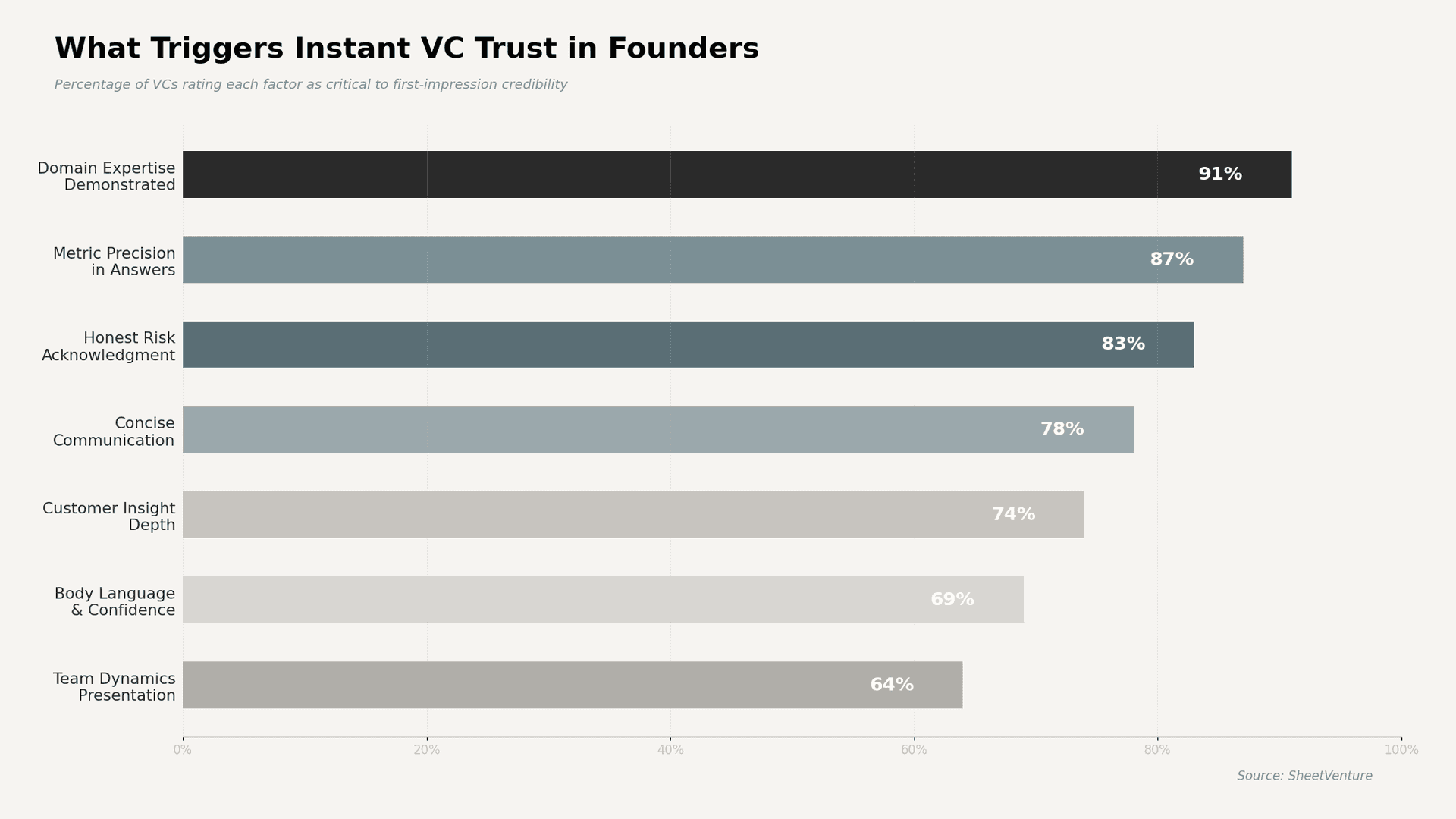
Investors aren't just listening to your pitch. They're scanning for credibility signals that predict whether you can execute. Here's what they assess before you finish your introduction:
• Domain fluency: Can you explain your market without slides? Founders who speak about their space with natural depth, referencing customer pain points, competitor weaknesses, and regulatory nuance, trigger immediate trust.
• Metric precision: Investors notice when you say "$2.1M ARR growing 18% MoM" versus "we're growing fast." Exact numbers signal that you operate your business with discipline.
• Honest risk framing: Acknowledging what could go wrong actually increases trust. VCs distrust founders who present a zero-risk narrative because it signals either naivety or deception.
• Concise answers: Rambling under pressure is a red flag. The ability to answer hard questions in 2-3 sentences shows clarity of thinking, which investors associate with execution ability.
• Customer proximity: Founders who quote specific customer conversations, churn reasons, or onboarding friction instantly differentiate themselves from those repeating market research.
Understanding what investors look for in a founding team goes beyond credentials; it's about how you communicate under pressure.
What Behaviors Make VCs Distrust Founders Immediately?
Distrust triggers are often faster and harder to reverse than trust signals. VCs report that the following behaviors create an immediate credibility deficit:
• Vague traction claims: "We have strong interest from enterprise customers" without naming a single company, contract size, or pipeline stage.
• Avoiding hard questions: Redirecting to strengths when asked about weaknesses signals that you either don't understand your risks or won't be transparent with investors post-funding.
• Over-rehearsed delivery: Sounding scripted without the ability to go off-script destroys authenticity. VCs want to see thinking, not performance.
• Inflated market sizing: Claiming a $50B TAM with no clear logic for your serviceable segment tells investors you don't understand go-to-market reality.
• Dismissing competition: "We don't really have competitors" is one of the fastest ways to lose investor trust. Every market has alternatives, and denying that signals poor market awareness.
These patterns align with what causes investors to disengage mid-pitch and ultimately pass on otherwise promising deals.
How Do Trust and Distrust Signals Compare Side by Side?
The gap between earning trust and losing it often comes down to how you frame the same information:
Signal Area | Trust Trigger | Distrust Trigger | VC Impact |
Traction | "$1.8M ARR, 22% MoM, 94% retention" | "Revenue is growing really fast." | Decides if VC reads your deck or skips it |
Competition | "Three main players, here's our wedge." | "We don't have real competitors." | Determines perceived market awareness |
Risk | "Our biggest risk is X, here's our mitigation." | "We don't see major risks right now." | Shapes whether VC proceeds to diligence |
Market Size | "$3.2B SAM based on segment analysis." | "$50B TAM" with no breakdown. | Signals analytical rigor or lack of it |
Customer | "Our top user churned, here's what we learned." | "Customers love us, NPS is high." | Reveals depth of customer understanding |
Can Founders Recover From a Bad First Impression?
Rarely. Research on investor decision-making shows that only 3-7% of VCs significantly change their initial trust assessment during a single meeting. The first impression acts as a filter through which every subsequent data point is interpreted.
If a VC distrusts you early, your strongest metrics will be scrutinized more aggressively. If they trust you, they'll approach your weaknesses with more patience. This is why understanding how VCs assess founder credibility is critical preparation before any investor meeting.
The most effective recovery tactic is to address a weakness before the investor asks about it. Proactive vulnerability: "Here's where we're weakest and what we're doing about it"; can reset a shaky first impression faster than any metric.
The Bottom Line
VCs instinctively trust founders who demonstrate domain depth, cite precise metrics, and acknowledge risks without flinching. They distrust founders who give vague answers, dodge hard questions, or present an unrealistically clean narrative. Trust is formed in the first 2-5 minutes and rarely changes.
Prepare for those five minutes like they're your entire pitch, because to the investor, they are.
SheetVenture helps founders understand exactly how investors evaluate credibility, so every conversation starts with the right signals and the right data behind them.
Last Update:
Everything you need to understand private markets
Understand your market in real-time.
Filter by stage, sector, and exact geography.
Access 30,000+ verified, daily-updated active