VCs pass in 48 hours or delay for weeks. These seven signals determine which path your startup gets.
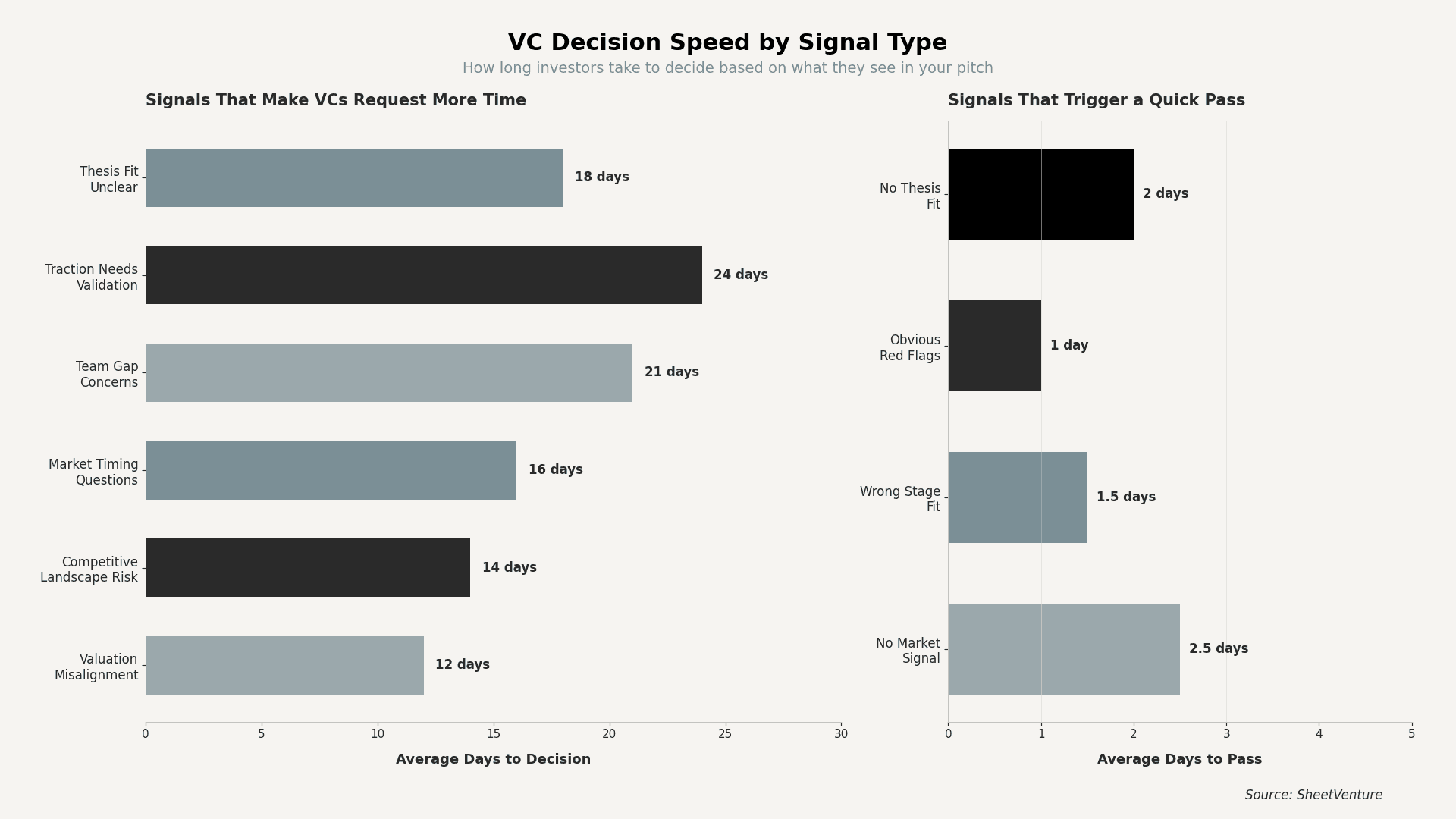
VCs request more time when they see potential but need to resolve specific concerns like thesis fit, traction validation, or team gaps. They pass quickly, often within 48 hours, when there is an obvious mismatch in stage, sector, or deal structure.
The difference comes down to whether your startup triggers curiosity or confirmation of a "no." Understanding these patterns changes how you interpret silence, manage follow-ups, and allocate your fundraising time. Most founders treat every delayed response the same way. That is a mistake. The signals behind each outcome are specific, identifiable, and actionable.
Why Do Some VCs Ask for More Time Instead of Passing
Investors delay when something about your startup holds their attention but does not give them full conviction. This is not indecision. It is an active evaluation. When VCs delay decisions, they are usually working through one or more unresolved questions internally.
Signals that make VCs pause and dig deeper:
Traction that looks promising but needs independent validation, such as unverified revenue claims or early cohort data without enough time to show retention
Thesis alignment that is close but not exact, where the partner sees a possible fit but needs to build an internal case for the investment committee
Team composition that raises questions, particularly gaps in technical leadership or missing operational experience that could affect execution
Market timing uncertainty, where the opportunity looks real, but investors want to see one or two more data points before committing
Competitive landscape complexity, where differentiation exists but requires deeper analysis to confirm defensibility
Valuation that does not match current traction, prompting negotiation instead of outright rejection
What Signals Trigger a Quick VC Pass
Quick passes happen when investors see an immediate disqualifier. These rarely involve ambiguity. The decision is clear within minutes or hours. When VCs pass on deals fast, they are not being dismissive. They are recognizing patterns they have seen hundreds of times.
Common triggers for a fast "no":
• No thesis fit whatsoever. The startup operates in a sector or model that the fund simply does not cover.
• Stage mismatch. The company is too early or too late for the fund's current deployment cycle.
• Obvious red flags in the pitch, such as inflated metrics, unrealistic projections, or evasive answers about unit economics.
• No discernible market signal. The problem being solved lacks evidence of demand or urgency.
• Founder credibility gap, where background, communication, or preparation raises immediate concerns.
A fast no actually saves founders time. It frees up your pipeline to focus on investors who are genuinely evaluating. Learn more about reading decision timelines so you can calibrate expectations before every meeting.
How Long Do VCs Typically Take to Decide on Startups
Decision timelines vary depending on the signal type, fund size, and internal process. The table below shows what typical timelines look like across the most common scenarios.
Decision Scenario | Typical Timeline | What Drives It |
Strong thesis fit, minor concerns | 2 to 3 weeks | Internal conviction building, partner alignment |
Traction needs external validation | 3 to 4 weeks | Reference checks, customer calls, data requests |
Team gap evaluation | 2 to 3 weeks | Additional meetings, co-investor input |
Market timing uncertainty | 2 to 4 weeks | Waiting for data points or market signals |
No thesis fit | 24 to 48 hours | Immediate pattern recognition by the partner |
Red flag detected | Under 24 hours | Quick internal alignment, no further diligence |
How Should Founders Respond When VCs Delay
A delay is not a rejection. It is a buying signal that needs nurturing. But there is a right way and a wrong way to handle it.
What to do when a VC asks for more time:
• Ask what specific information or milestone would help them reach a decision. This turns vague interest into a concrete next step.
• Send progress updates every two weeks with new traction data, customer wins, or product milestones.
• Avoid creating artificial urgency that does not exist. Experienced investors recognize fake deadlines immediately.
• Track how decision timelines compare across your pipeline. If most investors move faster, a delay may signal a lower-priority deal.
Use SheetVenture's investor intelligence to track which investors are actively evaluating startups in your space and how their decision timelines typically unfold. Knowing who is moving and who is stalling changes your entire follow-up strategy.
The Bottom Line
VCs request more time when they see potential wrapped in uncertainty. They pass quickly when the mismatch is obvious. The signals that trigger each outcome are specific and identifiable: thesis fit, traction quality, team composition, and market timing drive delays, while stage mismatches and red flags drive fast passes.
Founders who learn to read these signals stop chasing dead-end conversations and focus on investors who are genuinely evaluating. The difference between a delay and a pass is often the difference between a funded round and a wasted quarter.
SheetVenture helps founders identify which investors are actively deciding on deals like theirs, so follow-up strategy matches real decision timelines instead of guesswork.
Last Update:
Everything you need to understand private markets
Understand your market in real-time.
Filter by stage, sector, and exact geography.
Access 30,000+ verified, daily-updated active