
What Pitch Deck Length Converts Best for Institutional Investors?
On this page
15-20 slides. Funded startups average 19.2 slides per deck, and institutional VCs complete 65% of decks in that range. Go shorter, and you look unprepared. Go longer, and investors abandon before reaching your ask.
Most founders follow the 10-slide rule from accelerator advice. That works at pre-seed. It fails at Series A and beyond. Institutional investors need financial rigor, market proof, and enough depth to circulate your deck internally without you in the room.
Investors spend an average of 3 minutes 44 seconds reviewing a pitch deck. Each slide gets roughly 10-15 seconds of attention. The financials slide earns the most scrutiny at 23-27 seconds. Everything after your first 50 words on any slide is likely unread.
Why 15-20 Slides Hit the Highest Completion Rate
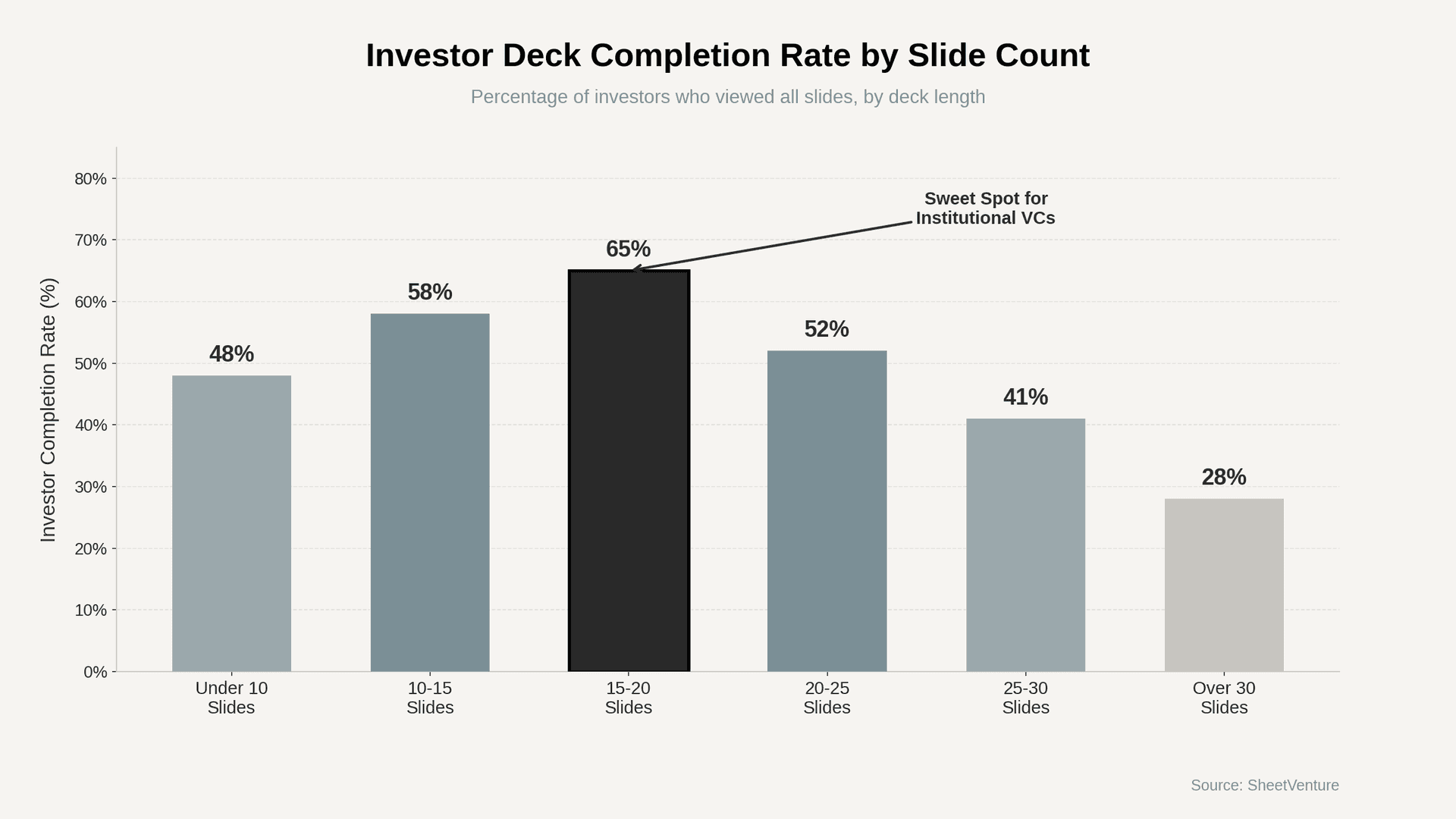
Completion rate measures whether an investor viewed every slide in your deck. It directly predicts whether they saw your ask and financials. Here is how deck length affects that metric:
Under 10 slides: 48% completion. Investors perceive the deck as thin. Lacks the depth institutional partners need for internal review.
10-15 slides: 58% completion. Works for seed rounds. Falls short when partners need unit economics, cohort data, or go-to-market detail.
15-20 slides: 65% completion. The sweet spot for Series A and institutional rounds. Enough substance for partner circulation. Short enough to hold attention.
20-25 slides: 52% completion. Attention starts dropping. Investors skip slides rather than reading sequentially.
Over 25 slides: Under 41% completion. Most investors never reach the financials or ask about the slide.
The 15-20 range works because institutional VCs run a different evaluation process than angels. Your deck travels through partner meetings, investment committee reviews, and associate pre-screens. It must stand alone. A 10-slide deck designed for a live pitch cannot survive that circulation.
What Institutional Investors Need That Angels Do Not
The slide count gap between seed and Series A reflects a shift in what investors evaluate. Institutional VCs expect specific slides that seed investors often skip:
Bottoms-up TAM/SAM/SOM analysis, not top-down market guesses.
Unit economics with CAC, LTV, and payback period are shown clearly.
Cohort retention data proves customers stay.
3-5 year financial projections with stated assumptions.
Go-to-market strategy with channel-level detail.
These slides are non-negotiable at Series A. Cutting them to hit a 10-slide target tells investors you either lack the data or do not understand what they need. Use the first deck data expectations to calibrate what belongs in your core slides versus your appendix.
The Two-Deck Strategy That Converts
Smart founders do not send the same deck for cold outreach and partner meetings. The highest-converting approach uses two versions:
Teaser deck (5-8 slides): Built for cold emails and intro requests. One-liner, problem, traction headline, market size, team, ask. The goal is one thing only: get the meeting.
Full deck (15-20 slides plus appendix): Built for the meeting and post-meeting circulation. Includes all the depth institutional partners require for internal review.
The teaser deck earns attention. The full deck earns conviction. Sending a 20-slide deck cold overwhelms investors who have not agreed to engage yet. Use investor intelligence to identify which VCs are actively deploying capital before choosing which deck version to send.
Review a pitch deck guide for structuring each slide to maximize the time investors spend on it.
Where Founders Lose Institutional Investors
Most decks fail not because of slide count but because the wrong slides get the most space:
Too many product screenshots, not enough market proof.
Vision slides that run 3 pages when 1 would convert better.
Missing the "Why Now" slide that institutional VCs consider critical.
Financials are buried at slide 22, where 60% of investors never scroll.
No appendix for detailed data that partners request after the meeting.
Understand what triggers an investor meeting so your deck structure matches how VCs actually decide.
The Bottom Line
15-20 slides convert best for institutional investors, hitting 65% completion rates. Below that range, decks lack the depth partners need for internal circulation. Above it, investors abandon before reaching your ask and financials. Use a teaser deck for cold outreach and a full deck for meetings. Match your slide count to your funding stage, not to generic startup advice.
SheetVenture helps founders match pitch materials to investor expectations so every deck reaches the partners who make funding decisions.
Find investors who are actually writing cheques
Explore live coverage, or book a walkthrough of the product.