72% of VCs track founders who show thesis fit. Here are the exact email signals that trigger it.
VCs add founders to their tracking list when an email demonstrates clear thesis alignment, includes a specific traction metric, and references a recognizable signal like a notable customer or mutual connection.
These signals tell investors the founder understands their portfolio strategy and has real momentum worth monitoring, even if the timing isn't right for an immediate investment.
Most founders think cold emails either get a meeting or get deleted. The reality is more nuanced. Investors maintain tracking lists, internal databases of founders they want to revisit when timing, stage, or fund cycle aligns. Getting on that list means your next email gets read first. The difference between delete and track comes down to a handful of signals embedded in how you write, not just what you write.
Which Email Signals Trigger VC Tracking Behavior?
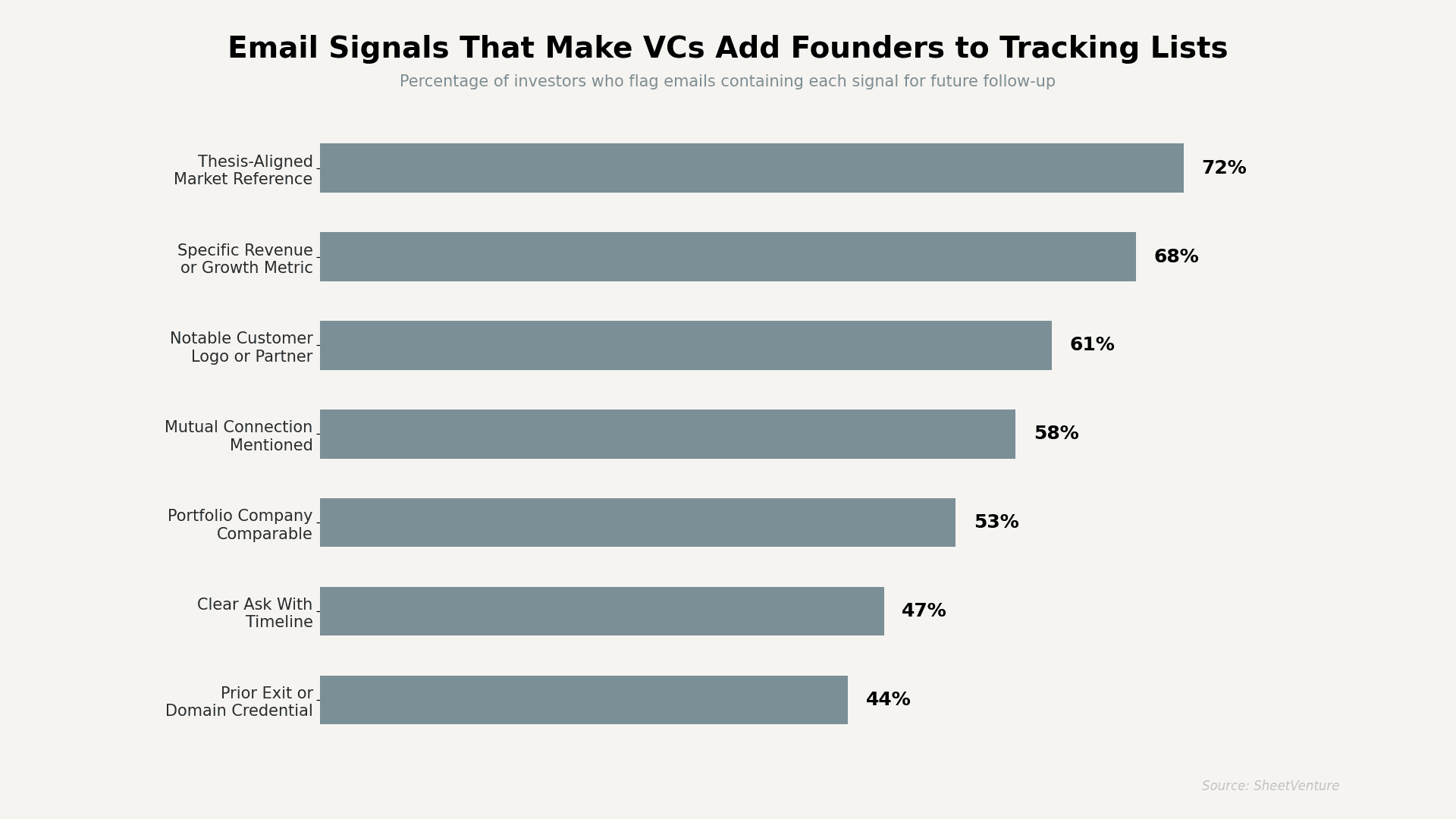
Not every signal carries equal weight. Thesis alignment, where a founder explicitly connects their startup to the investor's stated focus area, is the strongest trigger at 72%. A specific revenue or growth metric follows at 68%, because numbers cut through narrative. Notable customer logos (61%) and mutual connections (58%) provide external validation that reduces perceived risk. Portfolio company comparables (53%) show the founder has done research. A clear ask with a timeline (47%) signals founder discipline, and prior exits or domain credentials (44%) add founder credibility. Each of these signals answers a different question the investor is subconsciously asking: Is this relevant to me? Is this real? Is this founder serious?
Understanding VC investment thesis structures helps founders craft emails that hit these triggers naturally.
How Do VCs Decide Which Cold Emails to Save?
The decision happens in layers. The subject line earns the open in 1-2 seconds. The first sentence determines whether the investor reads further. But the tracking decision, the moment an investor flags a founder for later, depends on a pattern match across multiple signals within 10-15 seconds of scanning.
Investors save emails when the founder's market maps to their active thesis, the traction is credible, but the round may be early, or the founder profile matches a pattern they've seen succeed. This is why founder emails that stand out in crowded inboxes share a common structure: signal-first, context-second, ask-last.
What Makes Each Signal Effective by Investor Type?
Email Signal | Top-Tier VCs | Mid-Tier VCs | Emerging Funds | Angel/Solo GPs |
Thesis-aligned market reference | Critical; only filter that passes | High impact; fast-tracks review | Strong; validates sector bet | Moderate; less thesis-rigid |
Specific revenue or growth metric | Required; no metric, no read | High impact; triggers deeper scan | High proves early traction | Helpful, but story matters more |
Notable customer or partner logo | Strong social proof shortcut | Strong; de-risks deal mentally | Moderate; less brand-dependent | Variable; depends on relevance |
Mutual connection mentioned | Essential; near-requirement | Valuable; boosts open rate | Helpful; builds trust faster | High, personal network-driven |
Clear ask with fundraising timeline | Appreciated; shows discipline | Strong; helps prioritize pipeline | Moderate; flexibility preferred | Moderate; less process-heavy |
What Email Structure Gets Founders Tracked Instead of Deleted?
Structure matters as much as content. Emails that lead with a metric in the subject line, connect to the investor's thesis in the first sentence, and keep the full message under 100 words have the highest tracking rates. The pattern is consistent: subject line creates relevance, opening line proves traction, body paragraph shows fit, and closing line states a specific ask or timeline. Founders who write compelling emails that follow this framework earn tracking placement even when the timing isn't right for a meeting.
When Do Tracked Founders Actually Hear Back From VCs?
Tracking doesn't mean silence forever. VCs typically revisit their tracking lists when a new fund closes, a portfolio gap becomes urgent, or a market shift makes a previously early startup suddenly relevant. Most tracked founders hear back within 3-9 months if they send periodic updates showing continued progress. The key is that the initial email earned the right to future attention. Without that first signal-rich email, updates go unread. With it, every follow-up compounds credibility. Learn how investors interpret fundraising updates to keep your tracking position strong.
The Bottom Line
Getting deleted and getting tracked are separated by a few deliberate signals. Thesis alignment, a specific metric, a recognizable name, and a clear timeline turn a forgettable cold email into one that earns a place on an investor's watch list. You don't need all seven signals. You need the right three for the right investor. Front-load them, keep it short, and make the next email worth opening too.
SheetVenture helps founders match outreach signals to each investor's active thesis so every cold email earns tracking placement, not deletion.
Last Update:
Everything you need to understand private markets
Understand your market in real-time.
Filter by stage, sector, and exact geography.
Access 30,000+ verified, daily-updated active