Five signals tell founders to increase outreach volume immediately. Learn each threshold and the exact response each signal demands.
Founders should increase outreach volume immediately when five signals appear: response rate drops below 5%, first meetings are not converting to second meetings at 30% or higher, the pipeline has fewer than 15 active conversations, a sector peer announces a close, and runway crosses below 12 months without a lead committed.
Each signal marks a specific failure point. Waiting for all five before acting guarantees a raise that runs out of time before it runs out of options.
Why Volume Is a Timing Decision, Not a Quality Decision
What increasing volume at the right moment enables:
Creating competitive dynamics a thin pipeline cannot produce
Buying time to iterate on pitch quality while maintaining active deal flow
What delaying volume increase causes:
Sequential conversations that never create competitive tension
Runway pressure forcing acceptance of the first committed check regardless of terms
For deeper context, understand how investors interpret momentum during a round and why pipeline density signals founder credibility before any meeting begins.
The Five Signals That Demand Immediate Volume Increase
Signal 1: Response Rate Falls Below 5%
Fewer than 5 replies per 100 emails over two weeks confirms the current target list is exhausted, the message is not landing, or both. Double outreach volume while testing one new subject line and one new opening sentence in parallel batches of 20 emails each.
Signal 2: First Meetings Not Converting to Seconds at 30%
Below 30% second-meeting conversion means the pitch generates curiosity but not conviction. More pipeline is the only way to find investors whose thesis fits closely enough to convert on the first meeting alone.
Learn what causes investors to disengage mid-pitch and how conversion failure signals a targeting problem as much as a pitch problem.
Signal 3: Fewer Than 15 Active Simultaneous Conversations
Below this threshold the process is effectively sequential. Competitive dynamics cannot form and a single investor passing creates a gap that takes weeks to refill. Add 20 to 30 new targets within 48 hours to rebuild density.
Signal 4: A Sector Peer Announces a Close
This event opens a 60 to 90 day window where investors who passed on the closed deal are actively looking for the alternative bet. Identify every investor who publicly congratulated the closed deal and send personalized outreach within one week.
Signal 5: Runway Crosses Below 12 Months Without a Lead Committed
The raise is no longer a positioning exercise. Expand to every qualified investor on the target list simultaneously. Selectivity at this runway level is a luxury the balance sheet cannot support.
Signal Response Table: What Each Trigger Demands
Signal | Threshold | Immediate Action | Volume Increase Target |
|---|---|---|---|
Response rate drop | Below 5% | Revise message, double send volume | Add 50 new targets per week |
Low first to second meeting conversion | Below 30% | Expand investor profile targeting | Add 20 to 30 targets immediately |
Thin active pipeline | Fewer than 15 conversations | Rebuild density within 48 hours | Reach 25 active conversations |
Sector peer announces close | Any adjacent close | Target their passed investors immediately | 15 to 20 personalized outreach in one week |
Runway below 12 months | No lead committed | Remove tier preference, contact all qualified | Full list activation immediately |
The pattern: Each signal has a specific volume response. Founders who treat all five as the same generic problem apply the wrong fix at the wrong moment and lose the timing advantage each signal creates.
How Many Founders Act on Each Signal in Time
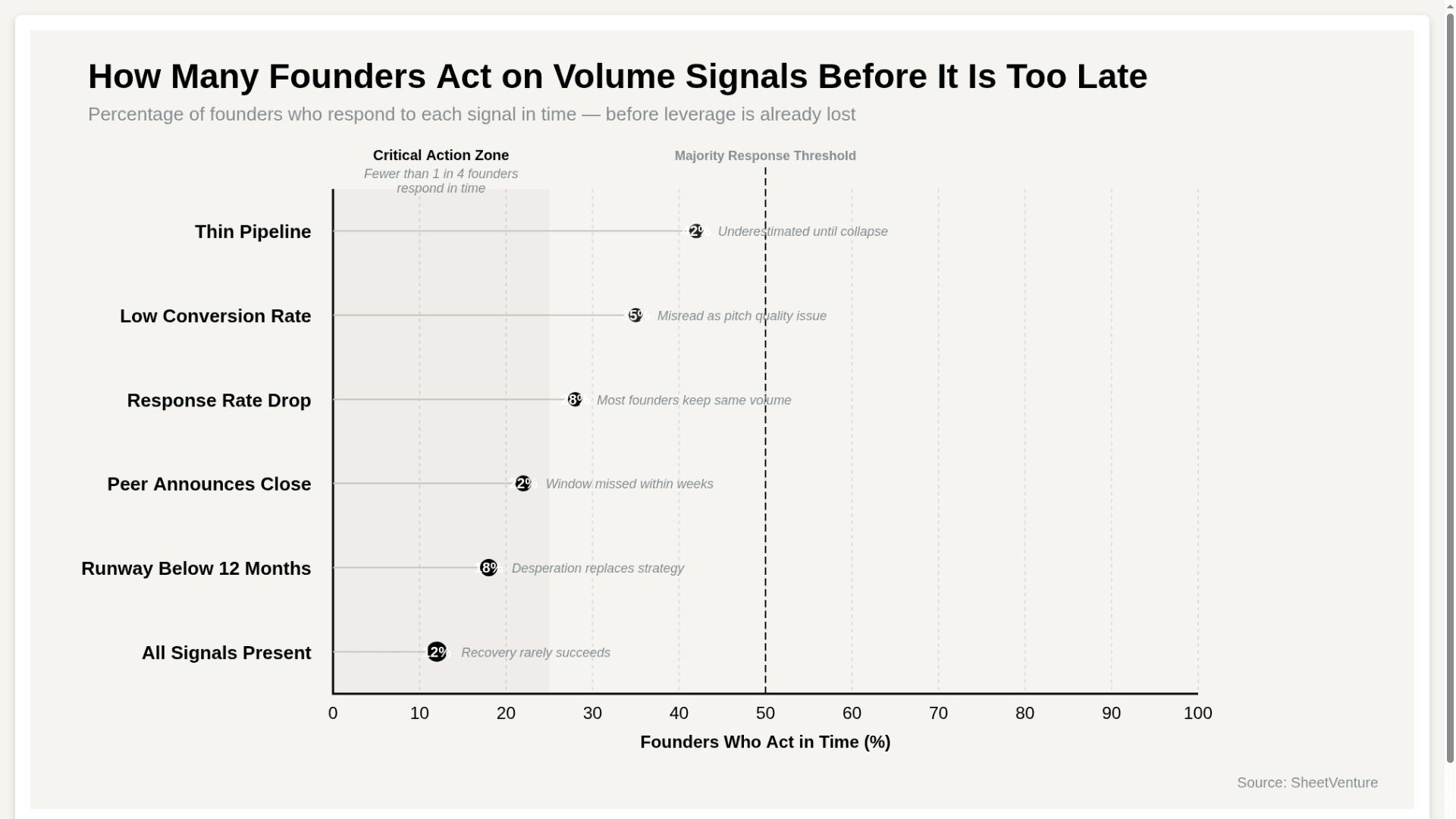
The chart shows timely action rates declining from 42% at the earliest signal to just 12% when all five are present simultaneously, confirming that most founders only respond when leverage is already gone rather than when the first signal creates the clearest opportunity to act.
How to Monitor the Five Signals in Real Time
Track response rate weekly and add new targets immediately if it falls below 5%
Count active conversations every Monday and trigger volume increase if below 15
Set a Google Alert for every company in your sector to catch peer close announcements within 24 hours
The principle: Each signal has a response window. Response rate drops give two to three weeks. Peer close announcements give 60 to 90 days. Runway below 12 months gives weeks not months. Acting on the earliest signal always produces better outcomes than waiting for the clearest one.
Access SheetVenture's database to expand your outreach list instantly when any signal triggers so volume response happens in hours rather than days.
The Bottom Line
Founders should increase outreach volume immediately when response rate falls below 5%, first-to-second meeting conversion drops below 30%, active conversations fall below 15, a sector peer announces a close, or runway crosses below 12 months without a committed lead. Acting on each signal individually preserves leverage. Waiting until all five appear removes it entirely.
SheetVenture helps founders monitor deal flow signals in real time so volume decisions are made from data, not from the feeling that something has gone wrong.
Last Update:
Everything you need to understand private markets
Understand your market in real-time.
Filter by stage, sector, and exact geography.
Access 30,000+ verified, daily-updated active