A competitor just announced funding mid-raise. Here is exactly how smart founders turn that news to their advantage.
A competitor's funding announcement does not hurt your raise. It validates the market you are both competing in, and if you respond correctly, it becomes a narrative asset within 48 hours.
You see the news alert. A competitor just closed a round, maybe larger than what you are raising right now. Your first instinct is dread, and that instinct is wrong.
Investors see the same headline. How you respond in your next email or meeting tells them more about your judgment than most slides in your deck ever will.
Why Competitor Funding Usually Helps Your Raise
Most investors do not see a funded competitor and think the market is taken. They think about whether the problem is proven worth solving at scale, and whether the space has room for multiple winners. Your job is to shape how they answer that question:
• A competitor raising at seed signals the problem is real, and investors are paying attention.
• A large Series A in your space suggests the market is still early, not saturated.
• A competitor relying on weaker metrics than yours is an argument in your favor.
The 48-Hour Response Window
If investors in your pipeline see the news before you bring it up, you lose the narrative. The 48 hours after a competitor announcement is your clearest window to own the story.
• Send a brief update to every investor in active conversations.
• Acknowledge the news in one sentence, no emotional language.
• Use it to reinforce your differentiation, not to criticize the competitor.
• If your metrics compare favorably, include them.
"You may have seen [Competitor] close their round this week. We see this as market validation. Our retention rate of 92% and CAC 35% below theirs reflects a product bet we made 18 months ago." One paragraph. Confident. Done.
How to Address It With Investors Directly
When it comes up in a meeting, and it will, treat it as a question you prepared for. Investors want to know three things: whether you understand the competitor clearly, whether their raise changes your strategy, and whether you are the kind of founder who uses external pressure or gets rattled by it.
Prepare a two-column competitive snapshot before your next pitch. What they have, what you have. No exaggeration. Investors read inflated competitive slides as insecurity.
Understanding your fundraising pace matters here, too. Going quiet after a competitor announcement tells investors you were not prepared for competition to exist. Keep your outreach moving.
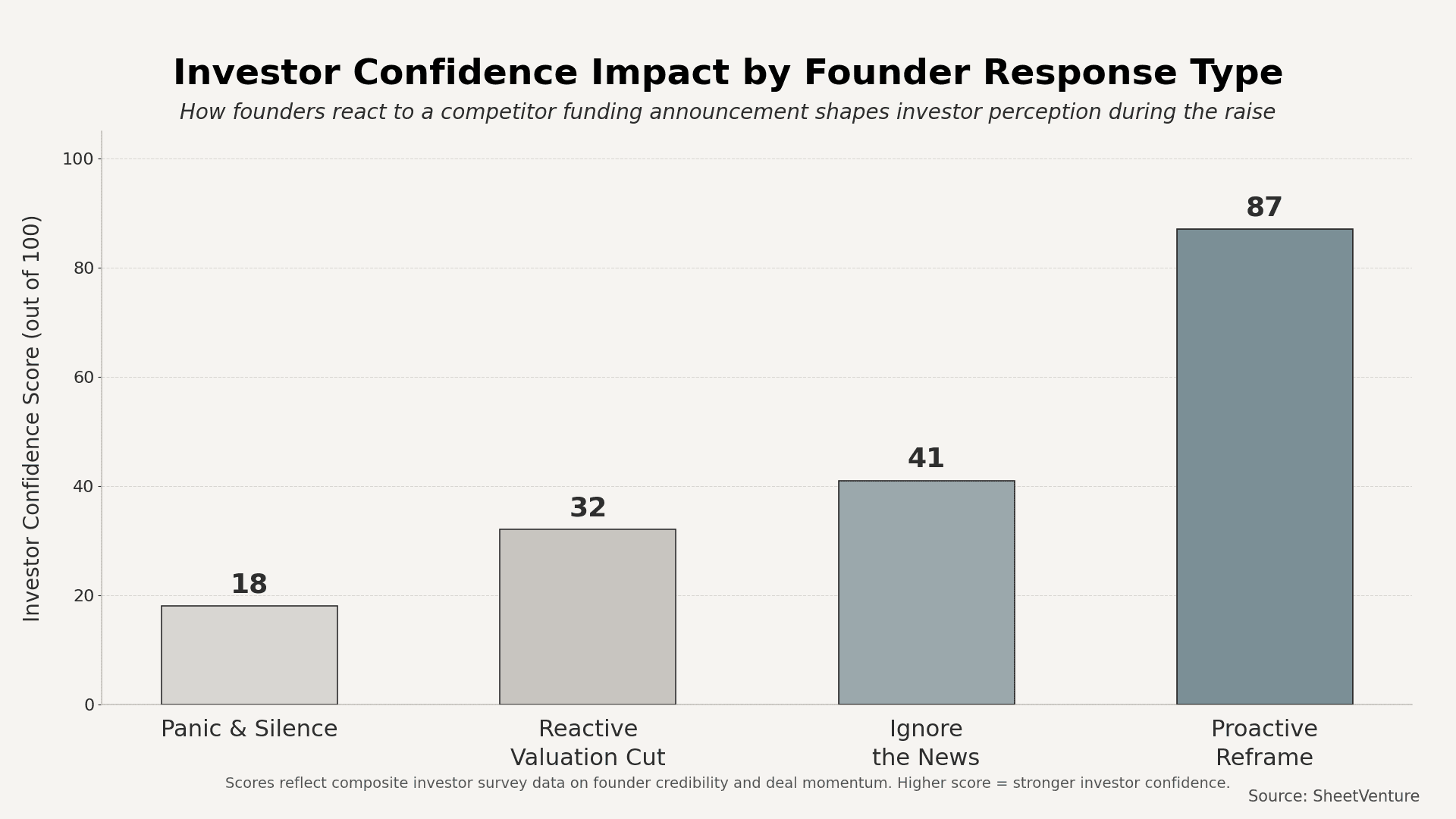
What Not to Do
• Do not go silent. Disappearing signals you were unprepared for competition.
• Do not criticize the competitor. That language reflects on you, not them.
• Do not cut your valuation reactively. It reads as panic, not strategy.
Founders who maintain and raise momentum under external pressure close faster. Consistency under noise is itself a signal that investors track carefully.
How to Flip the Script Entirely
The strongest response treats a competitor's funding as proof of demand, not a threat. You can say directly: "Three companies are now raising in this space. That is not a crowded market. That is a validated one." That framing works if your product stands on its own.
Use investor intelligence to identify which investors backed your competitor and which ones actively back multiple bets in the same category. Those are your highest-probability targets right now.
If investors rejected you, citing competition, learning how to handle rejections will sharpen exactly how you respond to that objection going forward.
The Bottom Line
A competitor announcing funding is a fact, not a verdict. The market is the same for both of you. Founders who respond with clarity and confidence tend to convert more investor meetings afterward, not fewer.
One proactive email, a sharper competitive narrative, and steady outreach. That is the entire playbook. Silence is the only response that actually damages your raise.
SheetVenture helps founders track which investors are backing competing companies, so you can target the ones still actively looking for a second winner in your market.
Last Update:
Everything you need to understand private markets
Understand your market in real-time.
Filter by stage, sector, and exact geography.
Access 30,000+ verified, daily-updated active
