Rising rates and slow GDP shift VC check sizes, timelines, and risk tolerance. See how macro signals reshape deal expectations.
Investors tighten check sizes by 30 to 50%, extend due diligence timelines by 2 to 4 weeks, and demand 18 to 24 months of runway when macroeconomic signals turn negative. Interest rate hikes, slowing GDP, and rising inflation directly shift how VCs evaluate risk, set valuations, and decide deployment speed. Founders who understand these shifts time their raises better and set expectations that match the current capital environment.
What Macroeconomic Signals Do VCs Watch Most?
Investors track a core set of economic indicators that directly influence deployment decisions.
• Federal funds rate: Higher rates raise the cost of capital and compress startup valuations. VCs benchmark returns against risk-free alternatives.
• GDP growth rate: Slowing GDP signals weaker consumer spending and enterprise budgets, making revenue projections less credible.
• Inflation (CPI): Elevated inflation erodes purchasing power and compresses real returns, pushing investors toward capital-efficient companies.
• Public market performance: IPO windows closing and tech stock drops reduce exit confidence, making VCs more selective on entry.
• Unemployment trends: Rising unemployment signals demand contraction across B2C and B2B, increasing execution risk for early-stage startups.
These signals compound. A rate hike paired with falling public equities triggers more conservative behavior than either signal alone.
How Do VCs Change Deal Terms in a Downturn?
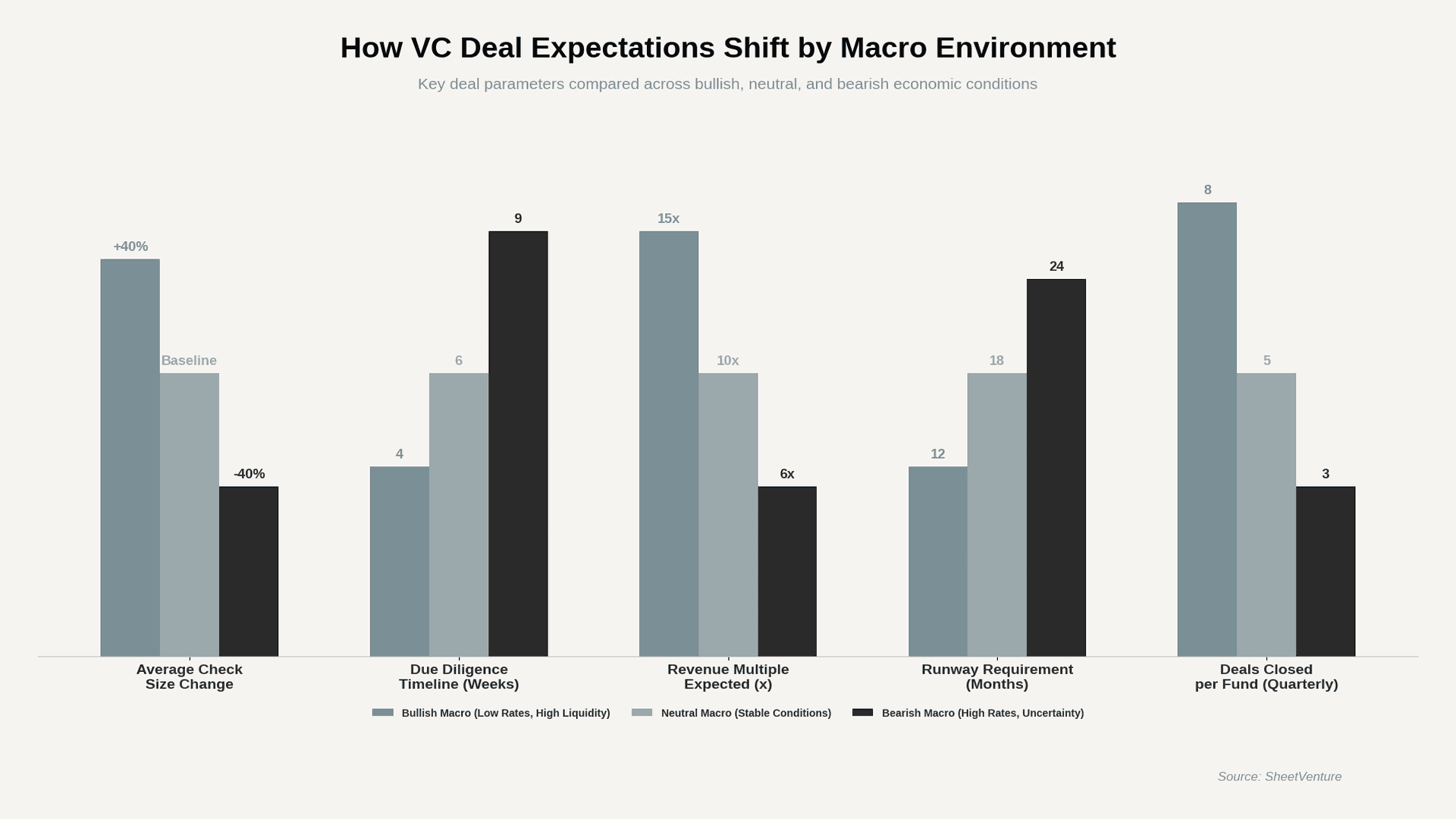
When macro signals turn bearish, investor behavior shifts across five dimensions.
• Check sizes shrink: Average seed checks drop 30 to 50% as funds conserve dry powder for follow-ons and bridge rounds within existing portfolios.
• Due diligence lengthens: Timelines stretch from 4 weeks to 8 or 9 weeks. Investors add extra reference calls, deeper financial modeling, and scenario planning.
• Revenue multiples compress: A startup commanding a 15x revenue multiple in a bull market might receive 6 to 8x in a downturn, even with identical growth metrics.
• Runway requirements increase: VCs expect 18 to 24 months of runway post-close rather than 12, ensuring startups survive without needing to raise in an unfavorable environment.
• Deal velocity slows: Funds close 3 to 4 deals per quarter instead of 7 to 8. Partners take more time in internal review and commit capital more cautiously.
Understanding VC market timing helps founders anticipate these shifts before they show up in term sheets.
How Do Investor Expectations Differ by Macro Environment?
The table below shows how key deal parameters shift across three macro conditions.
Deal Parameter | Bullish | Neutral | Bearish | Key Driver | Founder Action |
Avg. Check Size | +40% above baseline | Baseline | -30 to 50% | Risk-free rate, LP pressure | Raise more in bull windows |
Due Diligence | 3 to 4 weeks | 5 to 6 weeks | 8 to 10 weeks | Exit uncertainty, portfolio risk | Prepare materials early |
Revenue Multiple | 12 to 18x | 8 to 12x | 5 to 8x | Public comps, IPO market | Anchor to realistic comps |
Runway Expected | 12 months | 15 to 18 months | 20 to 24 months | Follow-on risk, bridge avoidance | Model conservative burn |
Deals per Fund/Qtr | 7 to 8 | 4 to 5 | 2 to 3 | Capital preservation, selectivity | Target funds with dry powder |
What Signals Tell Founders the Macro Environment Is Shifting?
Founders can read the same signals investors track to anticipate changes before they hit term sheets.
• Rate announcements: Fed rate decisions move markets within 48 hours. Two consecutive hikes typically trigger a visible VC pullback within one quarter.
• IPO pipeline: When major tech IPOs get delayed or pulled, VCs tighten new investments because exit timelines stretch.
• Layoff cycles: Broad tech layoffs signal that growth-stage companies are cutting burn, which cascades into earlier-stage caution.
• Fund announcements: When top-tier funds publicly report smaller new fund sizes or longer fundraising periods, capital supply is contracting.
Founders who track macro signals can adjust their fundraising strategy and outreach timing before the window narrows.
How Should Founders Adjust Their Approach During Macro Uncertainty?
• Raise ahead of downturns: If macro signals point to tightening within 6 months, start your raise immediately. Capital availability drops faster than most founders expect.
• Lead with capital efficiency: In bearish environments, show investors burn ratios, unit economics, and a clear path to break-even. Growth at all costs loses appeal.
• Extend your raise target: Add 20 to 30% to your planned raise amount so you carry enough runway to survive the next 18 to 24 months without needing to return to market.
• Target active deployers: Not all funds slow equally. Use a venture capital database to identify funds that are still actively writing checks in the current cycle.
The Bottom Line
Macroeconomic signals reshape every dimension of VC decision-making. Interest rates, GDP, inflation, and public market performance determine check sizes, due diligence depth, valuation multiples, and deployment speed. Founders who monitor the same signals investors watch can time raises strategically, set realistic expectations, and target funds still actively deploying capital.
Ready to find investors who are actively deploying in the current macro environment?
SheetVenture helps founders track which investors are actively deploying capital across macro cycles, so your outreach targets funds with real allocation capacity, not frozen pipelines.
Last Update:
Everything you need to understand private markets
Understand your market in real-time.
Filter by stage, sector, and exact geography.
Access 30,000+ verified, daily-updated active