Most investors mentally halve your claims before analysis begins. Learn the five automatic discount filters applied to every founder pitch and exactly how to get below them.
Investors mentally discount founder claims through five automatic filters: market size claims get reduced by 60 to 80%, competitive landscape assessments get discounted entirely, revenue projections get halved before analysis begins, customer traction claims get weighted by whether the investor can verify them independently, and team capability claims get held against the specific execution challenge rather than general credentials.
Discounting is not cynicism. It is pattern recognition built from hearing the same inflated claims repeated across thousands of pitches.
Why Investors Discount Claims Before You Finish the Sentence
Every investor has heard the same pitch multiple times. "$1 trillion market opportunity." "No real competitors." "Conservative projections show $50M revenue by year three." Each claim arrives pre-discounted because the base rate of accuracy on founder pitch claims is low enough that skepticism is the rational default position.
Understanding how investors validate market size claims reveals exactly what verification process runs in the background while founders are still presenting the slide.
What Investors Discount and By How Much
Market size: Top-down TAM figures get discounted 60 to 80% automatically. Investors apply a serviceable addressable market filter in their head while the founder is still describing the total market. A founder who presents $500M SOM with clear acquisition logic gets more credit than one presenting a $50B TAM with no path to capture.
Competitive landscape: "We have no direct competitors" triggers immediate skepticism. Investors interpret this as either poor research or deliberate omission. Both reduce credibility on every subsequent claim in the pitch.
Revenue projections: Three-year projections get halved before analysis begins regardless of the model behind them. Investors add their own failure rate assumption automatically. The founder who explains the assumptions explicitly rather than defending the number recovers credibility the projection itself cannot earn.
Customer traction: Claims about customer interest, pilots, and LOIs get weighted entirely by verifiability. Named customers with referenceable contacts carry full weight. "Strong pipeline" with no specifics carries near zero weight.
Team capability: Impressive credentials get discounted against the specific execution challenge. A founder with a McKinsey background pitching a blue-collar logistics startup gets less team credit than a founder with direct industry experience and no brand name employer on the resume.
How Founders Can Reverse the Discount
The goal is not to eliminate discounting. It is to present claims in formats that survive the discount filter with enough residual credibility to sustain conviction.
Replace TAM slides with bottoms-up acquisition math: Show how you get to 1,000 customers before showing what the total market contains. Bottoms-up logic is harder to discount because it requires engaging with the assumptions rather than applying a blanket reduction.
Name competitors directly before the investor doe: Founders who acknowledge competition and explain differentiation clearly signal market awareness that pre-empts the credibility damage of appearing to deny competition exists.
Anchor projections to current actuals: A projection that starts from this month's revenue and explains each growth assumption is harder to halve than a hockey stick that starts from zero.
Make traction claims immediately verifiable: Customer names, LinkedIn profiles of decision-makers who signed LOIs, and referenceable contacts transform claims from assertions into evidence before the investor has left the room.
Learn what behaviors signal strong founders during fundraising conversations and how the specific way claims are framed changes whether investors apply the discount filter at all.
How Deeply Investors Discount Each Claim Type
Claim Type | Automatic Discount Applied | What Survives the Filter | What Eliminates the Discount |
|---|---|---|---|
Total addressable market | 60 to 80% reduction | Bottoms-up SOM logic | Acquisition math with named channels |
Competitive landscape | Full skepticism if "no competitors" stated | Named competitors with clear differentiation | Acknowledging competition before investor asks |
Year 3 revenue projections | 50% reduction before analysis | Current month actuals as anchor | Assumption-by-assumption explanation |
Customer traction claims | Weighted by verifiability | Named referenceable customers | Offer to connect investor with customer in room |
Team capability | Discounted against execution challenge | Direct domain experience | Evidence of having solved adjacent problem before |
Fundraising interest claims | Verified against network immediately | Named firms at specific stages | Accurate stage description with timeline |
The pattern: Every claim that can be independently verified before the meeting ends gets discounted less than every claim that requires the investor to take the founder's word for it.
How Much Investors Discount Each Claim Type
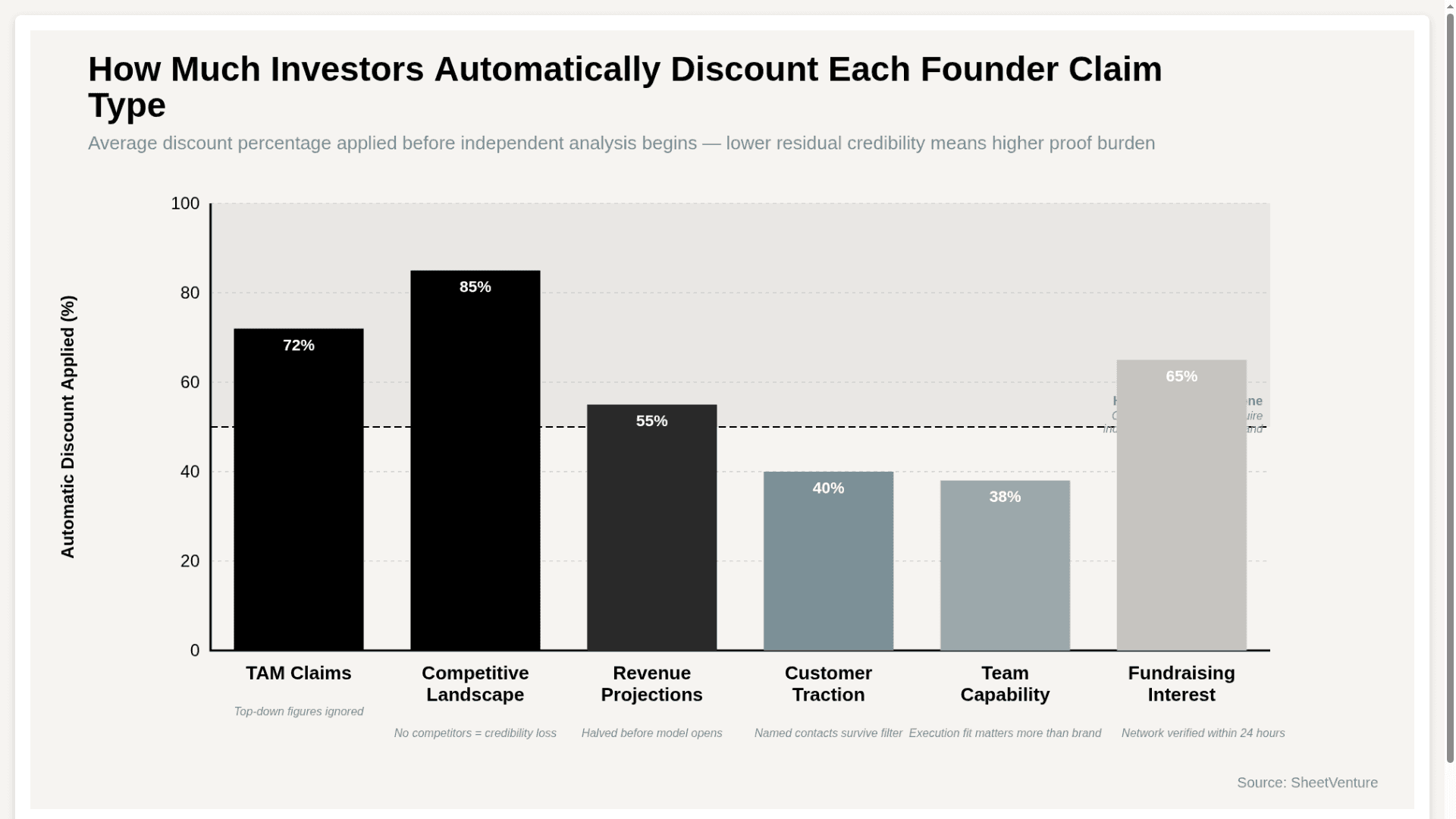
Competitive landscape and TAM claims sit highest in the discount zone, confirming that the two slides founders spend the most time building receive the least credible reception. Customer traction and team capability survive the filter most reliably because both can be partially verified before the meeting ends.
What Investors Are Actually Listening For
Founders who understand the discount filter stop trying to make claims more persuasive and start making them more verifiable. The investor is not looking for confidence. They are looking for evidence that confidence is justified.
The founder who says "our churn is 4%, here is the cohort data" is presenting a claim that cannot be discounted
The founder who says "customers love the product" is presenting a claim that gets discounted to zero before the sentence ends
Access SheetVenture's database to identify investors who have funded companies with similar traction profiles so the claims being made land with investors whose discount filters have already been calibrated to recognize that type of evidence as credible.
The Bottom Line
Investors discount 60 to 80% of TAM claims, 50% of revenue projections, and nearly all competitive landscape assessments before independent analysis begins. The claims that survive the filter are the ones that can be verified before the meeting ends.
Founders who replace assertions with evidence, acknowledge competition before being asked, and anchor projections to current actuals consistently present below the discount threshold that kills most pitches in the first ten minutes.
SheetVenture helps founders identify which investors have funded companies with similar proof points so every pitch lands with an investor whose credibility threshold the evidence can actually clear.
Last Update:
Everything you need to understand private markets
Understand your market in real-time.
Filter by stage, sector, and exact geography.
Access 30,000+ verified, daily-updated active