Market validation offsets weak credentials up to a point. Learn four conditions where traction replaces credentials and where the trade-off stops working.
Strong market validation offsets weak founding team credentials across four specific conditions: paying customers reduce team risk by 60 to 70%, inbound demand without outbound effort signals product-market fit that credentials cannot replicate, a referenceable customer base neutralizes background concerns at seed stage, and revenue growth above 20% month-over-month shifts investor attention from who built it to whether the market wants it.
Credentials open doors. Validation keeps them open when credentials were not enough to do it alone.
Why Market Validation and Team Credentials Trade Off
Investors evaluate founding teams because team quality predicts execution probability when no other evidence exists. Market validation replaces that prediction with actual evidence. The stronger the validation, the less the team prediction matters because the market has already answered the question credentials were being used to approximate.
Understanding how investors assess founder market fit explains why the relationship between credentials and validation is a sliding scale rather than a fixed requirement at every stage.
What Market Validation Actually Offsets
No brand name employers: Three paying enterprise customers with referenceable contacts outweigh a Goldman Sachs background for any investor evaluating whether the product solves a real problem.
No prior startup experience: Month-over-month revenue growth above 15% signals execution capability more directly than a previous exit. The founder is already executing.
No domain expertise: Inbound demand without outbound sales effort is the strongest domain validation signal. If customers are finding the product without being sold to, the founder understood the market well enough to build something people seek out.
No technical co-founder: A waitlist of 5,000 with 40% weekly active engagement on an MVP signals demand that justifies hiring the technical depth the team currently lacks.
No prestigious education: Net dollar retention above 110% means existing customers are expanding. Expansion revenue from a weak-credential team is stronger PMF evidence than any degree.
How Much Validation Is Required to Offset Each Credential Gap
Credential Gap | Minimum Validation to Offset at Seed | Strong Offset Signal | Does Not Offset At |
|---|---|---|---|
No prior startup experience | 3 paying customers, any size | 10% MoM revenue growth for 6 months | Series B without experienced operator hire |
No domain expertise | Inbound demand without outbound effort | 20% MoM growth, customer-led expansion | Deep technical regulated markets |
No brand name background | Referenceable enterprise customer | Named logo customer in target segment | Institutional Series A without any signal |
No technical co-founder | Working MVP with active users | 40% weekly active usage on MVP | At scale without CTO hired |
First-time founders, all gaps | $10K MRR with strong retention | $50K MRR growing 15% MoM | Late stage without team upgrade |
The pattern: Each credential gap has a specific validation threshold that moves investor attention away from the gap. Founders who present validation without knowing which gap it offsets consistently undersell the evidence they have.
Where the Offset Stops Working
Market validation offsets credential gaps at seed and pre-seed. The relationship changes at Series A for three reasons:
Scaling requires credentials: Investors funding the transition to go-to-market scale evaluate whether the team can hire and retain the talent required at the next order of magnitude. Validation proves the product. It does not prove the team can build the company around it.
Board and LP scrutiny increases: Series A investors answer to LPs who apply institutional pattern matching to founding team composition regardless of traction.
Competitive response requires domain depth: A competitor with stronger credentials and equal validation will attract better talent and better subsequent investors.
Learn what investors look for in a founding team and how the team evaluation framework shifts between seed and growth stage in ways that change which gaps market validation can and cannot close.
How Much Each Validation Signal Offsets Team Credential Gaps
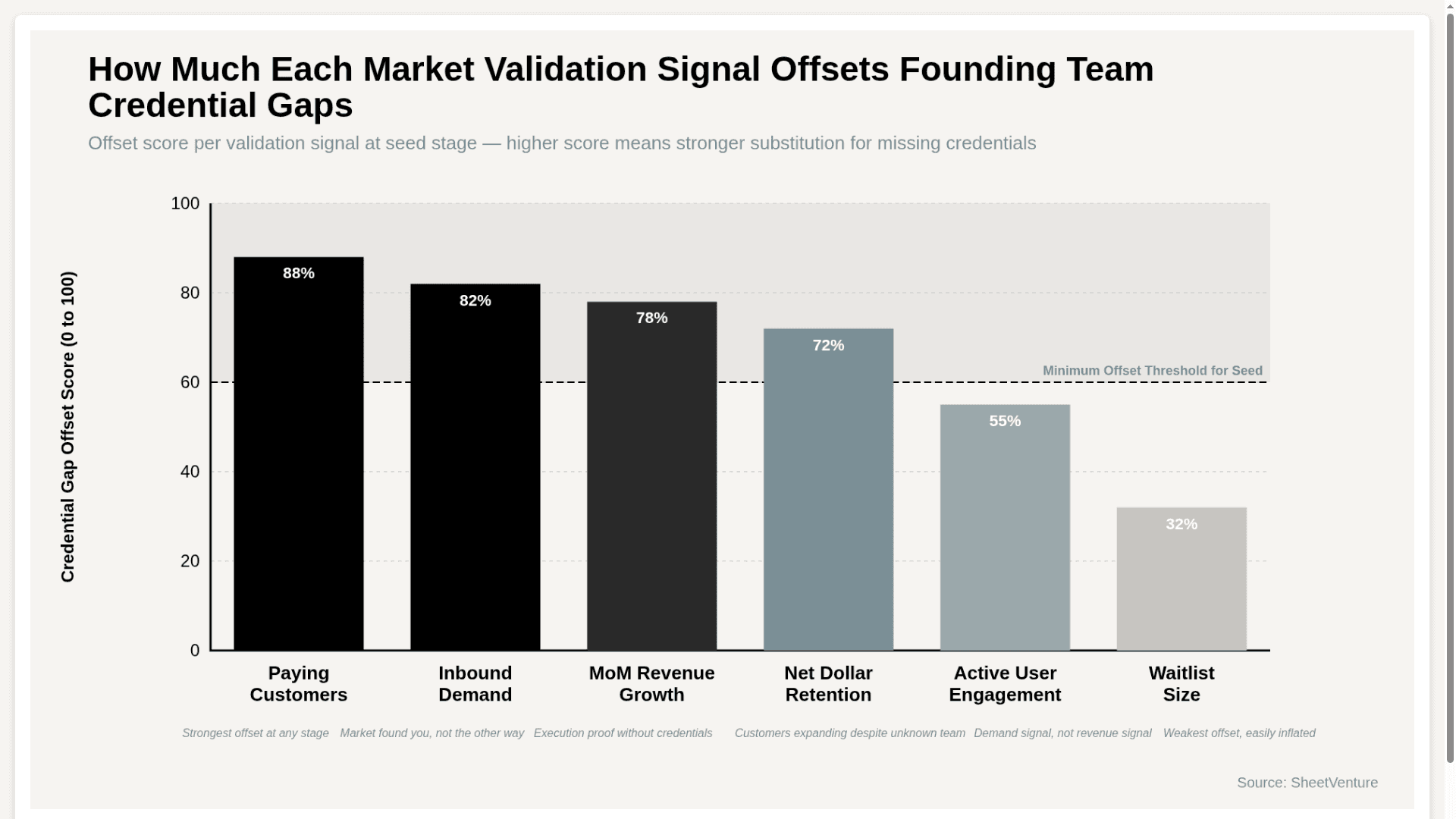
Paying customers and inbound demand sit highest in the effective offset zone, confirming that signals most directly controlled by the founder carry more credential-offsetting power than any metric requiring interpretation before it lands.
How Founders With Credential Gaps Should Frame the Pitch
Open with customer evidence before the team slide so investors evaluate the market signal before forming a credential-based prior
Name customers before naming team members. Sequence shapes which lens the investor applies to everything that follows
When the team slide arrives, acknowledge the gap directly and name the specific hire that closes it
Use investor intelligence to identify which investors have funded weak-credential teams with strong validation signals so the pitch lands with investors whose pattern recognition already includes this profile as fundable.
The Bottom Line
Strong market validation offsets weak founding team credentials at seed stage when paying customers, inbound demand, or consistent revenue growth provide direct evidence that the team already executed what credentials were being used to predict. The offset weakens at Series A when scaling requirements and competitive response create execution challenges that validation alone cannot answer.
SheetVenture helps founders identify investors who have backed credential-light teams on validation strength so every pitch targets a firm whose history confirms the evidence being presented is enough.
Last Update:
Everything you need to understand private markets
Understand your market in real-time.
Filter by stage, sector, and exact geography.
Access 30,000+ verified, daily-updated active
