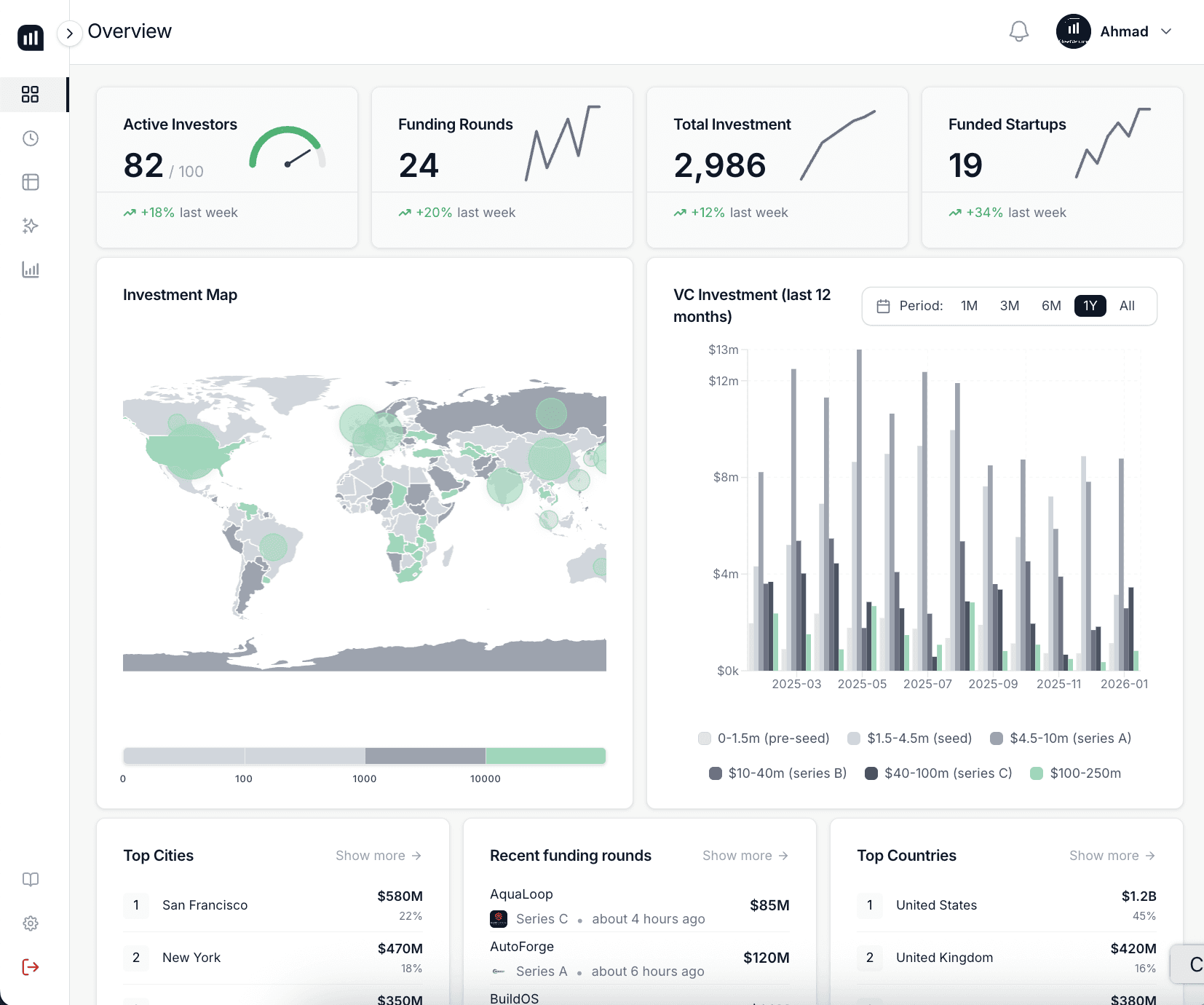
Real-time investor tracking reveals who's deploying capital now. Static databases leave founders chasing investors who stopped writing checks months ago.
Real-time investor tracking shows live fund activity, recent deals, and current deployment status. Static databases show historical snapshots that are often months or years behind. For founders in active fundraising, that gap can mean the difference between reaching the right investor at the right moment or burning weeks on outreach that was never going to work.
What Does Real-Time Investor Tracking Actually Show?
Real-time tracking pulls live signals from multiple sources, including deal announcements, LP filings, portfolio updates, founder interviews, and fund close data. The result is a picture of who is actively deploying capital right now, not who was deploying it 18 months ago. It also tells you which partners at a firm are most active, which can matter just as much as the firm itself.
What real-time tracking captures:
• Recent investments made in the last 30 to 90 days.
• Fund deployment stage: early deployment vs. nearly fully allocated.
• Partner-level focus areas based on current portfolio additions.
• Stage and sector shifts signaled by recent deal patterns.
• New fund closes and fresh dry powder availability.
This is the data that changes how you write your outreach. An investor who led three fintech seed rounds in Q4 last year is far more likely to respond to a fintech seed pitch than one whose last recorded deal was in 2022. Before you build your outreach list, it helps to know active investor actually means in practice.
Where Static Database Queries Fall Short
A static database is a snapshot. Someone built it, populated it with data, and it started aging the moment they pressed save.
Common problems with static investor data:
• Investors listed as seed-stage who have since moved to Series A only.
• Partners listed at firms they left 12 to 24 months ago.
• Email addresses that bounce because job changes went untracked.
• Fund status shows active when the fund is fully deployed.
• Thesis descriptions that predate a major strategy pivot.
The bigger problem is that founders often don't know the data is stale. They built a 200-investor list from a static source, spent four weeks on outreach, and got a 0.8% response rate, blaming their pitch when the real issue was the list. One study found that roughly 30 to 40% of investor profiles in legacy databases contain at least one critical accuracy problem: wrong stage focus, wrong fund status, or wrong contact.
Real-Time vs. Static: Key Differences at a Glance
Feature | Real-Time Tracking | Static Database Query |
Data freshness | Updated daily or weekly | Updated quarterly or annually |
Active fund status | Live deployment tracking | Historical status only |
Partner-level activity | Based on recent deal patterns | Based on profile submissions |
Stage/thesis shifts | Captured within weeks | Often missed entirely |
Avg. outreach response | 3x to 5x improvement over static | Baseline 1-3% |
Ghost investor rate | Under 10% | 25 to 40% |
Source | SheetVenture | SheetVenture |
Why This Gap Matters More During Active Fundraising
When you're fundraising, time is the one resource you can't recover. Every week spent on outreach to inactive investors is a week not spent building relationships with the ones who are actually writing checks.
Real-time data lets you sequence your outreach intelligently:
• Prioritize investors who closed a new fund in the last 12 months.
• Target investors who just backed a company in your adjacent market.
• Avoid investors who are mid-portfolio review or sitting between funds.
• Spot thesis momentum before it becomes common knowledge.
To understand what signals confirm an investor is in active deployment, see our guide on how to know if a VC is actively investing this year.
Founders using SheetVenture's investor intelligence consistently report shorter fundraising timelines. When you start every outreach sequence with live data, you're not recycling lists; you're reaching people who are actually in market.
How to Tell If Your Investor Data Is Real-Time or Static
Before building your outreach list, ask these questions about your data source:
• When was this investor's last recorded deal?
• Is the fund stage based on LP filings or self-reported profile data?
• How frequently is this database updated?
• Does it show individual partner activity or just firm-level data?
If the answer to most of those is unclear or annual, you're working with a static source. Check SheetVenture's investor intelligence to see what live deployment data looks like in practice.
For a practical breakdown of how to source investors during an active raise, the guide on how to find active VCs covers the sourcing process step by step.
The Bottom Line
Real-time tracking and static database queries are not the same tool. One shows where the money is moving. The other shows where it was. For founders mid-raise, that distinction isn't technical; it's the difference between a productive fundraising sprint and months of dead-end outreach.
SheetVenture helps founders access live investor deployment data so every outreach decision is built on who's actually writing checks right now, not who wrote them two years ago.
Last Update:
Everything you need to understand private markets
Understand your market in real-time.
Filter by stage, sector, and exact geography.
Access 30,000+ verified, daily-updated active