Investors requesting above 1x liquidation preference signal weak confidence in your startup. Here is when to push back.
In most cases, no. A liquidation preference above 1x costs founders millions in realistic exit scenarios, signals investor doubt, and creates problems for future fundraising rounds.
Only 7-15% of venture deals in 2024 carried above-1x preferences. The standard remains 1x non-participating preferred, used in roughly 85-93% of all priced rounds. Accepting a higher multiple rarely makes strategic sense unless the alternative is shutting down.
Liquidation preference determines who gets paid first and how much when your company exits. At 1x, the investor recovers their investment before common shareholders split the rest. At 2x or 3x, that guaranteed payout doubles or triples, directly reducing what founders and employees take home.
Why Above 1x Destroys Founder Economics
The damage concentrates in moderate exits, which represent the majority of venture-backed outcomes. Consider a $10M investment at $50M post-money (20% ownership). Here is what founders actually receive:
• At a $50M exit with 1x preference, founders take home $40M.
• At a $50M exit with 2x preference, founders take home $30M.
• At a $50M exit with 3x preference, founders take home $20M.
• The conversion point where 2x becomes irrelevant is $100M, double the threshold for standard 1x.
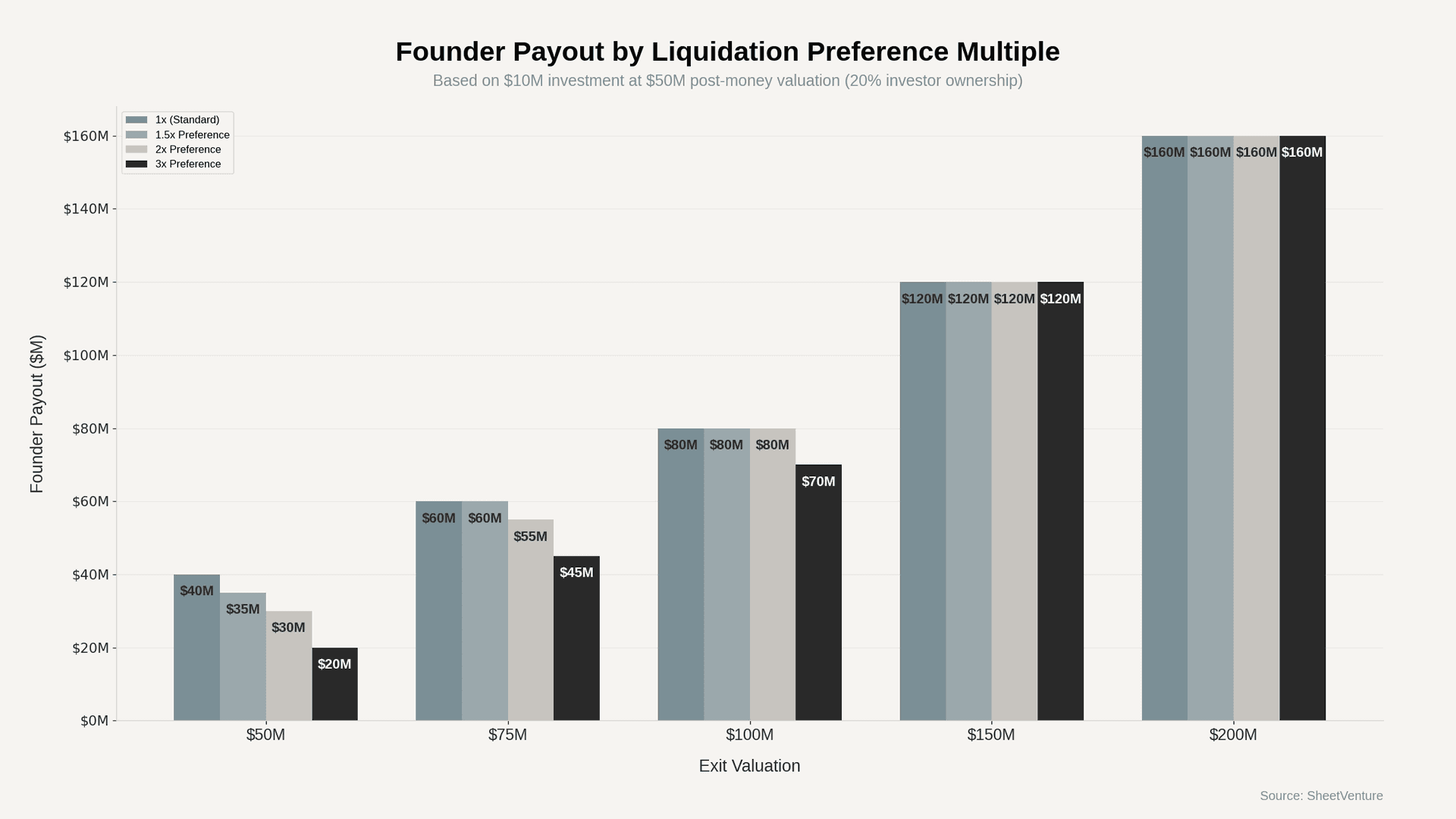
Every dollar added to the preference stack comes directly from founder and employee payouts. The math gets worse when multiple rounds carry elevated preferences. A company with $5M Series A at 1x, $15M Series B at 1.5x, and $30M Series C at 2x creates a total preference stack of $87.5M. At a $100M exit, common shareholders split just $12.5M. Understanding investor red flags like these helps founders avoid cap table damage before it happens.
When Investors Request Above 1x
Above-1x preferences cluster in specific situations:
• Down rounds where the new valuation falls below the previous round.
• Bridge financing when the runway drops below six months.
• Late-stage structured deals with growth equity investors.
• Inside rounds led by existing investors without outside participation.
• Distressed fundraising where the company has limited alternatives.
Each scenario signals something different. A growth equity fund requesting 1.5x at Series C follows different logic than a seed investor demanding 2x. The seed request should concern you more because it reveals fundamental doubt about your upside potential. Research early-stage valuation dynamics before entering any negotiation around preferences.
What to Negotiate Instead
Founders have at least five strong alternatives that address investor concerns without the blunt damage of higher multiples:
• Participation caps that limit total investor return to 3-5x before converting to common.
• Sunset provisions that reduce the multiple annually (2x dropping to 1x over four years).
• Lower valuation with clean 1x terms, which often produces better founder outcomes than a higher headline number with aggressive structure.
• Milestone-based reductions tied to revenue or growth targets.
• Management carve-outs reserving 5-15% of exit proceeds for the team before the waterfall kicks in.
The strongest approach: identify what the investor actually worries about and propose a targeted fix. Downside protection concerns respond well to participation caps. Time-value concerns respond to cumulative dividends. Risk concerns respond to milestone triggers. Review how equity decisions compound across rounds before accepting any non-standard terms.
The Red Line Most Founders Miss
The combination of above-1x preference plus participating preferred is the most founder-destructive structure in venture capital. Participating preferred means the investor collects their preference and then shares pro rata in the remaining proceeds. At 2x participating on a $10M investment, the investor takes $20M off the top and then 20% of the remaining $30M at a $50M exit. Founders receive $24M instead of $40M.
This structure appeared in 15-25% of late-stage deals during 2023-2024. Recognizing it requires reading every line of the term sheet, not just the valuation number. Use SheetVenture's market intelligence to compare term sheet structures across active investors before you negotiate.
The Bottom Line
Accepting above-1x liquidation preference should be a last resort, not a negotiation starting point. The standard is 1x non-participating, and 85-93% of deals in 2024 held that line. Every multiple above 1x directly reduces founder payout at the exit scenarios most companies actually reach.
Negotiate alternatives. Model the waterfall. Know your walk-away point. If an investor insists on 2x or higher and refuses a creative structure, that tells you something about their confidence in your business. The best term sheet protects both sides. Above-1x preferences protect only one.
SheetVenture helps founders compare investor term patterns across thousands of active funds so every negotiation starts with data, not guesswork.
Last Update:
Everything you need to understand private markets
Understand your market in real-time.
Filter by stage, sector, and exact geography.
Access 30,000+ verified, daily-updated active