Accepting funding from outside your industry can work. Here is exactly when it helps and when it backfires.
Yes, you can accept funding from an investor outside your industry, and many successful startups have. The decision comes down to three things: whether their thesis still fits your model, what they bring beyond capital, and whether they will trust your domain expertise rather than second-guess it.
Cross-industry investors fund startups outside their core specialization far more often than founders realize. A fintech VC backing a digital health company is not unusual when the underlying problem involves payments, data, or consumer behavior; they already understand. What matters is whether they grasp your business mechanics, not whether they have a portfolio full of direct sector peers.
The common fear is about missing introductions. Founders worry that a cross-industry investor cannot open the right doors. But a well-connected generalist often outperforms a sector specialist who is spread thin across thirty similar bets. The real question is not whether they know your industry, but whether they know what you need to reach the next stage.
What Cross-Industry Investors Actually Bring
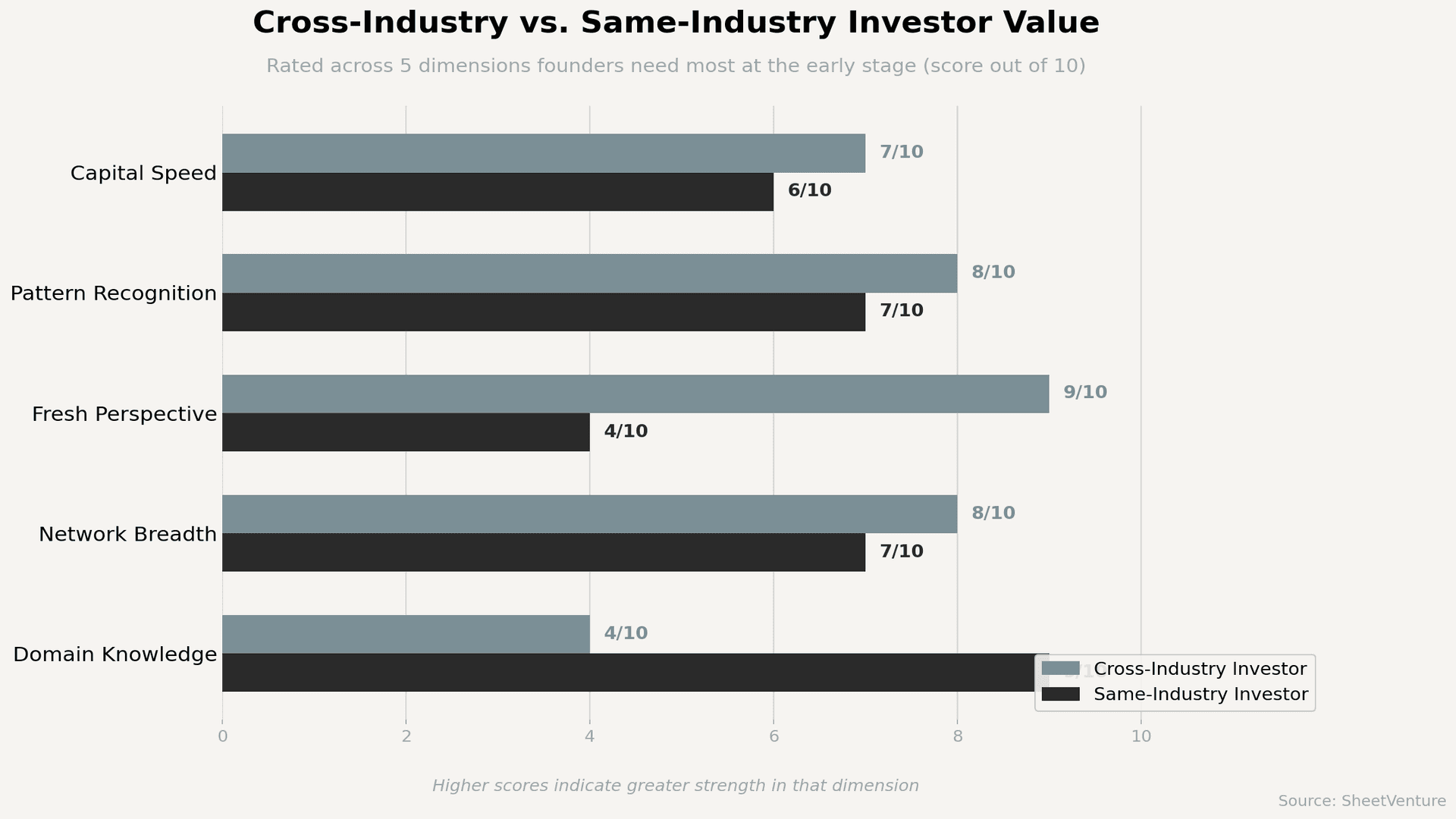
Founders often assume sector knowledge is the most valuable thing an investor contributes. At the early stage, it rarely is. What tends to matter more:
• Pattern recognition across business models. An investor who has seen fifty SaaS companies scale knows when your churn numbers are a product problem versus a sales problem, regardless of vertical.
• Unbiased perspective. Sector insiders carry assumptions. A cross-industry investor is more likely to question why your market works the way it does, which is exactly the pressure founders need before they hit a growth ceiling.
• Broader networks in unexpected places. The VC who backed three logistics companies might introduce you to a distribution partner your industry-specialist investor would never consider.
• Faster capital deployment. Investors who recognize the business model do not need months of sector education before writing a check.
Understanding how an investor thesis fits your situation is worth exploring before you decide.
When Cross-Industry Funding Works
These are the conditions where accepting this type of funding makes sense:
• The investor has backed adjacent markets before. A consumer VC backing a B2B startup is a stretch. A B2B SaaS investor entering a new vertical SaaS market is not.
• They are investing based on team and model, not sector thesis. If their excitement is about how you acquire customers or how unit economics scale, that enthusiasm will hold when domain-specific questions come up.
• Their portfolio adds indirect value. A healthtech investor in a fintech company might seem like a mismatch, but if their portfolio includes enterprise buyers who would purchase your product, the friction is worth absorbing.
• They defer to you on domain judgment. The investor who says, "You know this market better than I do, help me understand," is a far better partner than one who lectures you about a space they just entered.
When to Pause Before Accepting
Not every cross-industry check is worth cashing. These patterns suggest the relationship could become difficult:
• They need constant sector education. If you spend board meetings teaching basics, that time is gone from running the company.
• Their terms assume more risk than the deal justifies. Investors who do not understand your market sometimes price in uncertainty that does not exist, leading to unfavorable valuations or control provisions.
• Their network offers nothing relevant to your stage. Capital alone from a disengaged investor means one fewer advisor slot for someone who could actually move the needle.
• They question things your space treats as settled. That skepticism is not due diligence. It is a signal they have not done their homework.
Before you accept or reject any check, invest time in VC research. What sector did they come from? What do portfolio companies say about the relationship post-investment? These answers matter more than whether the fund name includes your industry's buzzwords.
You should also understand how investors assess founder market fit, because a cross-industry investor evaluating you will weigh your domain credibility even more heavily than a sector specialist would.
Use SheetVenture to filter investors by actual portfolio behavior, not just their stated thesis. Cross-referencing past investments reveals whether a specific VC stretches sectors comfortably or consistently struggles outside their lane.
Questions to Ask Before You Sign
Four questions that cut through the noise:
• What draws you to this space specifically right now?
• Which of your portfolio companies would be natural collaborators for us?
• How do you typically engage when you are outside your primary sector?
• What metrics will you track us on, and who on your team will lead this relationship?
The answers tell you whether the cross-industry dynamic will be productive tension or a slow drain on your bandwidth.
The Bottom Line
Accepting funding from an investor outside your industry is not a red flag. It is a trade-off. You give up some sector-specific network depth and gain capital, cross-domain pattern recognition, and a perspective that can prevent the groupthink that stalls startups in competitive verticals.
The deal is worth taking when the investor understands your model, respects your expertise, and brings something beyond a wire transfer. It is worth passing when their involvement would cost more in time and misalignment than their capital is worth.
SheetVenture helps founders identify which investors have the portfolio track record and behavioral signals that make cross-industry funding a genuine asset rather than a costly distraction.
Last Update:
Everything you need to understand private markets
Understand your market in real-time.
Filter by stage, sector, and exact geography.
Access 30,000+ verified, daily-updated active
