Mega seeds buy runway, Series A buys growth. Five factors decide which round actually fits your startup stage.
The choice comes down to revenue maturity, dilution tolerance, and investor thesis fit. Founders with $1M+ ARR and proven unit economics usually fit Series A. Those still refining product-market fit benefit from mega seed rounds that fund 18 to 24 months without Series A-level expectations.
The line between mega seed and Series A has blurred since 2022. Mega seeds now stretch from $5M to $15M, overlapping with what used to be a standard Series A check. The round a founder takes is less about the label and more about what the capital actually buys and what investors expect in return.
Choosing wrong costs more than cash. Take a Series A too early, and you miss the milestones that trigger the next round. Take a mega seed too late, and you cap the valuation ceiling for Series B. The right choice aligns capital structure with the stage you can actually defend.
What Each Round Looks Like In 2026
Mega seed rounds now include:
• Check sizes of $5M to $15M
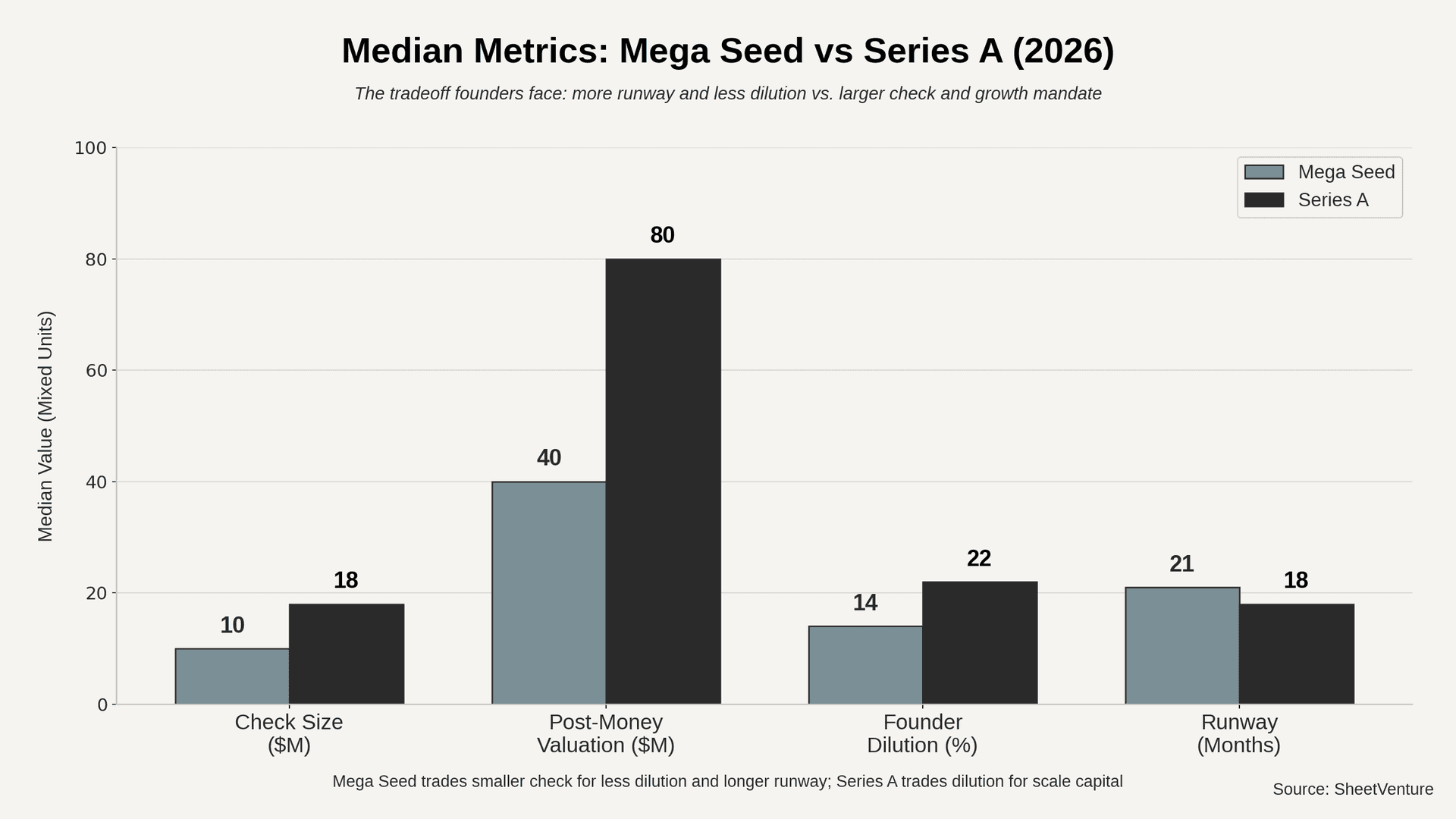
• Valuations between $25M and $60M post-money
• Dilution typically 10% to 18%
• Led by seed specialists or multi-stage funds
• Runway expectations of 18 to 24 months
Series A today means:
• Check sizes of $10M to $25M
• Valuations between $50M and $120M post-money
• Dilution typically 18% to 25%
• Led by institutional partners taking board seats
• Growth expectations: triple revenue within 18 months
Five Factors That Decide Your Round
Revenue Maturity
• Series A investors expect $1M+ ARR with predictable month-over-month growth
• Mega seed investors back a strong early signal, not locked revenue
• If revenue is inconsistent quarter to quarter, raise a mega seed
Dilution Math
• Mega seeds dilute 10% to 18%; Series A dilutes 18% to 25%
• A $10M mega seed at $50M post leaves more room than a $15M Series A
• Cap table math after this round decides what Series B looks like
Board Composition
• Series A always comes with a board seat and quarterly governance
• Mega seeds often close without formal board control
• If you want independence for 18 more months, Mega Seed protects it
Growth Pressure
• Series A partners expect 3x revenue within 18 months
• Mega seeds expect product-market fit within that same window
• Missing a growth target after Series A damages the Series B story
Investor Access
• Mega seeds often involve multi-stage funds that can follow on
• Series A locks you into one lead's reserves and network
• Check whether your lead has dry powder for the next round
Reference seed check sizes and early valuation signals to stress test your own math before you commit.
When Mega Seed Wins
Raise a mega seed when:
• Product-market fit is close but not conclusive
• You want to avoid board control for one more year
• Revenue is under $1M ARR but growing fast
• You need runway to build, not scale sales
• The cap table cannot absorb 20%+ dilution yet
Use investor intelligence to find mega seed leads actually writing checks this quarter.
When Series A Wins
Choose Series A when:
• ARR sits above $1M with clear retention data
• The next 18 months are about scaling, not inventing
• A repeatable sales motion is ready to expand
• A board partner is needed for executive hires
• Mega seed valuations would crowd your ownership
See how seed vs series timing shapes the runway math and which round protects future optionality.
The Real Cost Of Choosing Wrong
A mistimed round compounds quickly:
• Series A too early: miss growth targets, face a flat Series B
• Mega seed too late: Series A leads skip you
• Wrong investor type: a seed-focused fund cannot lead Series B
Pick by future fit, not current check size.
The Bottom Line
The Series A versus mega seed decision sits at the intersection of revenue, dilution, and fund structure. Founders clear the Series A bar when ARR, retention, and sales mechanics speak for themselves. Everyone else either stretches into a stale round or accepts a mega seed that protects optionality until those signals emerge. The wrong answer does not show up today; it shows up 18 months from now, when the next round either closes fast or stalls.
SheetVenture helps founders identify which fund type is in active deployment at every stage, so outreach strategy matches both timeline reality and capital quality.
Last Update:
Everything you need to understand private markets
Understand your market in real-time.
Filter by stage, sector, and exact geography.
Access 30,000+ verified, daily-updated active