Most investor databases decay within months. Discover the five hidden triggers that make your outreach data completely worthless.
Investor databases become unreliable because fund status, partner roles, contact details, and investment theses change faster than static databases can update. Within 12 months, up to 40% of investor records contain outdated information that leads founders to pitch the wrong people at the wrong time.
The core problem is structural. Traditional investor databases collect data at a single point in time and update it on slow editorial cycles. Meanwhile, the venture capital industry moves constantly. Partners leave firms. Funds close. Theses shift. A database that was 95% accurate in January can drop below 60% accuracy by December if it relies on manual updates alone.
Why Do Investor Records Go Stale So Quickly
Venture capital operates on faster cycles than most founders realize.
• GP turnover at mid-tier firms averages 18–22% annually.
• Fund deployment windows typically last 2–3 years before new vehicles launch.
• Investment thesis shifts happen quarterly at many firms, responding to market signals.
• Email contacts become invalid at a rate of roughly 25–30% per year across the industry.
• Portfolio strategy pivots often go unannounced publicly.
These changes compound. A single outdated record wastes one email. Thousands of outdated records waste an entire fundraising cycle. Founders building target VC lists from stale databases end up with outreach strategies built on dead information.
What Types of Investor Data Decay Fastest
Not all database fields degrade at the same rate.
• Contact emails decay at 25–30% per year as partners move between firms.
• Fund deployment status changes for roughly 35–40% of firms annually as funds close or pause.
• Investment thesis shifts affect 20–25% of active firms each year.
• Check size ranges become outdated for 15–20% of funds as new vehicles launch.
• Partner roles change at 18–22% of firms annually through promotions, departures, and lateral moves.
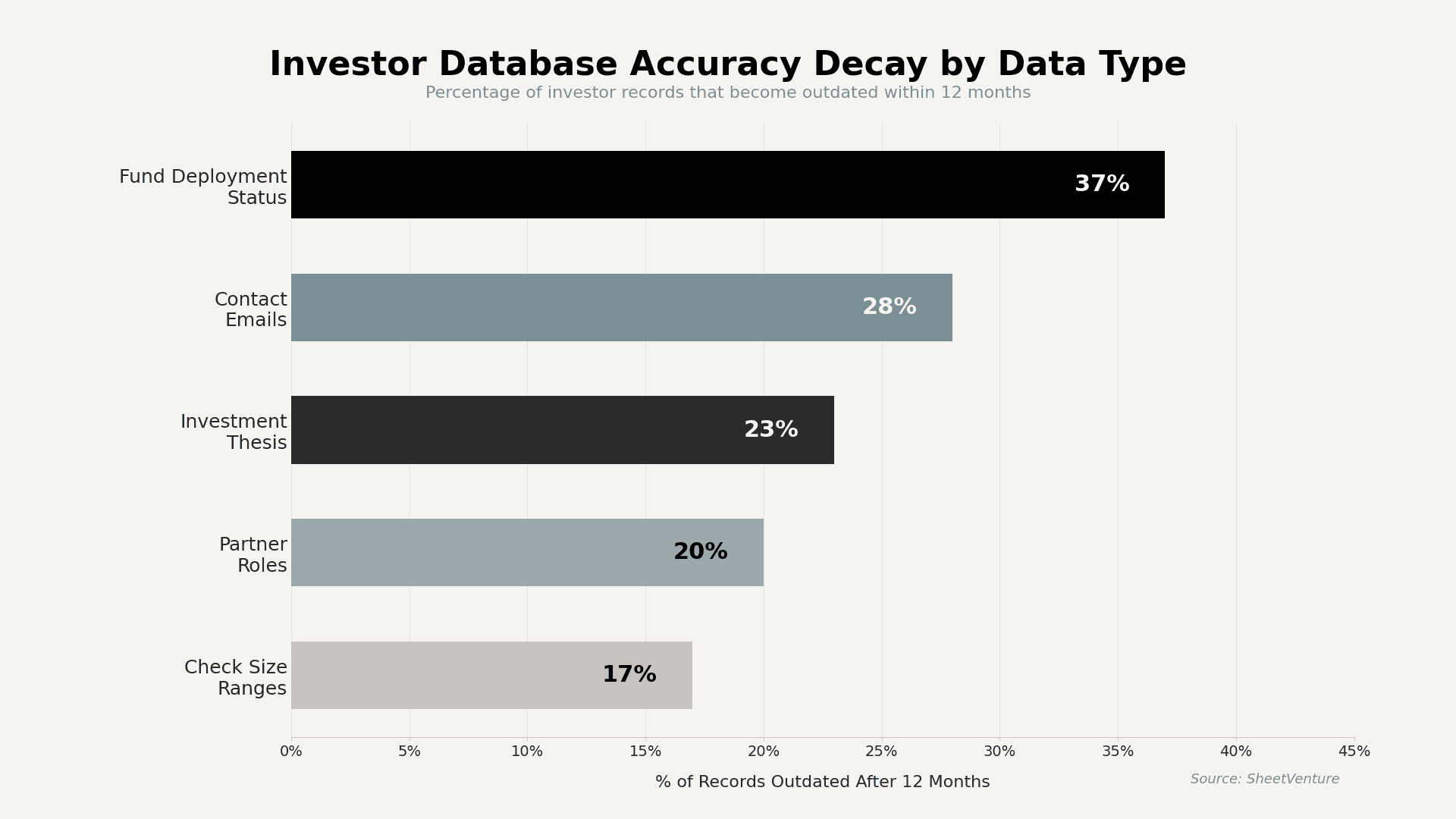
The most damaging decay hits fund status. Founders who pitch a firm that has already deployed its capital waste weeks chasing a dead end. Knowing whether a VC has dry powder matters more than knowing their office address.
How Does Database Decay Affect Fundraising Outcomes
Stale data does not just reduce response rates. It distorts entire fundraising strategies.
• Founders target firms that stopped investing months ago.
• Outreach hits general inboxes instead of decision-making partners.
• Pitch angles reference outdated theses that no longer reflect firm priorities.
• Follow-up sequences go to people who left the firm.
• Time spent on dead leads compresses the window for real conversations.
A founder sending 200 cold emails from a database that is 35% outdated effectively sends 70 emails into a void. That is not a volume problem. That is a data quality problem. Finding active investors now requires data that reflects current deployment activity, not last year’s snapshot.
What Makes Some Databases More Reliable Than Others
The difference comes down to update methodology.
• Static databases rely on annual or semi-annual editorial reviews and decay fastest.
• Community-sourced databases update unevenly because coverage depends on user contributions.
• Transaction-tracking databases stay fresher by monitoring actual deal activity.
• AI-filtered databases cross-reference multiple signals to flag stale records automatically.
Databases that track live deal flow, SEC filings, and public announcements maintain higher accuracy because they verify data against real-world events rather than waiting for manual corrections. SheetVenture uses real-time deal tracking and AI filtering to maintain investor data that reflects current activity, not historical snapshots.
How Can Founders Protect Themselves From Bad Data
Practical steps to avoid building a strategy on unreliable information.
• Verify fund status before outreach by checking recent deal announcements
• Cross-reference partner names against current LinkedIn profiles
• Prioritize databases that show recent transaction activity, not just firm profiles
• Update your investor list monthly, not just at the start of a raise
• Use live intelligence tools that flag stale records automatically
The founders who raise efficiently are not the ones who contact the most investors. They are the ones who contact the right investors with current data.
The Bottom Line
Investor databases decay because the venture capital industry changes faster than static data collection methods can track. Contact details, fund status, partner roles, and investment theses all shift at rates that make annual updates insufficient. Within 12 months, a significant portion of any traditional database becomes unreliable.
The fix is not more data. It is fresher data. Founders who rely on databases with real-time signals and AI-driven filtering avoid the silent cost of pitching dead leads.
SheetVenture helps founders access continuously updated investor intelligence so outreach targets active funds with current deployment capacity, not stale profiles from last year’s data.
Last Update:
Everything you need to understand private markets
Understand your market in real-time.
Filter by stage, sector, and exact geography.
Access 30,000+ verified, daily-updated active
