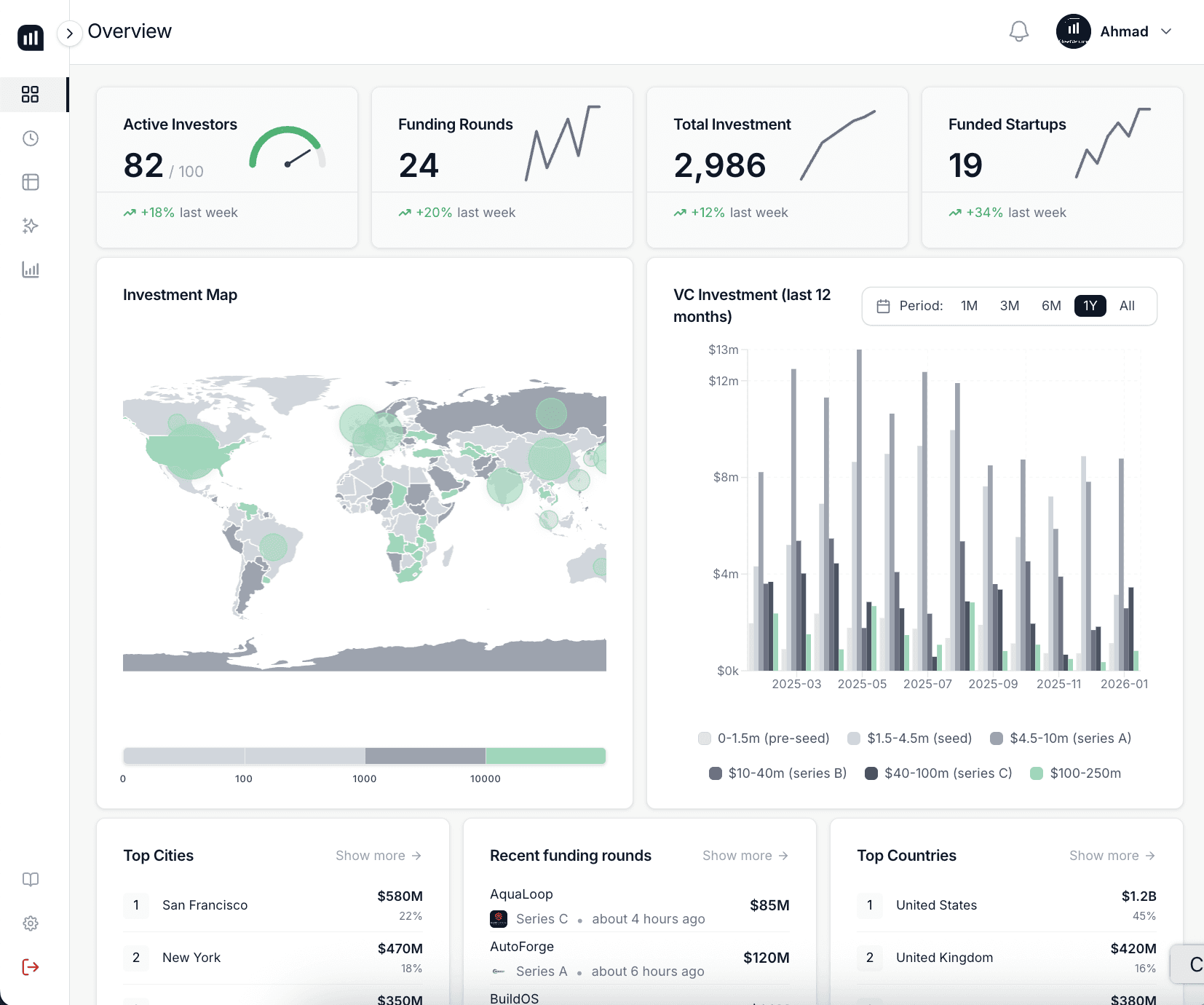
Discover why founders switch from Crunchbase to SheetVenture for active fundraising and how real-time data changes outcomes.
SheetVenture focuses exclusively on active, verified investors with real-time deal tracking, while Crunchbase provides broader company data that includes inactive profiles. For founders in active fundraising mode, SheetVenture delivers filtered, deployment-ready investor lists that Crunchbase’s general-purpose database cannot match.
The gap between these platforms matters most when you are raising capital right now. Crunchbase indexes over 100,000 investor profiles, but an estimated 30 to 40% have not made a new investment in 18 or more months. SheetVenture tracks only investors with verified recent activity, scoring each one by stage fit, sector alignment, and current deployment pace.
Why Do Founders Choose SheetVenture Over Crunchbase for Fundraising
The difference comes down to purpose. Crunchbase was built as a broad market intelligence tool for journalists, researchers, and corporate teams. SheetVenture was built for one thing: helping founders find investors who are writing checks right now.
Key differences that matter during a raise:
• SheetVenture filters by verified deal activity in the last 18 months.
• Crunchbase includes investor profiles regardless of current activity status.
• SheetVenture scores investors by startup fit using stage, sector, and founder profile.
• Crunchbase offers broader company data but limited fundraising-specific filters.
• SheetVenture exports directly to spreadsheets with no CRM lock-in.
• Crunchbase requires higher-tier subscriptions for comparable data exports.
Founders who understand investment thesis alignment see the biggest advantage when using purpose-built tools. Understanding an investor’s thesis before outreach separates productive fundraising from wasted meetings.
How Does Data Freshness Compare Between SheetVenture and Crunchbase
Data freshness is where the platforms diverge most sharply. Stale data costs founders weeks of wasted outreach. The table below shows where each platform stands on the metrics that matter most during a live raise.
Metric | SheetVenture | Crunchbase | Why It Matters |
Activity verification | Real-time AI tracking | Community-sourced updates | Stale profiles waste outreach hours |
Average profile update lag | Under 30 days | 60 to 180 days | Outdated contacts lower response rates |
Inactive investor filtering | Automatic exclusion | Manual filtering required | Saves 5 to 10 hours per raise cycle |
Deal recency window | Last 18 months verified | All time, includes inactive | Confirms capital deployment status |
New fund deployment alerts | Built in, all tiers | Limited, Pro tier only | Catches newly active investors early |
When 30 to 40% of profiles on legacy databases reflect investors who have paused deployment, founders contacting those profiles burn time on dead leads. SheetVenture removes that friction by surfacing only active investors with verified recent deals.
What Features Matter Most for Active Fundraising Campaigns
Not every database feature matters when you are mid-rise. Some shorten your time to the term sheet. Here is how both platforms compare on the five features founders rank most important.
Feature | SheetVenture | Crunchbase | Fundraising Impact |
Stage-specific filtering | AI scored by stage fit | Basic stage tags | Reduces mismatched outreach by ~60% |
Sector alignment scoring | Dynamic weighted scoring | Keyword-based search | Surfaces hidden fit investors others miss |
Investor deployment pace | Tracked and displayed | Not available | Avoids investors between funds entirely |
Spreadsheet export | One click, all tiers | Pro/Enterprise only | Enables fast pipeline building from day one |
Founder profile matching | Built in, automatic | Not available | Personalizes targeting by background and stage |
Knowing whether a VC has dry powder available is one of the most underused signals in founder outreach. SheetVenture tracks deployment pace so founders never waste a cold email on a fund that has already committed its allocation.
When Should Founders Use Crunchbase Instead of SheetVenture
Crunchbase still serves specific use cases well:
• Market research across industries, company sizes, and funding histories.
• Competitive analysis beyond the investor landscape.
• Corporate development and M&A target identification.
• Tracking broad venture ecosystem trends over time.
For general market intelligence, Crunchbase’s breadth is a genuine advantage. For active fundraising where every email needs to reach a real, currently deploying investor, SheetVenture’s focused approach delivers higher conversion.
Use live intelligence tools when fundraising is the priority. Use Crunchbase when broader research is the goal.
The Bottom Line
SheetVenture and Crunchbase serve different purposes at different moments. Crunchbase gives you the venture ecosystem in broad strokes. SheetVenture gives you the investors who are actually writing checks this quarter, scored by how well they match your startup.
For founders in active fundraising mode, the difference between contacting 100 random investors and 30 verified, high-fit investors is the difference between months of silence and a closed round.
SheetVenture helps founders target only verified, active investors, so every outreach email reaches someone who is actually deploying capital in their space.
Last Update:
Everything you need to understand private markets
Understand your market in real-time.
Filter by stage, sector, and exact geography.
Access 30,000+ verified, daily-updated active