Credible traction shows consistent growth, retention, and logical metrics. Learn the six factors VCs use to separate real traction from vanity.
Credible traction shows consistent growth patterns, paying customers over free users, retention proving value delivery, organic acquisition alongside paid, and metrics that reconcile logically.
VCs see inflated numbers constantly, they've developed filters for separating real traction from vanity metrics. Credibility comes from coherence: numbers that tell the same story from multiple angles.
Why Credibility Matters More Than Size
Understanding investor skepticism explains the bar:
What investors know:
Metrics can be gamed or cherry-picked
Early growth often comes from unsustainable sources
Vanity metrics hide fundamental problems
Many founders present best-case interpretations
What credibility proves:
Founder understands their business deeply
Metrics reflect real customer value
Growth comes from repeatable sources
Numbers can be trusted for diligence
For deeper context, understand how investors evaluate customer traction quality.
The Six Credibility Factors
1. Consistent Growth Patterns
Steady beats spiky:
Credible: 15% MoM growth sustained over 6+ months with explainable variations.
Not credible: 100% growth one month, flat the next, with no clear explanation.
Why it matters: Consistent patterns suggest repeatable mechanics, not lucky breaks.
2. Paying Over Free
Revenue validates value:
Credible: 500 paying customers at $200/month with 90% retention.
Not credible: 50,000 free signups with 2% conversion and unknown engagement.
Why it matters: Payment proves customers value the product enough to spend money.
3. Retention Proving Value
Customers stay and expand:
Credible: 95% logo retention, 110% NRR, improving cohort curves.
Not credible: High acquisition but churn eating growth, declining engagement.
Why it matters: Retention proves product-market fit better than acquisition.
4. Organic Alongside Paid
Multiple acquisition sources:
Credible: 40% organic, 35% referral, 25% paid, diversified and trackable.
Not credible: 95% from paid ads with unknown unit economics sustainability.
Why it matters: Organic signals genuine demand beyond paid reach.
Learn how to demonstrate traction that signals fundraising readiness.
5. Logical Metric Reconciliation
Numbers tell coherent story:
Credible: Customer count × ACV = ARR. Growth rate matches cohort additions. CAC × customers ≈ marketing spend.
Not credible: Numbers don't add up when cross-checked. Metrics from different sources conflict.
Why it matters: Internal consistency proves operational grip and honest reporting.
6. Quality Over Quantity
Customer profile strength:
Credible: 20 enterprise logos with expanding contracts and referenceable champions.
Not credible: 200 small accounts with high churn and no case studies.
Why it matters: Strong customers validate market positioning and indicate scalability.
Traction Credibility Framework
[See graph below showing how different traction signals map to credibility levels]
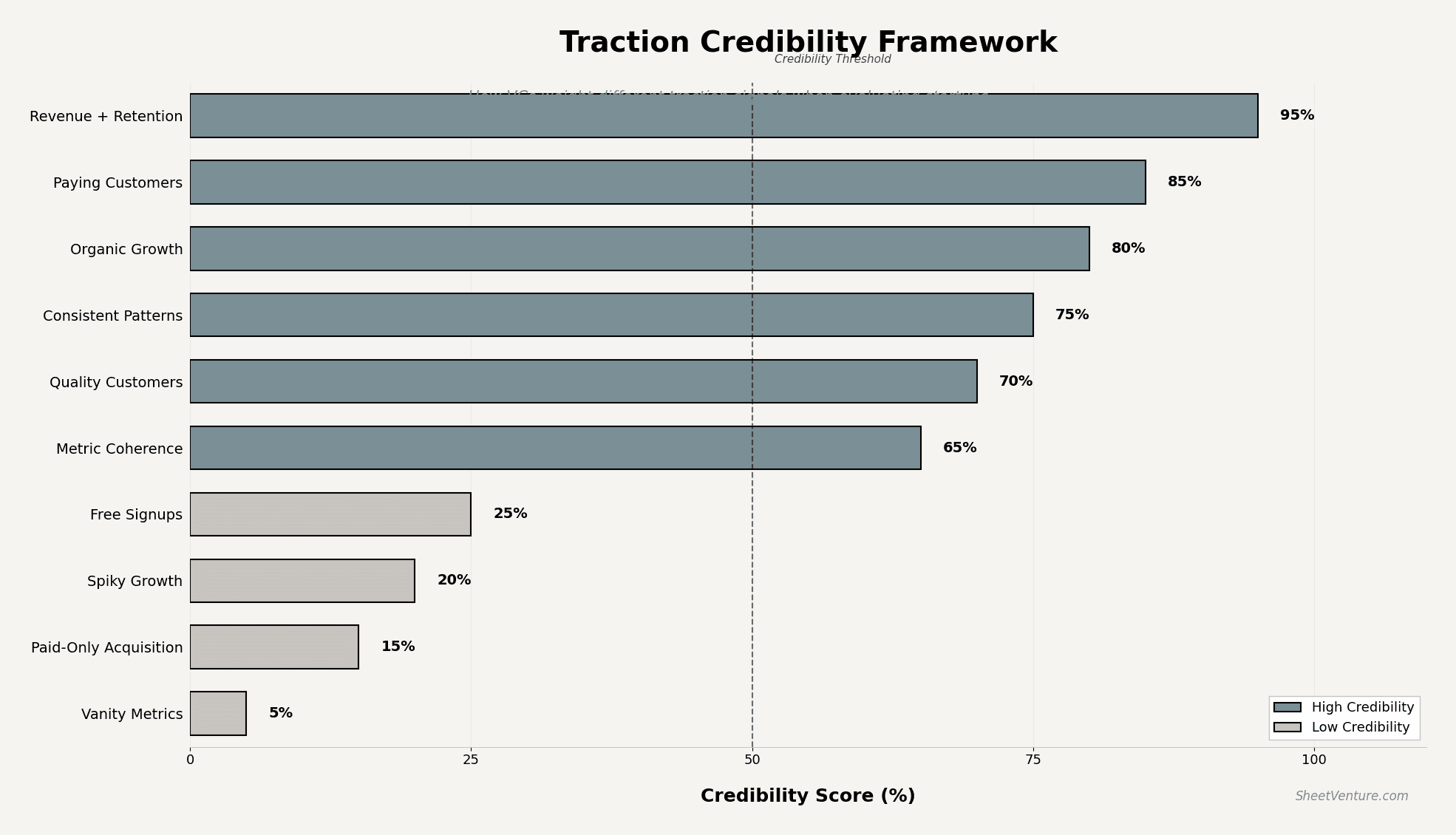
The graph illustrates how VCs weight different traction signals. Revenue with retention scores highest; vanity metrics score lowest regardless of size.
Red Flags That Destroy Credibility
Instant credibility killers:
Metrics that change between conversations
Inability to explain growth drivers
Round numbers suggesting estimates ("about 100 customers")
Defensiveness when asked for breakdowns
Presenting GMV as revenue, signups as users
What happens: One credibility red flag makes investors question everything else.
Check SheetVenture's resources for frameworks on presenting credible metrics.
How to Build Credible Traction Narratives
Before the pitch:
Reconcile all metrics across sources
Prepare cohort-level breakdowns
Know growth drivers specifically
Document methodology for calculations
During the pitch:
Present ranges honestly ("$180-220K MRR")
Acknowledge weaknesses proactively
Show trends, not just snapshots
Offer to share raw data access
The principle: Transparency builds credibility. Spin destroys it.
Questions That Test Credibility
Expect investors to ask:
"Walk me through how you calculated that"
"Show me the cohort breakdown"
"What percentage is organic vs. paid?"
"How has this metric changed quarter over quarter?"
"Can I talk to three customers?"
Use SheetVenture's intelligence to find investors who match your traction stage.
The Bottom Line
Credible traction shows consistent growth, paying customers, strong retention, diversified acquisition, logical metric reconciliation, and quality customer profiles. VCs see inflated numbers constantly, credibility comes from coherence and transparency. Numbers should tell the same story from every angle. One inconsistency makes everything suspect. Present honestly, acknowledge gaps, and let real traction speak for itself.
Credible beats impressive. Every time.
SheetVenture helps founders present credible traction, so your metrics build trust instead of skepticism.
Last Update:
Everything you need to understand private markets
Understand your market in real-time.
Filter by stage, sector, and exact geography.
Access 30,000+ verified, daily-updated active