When investor valuation expectations clash with yours, these five moves help founders close the gap and raise.
Founders should recalibrate their valuation using real market comps, not aspirational math. A gap between your number and what investors are willing to pay usually signals a data problem, a timing problem, or both. Fix the inputs before you fix the ask.
Valuation disagreements derail more rounds than bad decks. When an investor throws out a number 40% below yours, the instinct is to defend your model. That is usually the wrong move. Most of the time, the gap exists because founders and investors are looking at different data sets.
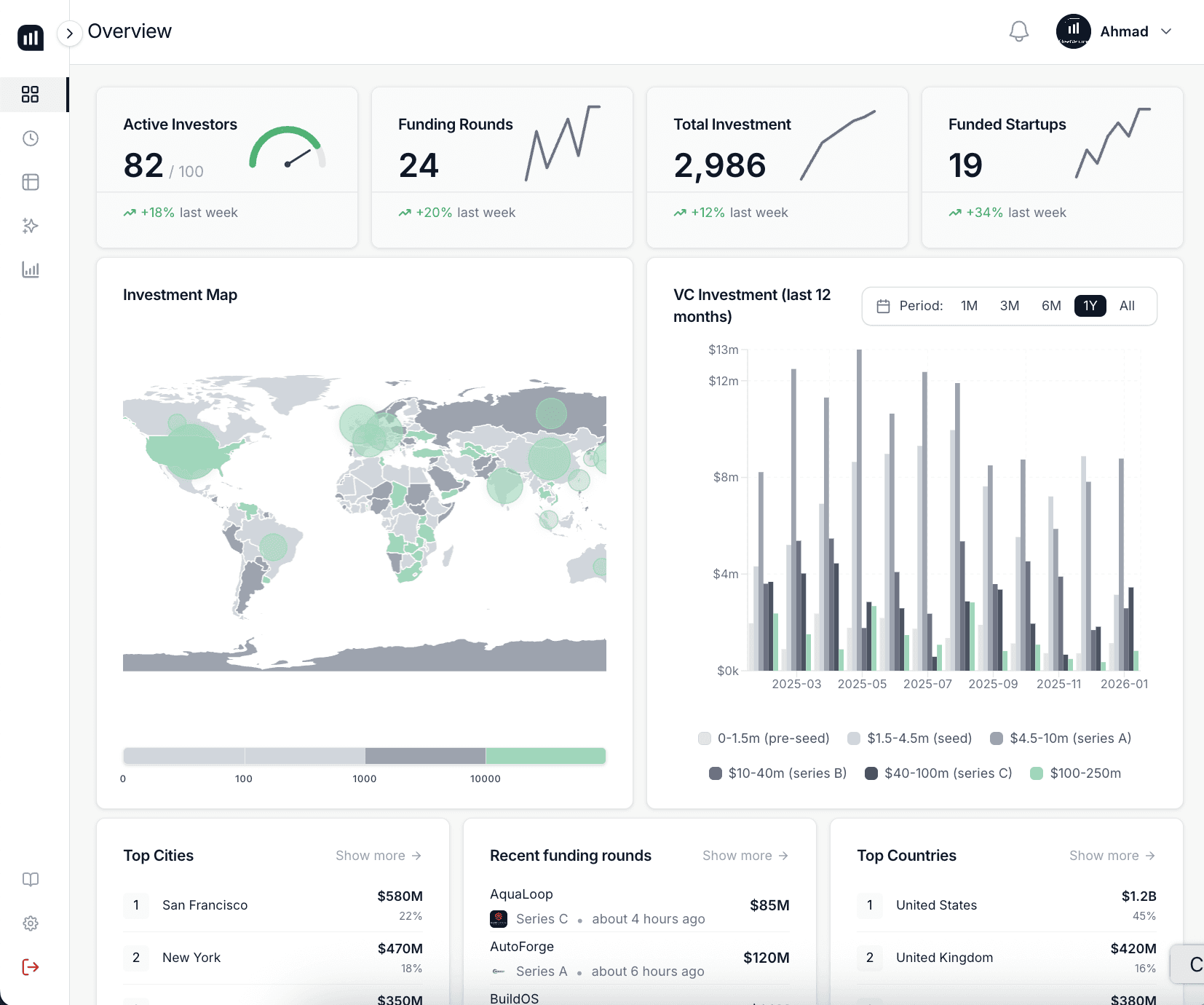
Understanding where that disconnect comes from, and how to close it without tanking your leverage, is what separates founders who close rounds from those who spend six months arguing over a number. A venture capital database that tracks live deal data is the fastest way to test whether your ask is grounded in current market reality.
Why the Gap Exists in the First Place
Investors use live market data. Most founders price their round based on internal projections, months-old comparables, or stories from other founders who raised in a different market. That mismatch is almost always the root cause.
Common reasons valuation expectations diverge:
• Stale comps: Using 2021 multiples in a 2024 market reads as out of touch immediately.
• ARR multiple assumptions: Investors value SaaS at 5-8x ARR right now; many founders still expect 15-20x.
• Revenue quality: Recurring vs. one-time, retention rate, and customer concentration all move the multiple.
• Stage mismatch: Pre-revenue founders often anchor to Series A valuations based on vision, not proof.
• Risk-adjusted math: Investors price for the probability of failure; founders price for the case where everything works.
Table 1: Current Market Valuation Benchmarks by Stage
Stage | Typical ARR | Valuation Range | Common Multiple | Source |
Pre-Seed | $0 - $100K | $2M - $6M | N/A (team + thesis) | SheetVenture |
Seed | $100K - $1M | $5M - $15M | 8-15x ARR | SheetVenture |
Series A | $1M - $5M | $15M - $50M | 6-10x ARR | SheetVenture |
Series B | $5M - $20M | $50M - $200M | 5-8x ARR | SheetVenture |
What to Do When the Numbers Do Not Match
1. Get Real Comps First
Before you argue your valuation, find actual closed deals in your sector, stage, and geography from the last 12 months. Arguing from real data is more convincing than arguing from internal models. Understanding how investors think about early-stage valuation reveals which data points actually move their numbers.
2. Separate Price from Terms
Valuation is not the only lever. If an investor insists on $8M pre-money when you want $12M, structure can close the gap. Lower dilution at a lower valuation offset by pro-rata rights, advisory shares, or milestone-based tranches can recover real economic value without conceding the headline number. Many founders give away more in terms than they realize while defending a valuation they eventually concede anyway.
3. Identify Where the Discount Is Coming From
Investors rarely say the ARR multiple is too high. They say they are not sure about the market size or that the team needs more depth. Each objection maps to a specific valuation driver. The table below shows the most common ones.
Table 2: Why Investors Discount Founder Valuations
Discount Driver | Typical Valuation Impact | How to Counter It |
High churn (>5% monthly) | -20 to -40% | Show retention fixes and cohort data |
Customer concentration (>30% in 1 customer) | -15 to -30% | Demonstrate pipeline diversification |
Unaudited revenue or MRR inconsistencies | -10 to -25% | Provide clean financials with reconciliation |
Founder-only sales (no repeatable GTM) | -15 to -20% | Hire a sales rep, show repeatable motion |
Thin team with key-person risk | -10 to -25% | Advisors, hiring plan, org chart |
4. Use a Competitive Process Correctly
Multiple term sheets compress the gap faster than any argument. When investors know a deal is moving, they sharpen their numbers. This only works if your pipeline is real. Building your list before you need it is what makes a competitive process possible.
5. Know When to Walk Away vs. When to Bridge
Not every gap is negotiable. If an investor's offer reflects a thesis mismatch, conceding on valuation does not fix the relationship. But if they are 20-25% below your ask on a deal that would otherwise close, bridging on terms is almost always worth more than restarting the process from scratch. The math usually favors closing.
When the Gap Is Market Feedback, Not Negotiation
Some valuation gaps are negotiating theater. Others are the market telling you something directly. Signs the gap is real and structural:
• Multiple investors are giving you the same number independently.
• Comparable companies in your space are closing rounds at lower multiples.
• Your ARR growth has slowed, but your ask has not changed.
• You are past 90 days of active fundraising with no term sheet.
If three or more of these apply, adjusting earlier is less painful than running out of runway while defending a number the market will not support. For a broader look at patterns that repeat, common fundraising mistakes show where founders consistently lose leverage.
The Bottom Line
A valuation gap is information. Treat it as a signal, not an insult. The fastest path to closing the gap is understanding where it comes from, speaking to real market data, and separating headline valuation from total deal value. Founders who do that raise cleaner rounds in less time.
SheetVenture helps founders access real-time private market intelligence so your valuation anchor reflects what deals are actually closing today, not what the market looked like two years ago.
Last Update:
Everything you need to understand private markets
Understand your market in real-time.
Filter by stage, sector, and exact geography.
Access 30,000+ verified, daily-updated active