Pitch Deck:
Pitch Deck Details:
The Clearbanc pitch deck works because it leads with a market-level problem every founder recognizes, backs every claim with hard numbers, and positions revenue-share financing as a distinct third category that neither equity nor debt has ever offered.
The deck does not open with a founder story or a mission statement. It opens with evidence: DTC brands are scaling faster than traditional capital structures allow, and founders are giving up permanent equity to fund something as predictable as ad spend. That framing sets the entire argument before a single product slide appears.
Every section compounds the same thesis. By the time the product appears, investors already understand why it needs to exist.
What Problem Does the Clearbanc Deck Actually Solve?
The deck's core insight is stark. Forty percent of all VC dollars flow directly into Facebook and Google. Founders are using the most expensive capital available to fund a repeatable, measurable activity that should never require dilution.
Clearbanc visualizes the gap with two existing options:
Equity at seed stage: 10-35% dilution, 3-6 months to raise, board control at risk
Debt at late stage: personal guarantees, covenants, MAC clauses, collateral requirements
Neither option fits. The deck then introduces revenue-share agreements as a third path, charging a 6-12% flat fee with no credit check, no personal guarantee, and approval in 24 hours. The comparison table against VC and bank loan alternatives is the strongest single slide in the deck. The contrast requires no explanation.
How Does Clearbanc Prove the Model Is Real?
Traction is where the deck becomes difficult to ignore. Revenue grew from $17M in 2017 to $143M in 2018 with a $1B projection for 2019, representing 940% CAGR. Loss rates fell every quarter as the underwriting model improved.
The case studies do what statistics alone cannot. Vinebox delivered a 1,101% ROI on Clearbanc capital. Coastal Co. gained $4M in lifetime value from a single round of growth funding. These are not hypotheticals. They are operational outcomes with named companies and verified numbers.
The team section closes the credibility loop. Michele Romanow and Andrew D'Souza carry institutional backgrounds and recognized names. The venture partner roster adds social proof without competing with the business case. No slide overstays its welcome.
The Clearbanc pitch deck works because the problem is real, the product is simple, and the numbers are impossible to dismiss. It is market-first, data-heavy, and structurally tight from the first slide to the last.
This Pitch Deck is taken from PitchDeckHunt.
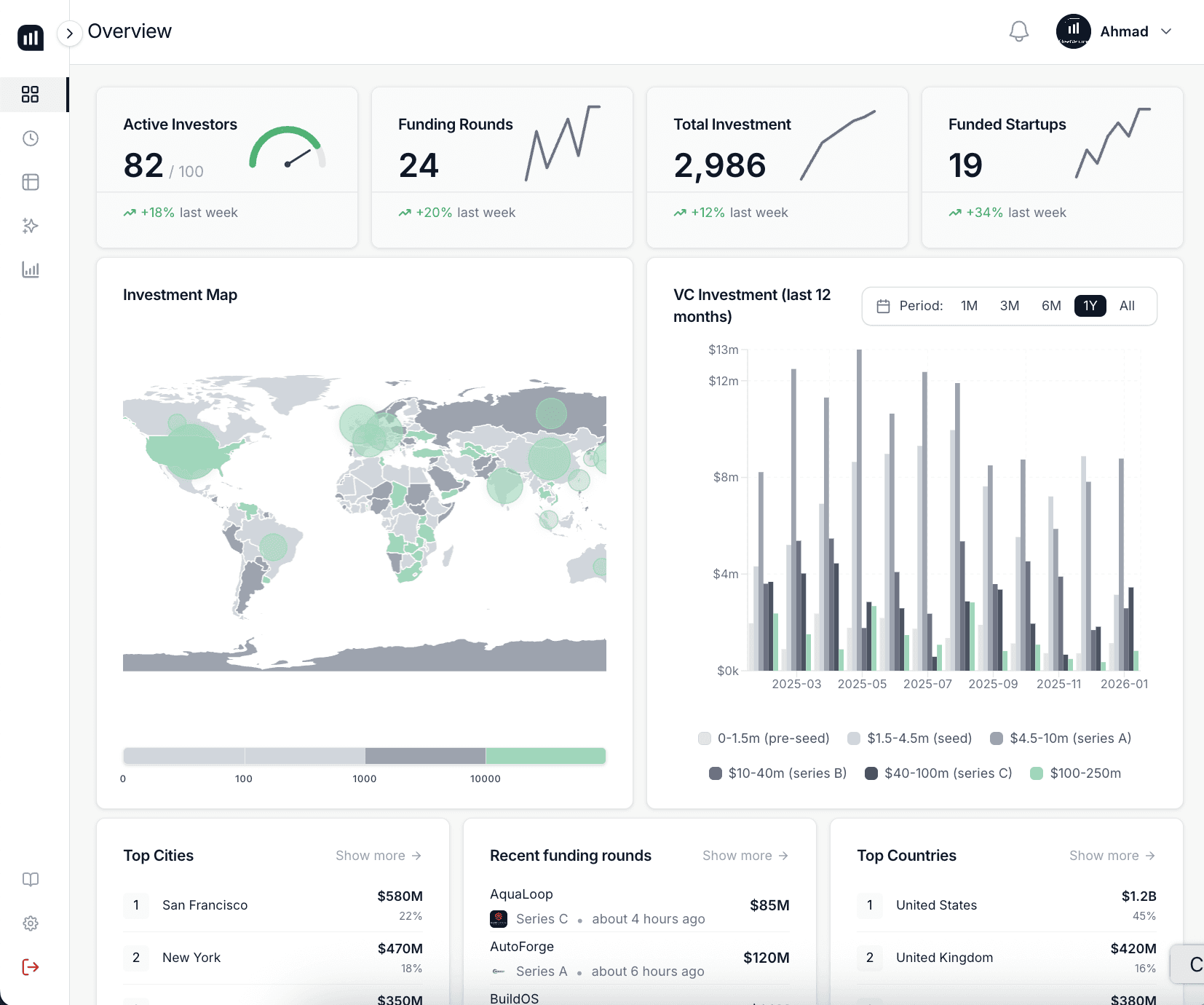
SheetVenture helps founders find the investors most likely to say yes, so every pitch lands with the audience it deserves.
FAQ:
Have questions,
We got answers.
Can't find your answer?
Get in touch with our support team, they a re friendly!
What funding model does Clearbanc use instead of traditional equity?
Clearbanc uses a revenue-share agreement, charging a 6–12% flat fee on funds deployed with no equity dilution, no personal guarantee, and no fixed repayment schedule founders repay as a percentage of daily sales.
How does Clearbanc prove its pitch deck claims with real results?
Clearbanc backs every claim with operational data: funded revenue grew from $17M to $143M in one year at 940% CAGR, with loss rates falling each quarter and case studies like Vinebox showing 1,101% ROI on deployed capital.
How does SheetVenture help founders find the right investors before pitching?
SheetVenture is a private market intelligence platform that tracks active investors by stage, sector, and recent deal activity so founders can identify which VCs are actually deploying capital right now, rather than cold-pitching funds that are not actively investing.
Others:










Everything you need to understand private markets
Understand your market in real-time.
Filter by stage, sector, and exact geography.
Access 30,000+ verified, daily-updated active