Pitch Deck:
Pitch Deck Details:
Purple Go's pitch deck is a strong, visual-first fundraising tool that clearly communicates a retail technology opportunity, supported by real traction and a compelling market comparison, though it would benefit from more financial detail and a sharper competitive moat narrative.
Purple Go positions itself as a Retail 3.0 solution, an in-store iPad app that connects traditional optical retailers to online sales, inventory, and customer data. The deck uses the Warby Parker benchmark smartly, showing how merged online-offline retail generates up to 10x more revenue per square foot. It's a tight, narrative-driven deck that respects investor attention spans. The visual storytelling is clean, and the problem-solution arc is immediately obvious.
Where most early-stage decks lose investors is in proving the "why now" and "why us" with hard evidence. Purple Go provides early traction, including 8 live locations and a 2-week sales cycle, which gives the deck credibility. The founding team's backgrounds from Cisco, Microsoft, IBM, and Panasonic add institutional weight. However, deeper financial projections and a clearer defensibility argument would push this deck from good to exceptional.
What the Purple Go Deck Gets Right
• Clear problem framing: Traditional retailers are losing ground to mobile-connected brands. The deck names this fear directly and pins a revenue number to the solution.
• Benchmark comparison: The Warby Parker vs. traditional optical bar chart ($3,000 vs. $350 per sq ft) is the single most persuasive data point. It makes the opportunity tangible in seconds.
• Traction that signals product-market fit: 8 locations, a 2-week sales cycle, and $4k annual contract value show real commercial validation, not just a concept.
• Team credibility: Logos from Cisco, Microsoft, IBM, and Panasonic on the team slide instantly build trust. Investors pattern-match on pedigree.
• Market size framing: "100,000's of Stores" is a headline that signals scale. Optical is the beachhead; the implied expansion path is every traditional retail vertical.
• Visual restraint: Purple-on-white design is bold without being distracting. Each slide carries one idea, which is the right structure for a pitch deck.
Where the Deck Could Be Stronger
• No financial projections: Investors at the seed stage expect at least a 3-year revenue model. The absence of this slide makes it harder to size the return.
• Weak competitive moat: The deck doesn't explain why a retailer couldn't replicate this with off-the-shelf tools or why a larger POS player won't enter the space.
• Pricing context missing: $4k ACV is stated but not benchmarked against the value delivered. How does this compare to the $150k revenue uplift from the pilot store?
3 Key Takeaways for Founders
• Use a single benchmark comparison that makes your market size undeniable. Purple Go's Warby Parker chart does this in under 3 seconds.
• Pilot revenue data beats projections every time at the early stage. Eight paying locations are worth more than a hockey stick forecast.
• Team slides must show relevant pedigree, not just titles. Match your background to the problem you're solving.
The Bottom Line
The Purple Go pitch deck is a well-structured, visual-first fundraising document that communicates a real market opportunity with authentic traction. It wins on narrative clarity, benchmark data, and team credibility. Its gaps in financial projections, competitive defensibility, and pricing context are solvable and common at this stage. Founders reviewing this deck will find a strong template for problem-solution-traction storytelling.
This Pitch Deck is taken from PitchDeckHunt.
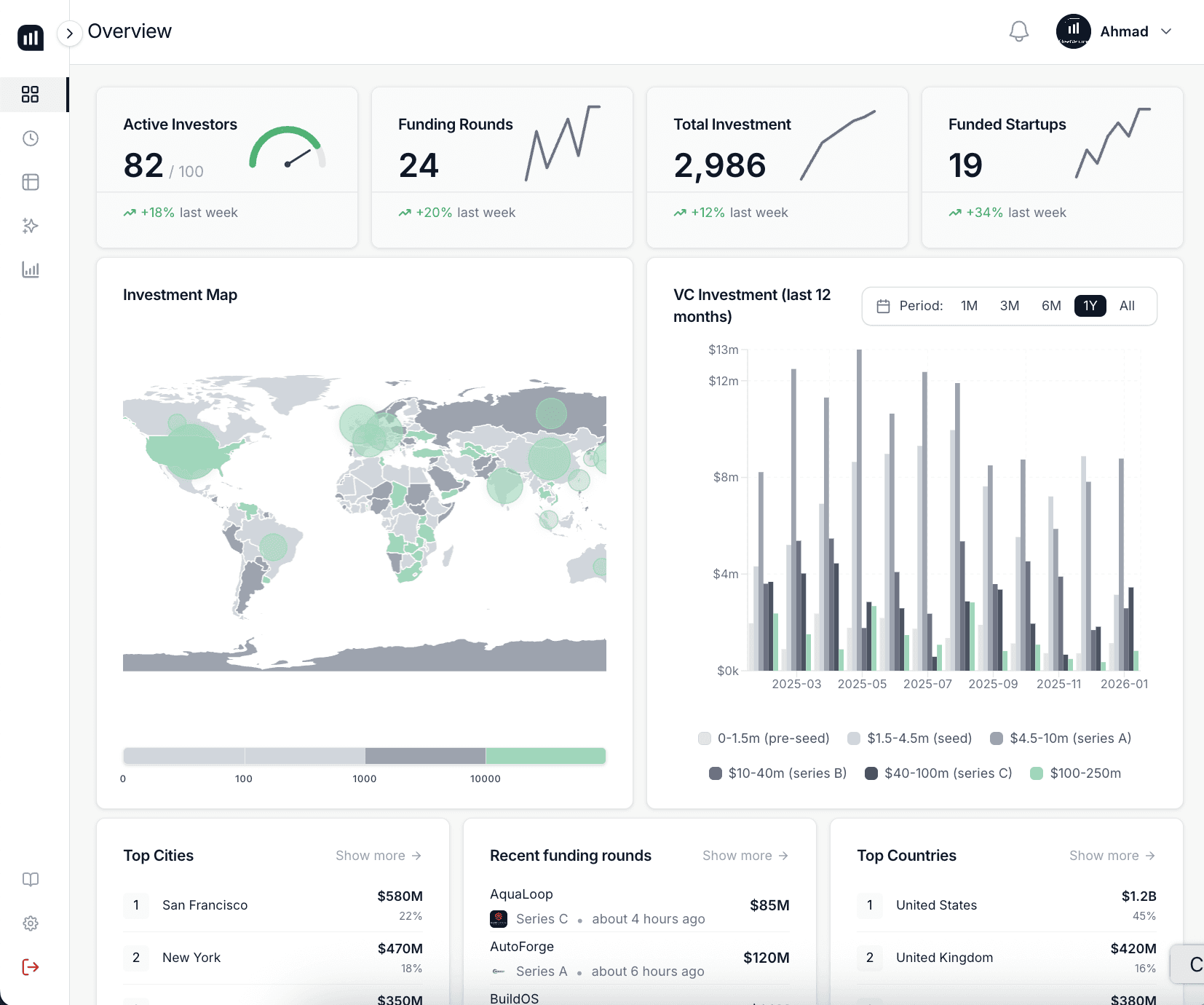
Access comprehensive investor data and startup funding intelligence through SheetVenture's platform
FAQ:
Have questions,
We got answers.
Can't find your answer?
Get in touch with our support team, they a re friendly!
What is the strongest element of the Purple Go pitch deck?
The Warby Parker bar chart , $3,000 vs. $350 per sq ft compresses the entire market case into one visual any investor processes in under 3 seconds.
What financial information is missing?
No revenue forecasts, CAC/LTV data, or burn rate context. These gaps make it harder for seed investors to size the return.
How can SheetVenture help founders before pitching?
SheetVenture is a private market intelligence platform with a curated investor database of 30,000+ active VCs filtered by stage, sector, and recent activity so founders pitch the right investors from day one.
Others:












Everything you need to understand private markets
Understand your market in real-time.
Filter by stage, sector, and exact geography.
Access 30,000+ verified, daily-updated active