Pitch Deck:
Pitch Deck Details:
VRMotion is building VR-based driver training simulations targeting military, law enforcement, and commercial fleets. The pitch deck makes a credible problem case: auto accidents account for nearly half of all military and law enforcement deaths, and the $4 billion spent annually on conventional driver training has failed to move the needle. The team has real credentials, early traction, and a compelling market angle. Here is a breakdown of what the deck does well and where it needs work.
Investors scanning this deck in under ten seconds will immediately register the problem urgency and the revenue number. That is the right instinct. But the deck still has structural gaps that could hold it back in competitive fundraising environments. Understanding both sides is essential for any founder preparing to go to market.
What the VRMotion Deck Gets Right
The deck opens with a high-stakes problem backed by a specific statistic, which is exactly how strong pitch decks work. The problem slide leads with emotion and data at once.
• The founding team is genuinely differentiated: a former Indy 500 driver, a 22-year Intel R&D engineer, and a lead AR/VR developer give the company rare cross-domain credibility.
• Traction is real: $266K in revenue over 12 months, 2,500 test drives completed, and $4M in the sales pipeline.
• The customer pipeline slide is well-structured, showing progression from In Discussion to Demo Complete to RFQ/Contract stages.
• Named customers include US Air Force bases, Oregon State Police, State Farm, and Hagerty, which signals institutional validation.
Where the Deck Falls Short for Serious Investors
Despite strong raw material, VRMotion's deck has presentation gaps that could cost it meetings at institutional VC firms. Founders should address these before the next round of outreach.
• No ask slide: the deck does not state how much capital is being raised, at what valuation, or how the funds will be deployed. Investors will not ask; they will move on.
• Revenue volatility is unexplained: the monthly revenue chart shows a sharp spike in February, followed by a significant drop in March and April. This pattern raises questions that the deck does not answer.
• No competitive positioning: the deck does not acknowledge competing simulation platforms or explain why VRMotion wins against existing solutions.
• Dark slide design hurts readability: several slides use very dark or near-black backgrounds with text that reduces scannability significantly.
• Business model is implied but never stated clearly, with no pricing per unit, contract structure, or recurring revenue breakdown included.
How Founders Can Use This Analysis to Fundraise Smarter
A pitch deck with real traction and a qualified team should not lose deals on structural omissions. The fixes here are straightforward and high-impact.
• Add a clear use of funds slide showing exactly how the raised capital maps to growth milestones.
• Annotate the revenue chart to explain the February spike and subsequent dip, turning a red flag into a proof of learning.
• Redesign slides for legibility using a lighter background so that text is immediately readable on any screen.
• Target investors who actively back defense tech, public safety, and B2G SaaS deals rather than spraying the deck broadly.
This Pitch Deck is taken from PitchDeckHunt.
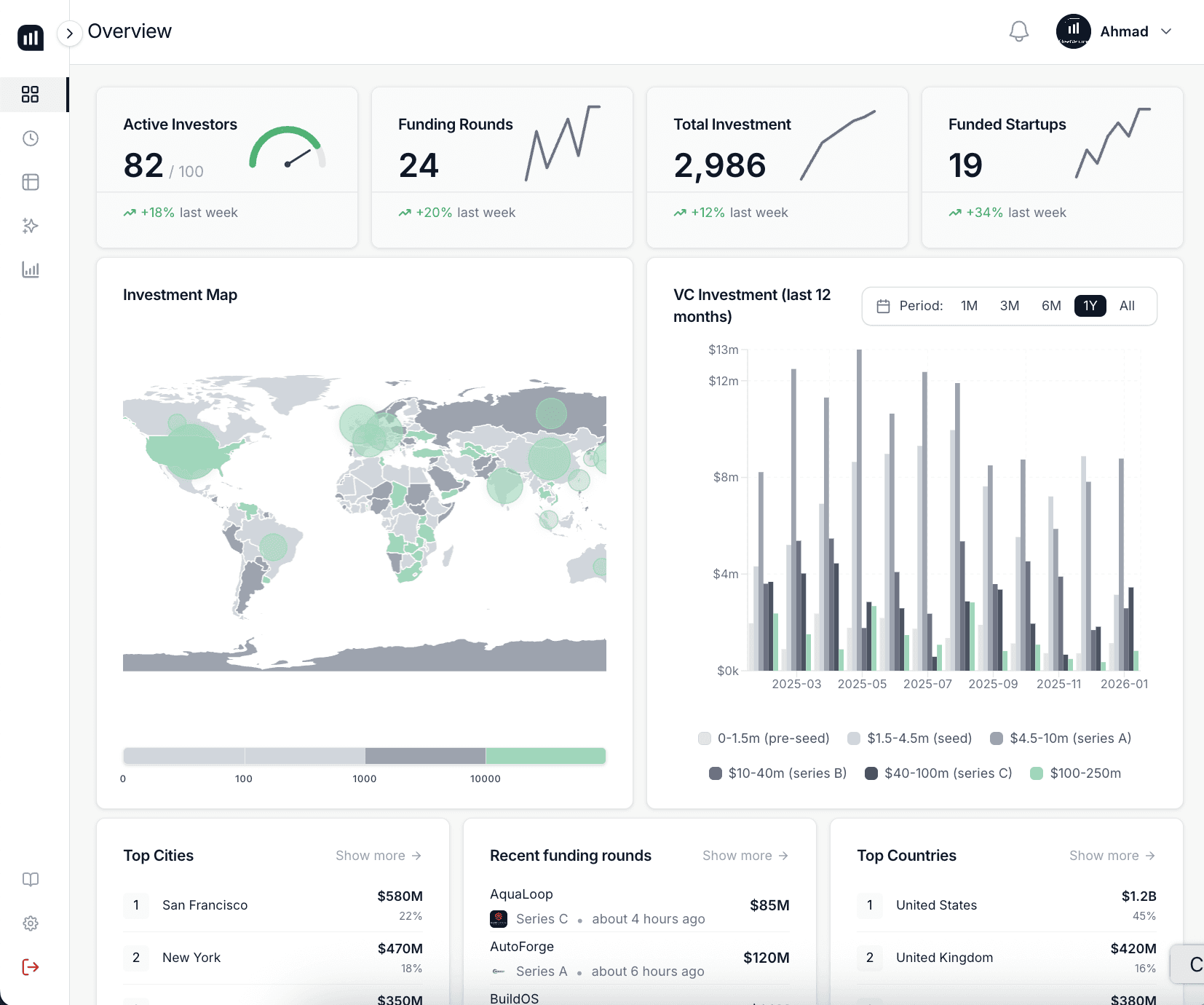
SheetVenture helps founders identify the right investors before they even open a deck, using real-time data from the market's most active private equity database.
FAQ:
Have questions,
We got answers.
Can't find your answer?
Get in touch with our support team, they a re friendly!
Does the VRMotion deck prove enough traction to attract institutional investors?
The traction is promising but not yet institutional-grade for most Series A VCs. $266K ARR over 12 months, 2,500 test drives, and a $4M pipeline tell a story of early momentum. However, the missing ask, unexplained revenue volatility, and absence of unit economics make it harder for institutional investors to build conviction. Angel investors and early-stage defence-focused funds are more likely to engage at this stage. Fixing the structural gaps in the deck could meaningfully expand the funnel.
Who is the strongest member of the VRMotion founding team from an investor credibility perspective?
Keith Maher, Cofounder and CEO, carries the most institutional weight. A 22-year engineering career at Intel, combined with hands-on VR simulation development, gives him deep technical credibility that investors in deep tech and defence simulation take seriously. Dominic Dobson adds a distinctive story as a former Indy 500 driver with AR patents, which is a memorable narrative hook. The combination of domain expertise and technical execution capability is genuinely rare and is one of the deck's most defensible assets.
How does SheetVenture help founders like the VRMotion team find the right investors?
SheetVenture is a private market intelligence platform that tracks 30,000+ active investors using real deal activity from the last 18 months, not static profiles. For a company like VRMotion pitching into defence tech, law enforcement, and fleet training markets, the platform helps founders identify which VCs and angels are actively writing checks into B2G and public safety verticals right now. Rather than wasting outreach on firms that have pivoted thesis or gone quiet, founders use SheetVenture's investor database to build a targeted list of investors who are genuinely active and sector-aligned, which is the single highest-leverage step before any outreach begins.
Others:









Everything you need to understand private markets
Understand your market in real-time.
Filter by stage, sector, and exact geography.
Access 30,000+ verified, daily-updated active