Investors weight gut instinct and analytical frameworks differently at each stage. Learn five decision stages and how to optimize for each.
Investors balance gut instinct with analytical frameworks across five decision stages: pattern recognition fires first, frameworks validate or challenge what instinct flagged, conviction forms where both signals agree, conflict triggers deeper diligence, and final decisions weight gut more heavily at early stage and frameworks more heavily at growth stage.
Gut and analysis are not opposing forces. They are sequential filters.
Why This Balance Matters to Founders
What understanding this enables:
Knowing which signals to lead with at each stage
Recognizing when hesitation is emotional versus analytical
What ignoring this causes:
Presenting data to an investor whose gut has already said no
Missing conviction opportunities by leading with analysis before establishing an emotional signal
For deeper context, understand what behaviors signal strong founders and how instinct-driven reads form before any data is reviewed.
The Five Decision Stages
Stage 1: First Impression (0-60 Seconds)
Pure pattern recognition. No framework active. Founders who pass the gut filter get the benefit of the doubt during framework review. Those who do not spend the rest of the meeting overcoming a deficit data alone rarely closes.
Stage 2: Market and Traction Review (Minutes 1-20)
The first analytical framework activates. The gut impression from Stage 1 colors how evidence gets interpreted. Strong gut plus weak metrics produces curiosity. Weak gut plus strong metrics produces skepticism.
Learn how investors validate market size claims and how the Stage 1 gut read changes how market evidence lands.
Stage 3: Founder Depth Assessment (Minutes 20-45)
Gut and framework interact most directly here. The investor evaluates analytical evidence of competence while forming an instinctive read on whether this is someone they want to work with for ten years.
Stage 4: Post-Meeting Deliberation
The investor must translate what they felt into the firm's analytical language. Gut impressions that cannot survive partner meeting scrutiny explain the most frustrating outcome founders experience: genuine enthusiasm that never converts to a term sheet.
Stage 5: Final Decision
At early stage, gut dominates because data is thin. At growth stage, frameworks dominate because data is rich. Founders who pitch as if both carry equal weight at every stage consistently miscalibrate.
How Gut vs Framework Weight Shifts Across Funding Stages
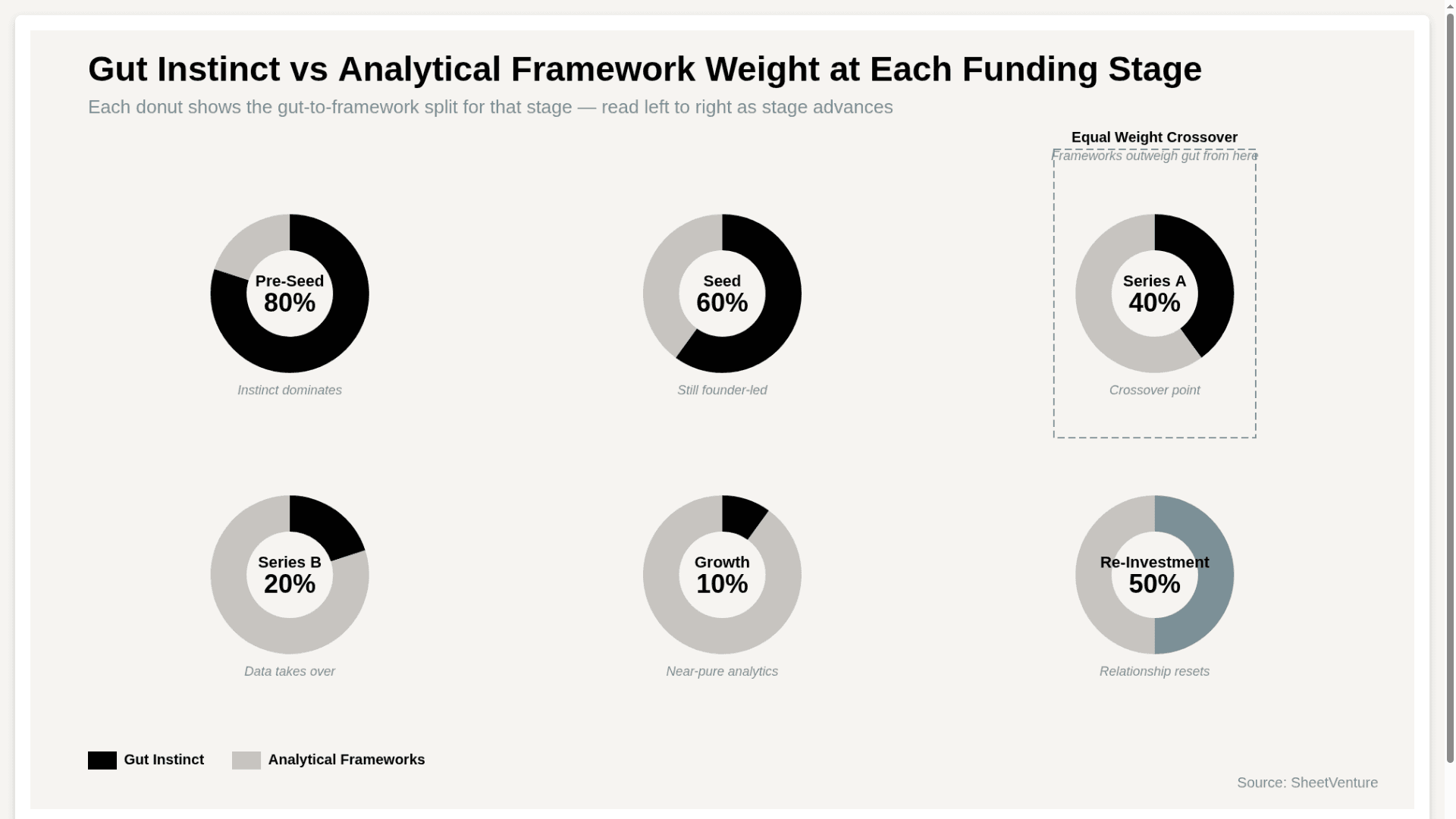
The chart shows the gut-to-framework inversion happening progressively across every stage, with the Series A crossover visible as the exact midpoint where both bars reach equal length before the gray side begins permanently dominating every subsequent row.
Gut vs Framework Weight by Stage
Decision Context | Gut Weight | Framework Weight | Primary Trigger for Yes |
|---|---|---|---|
Pre-Seed, first meeting | 80% | 20% | Founder energy and domain conviction |
Seed, full process | 60% | 40% | Founder plus early traction signal |
Series A, partner meeting | 40% | 60% | Metrics plus founder scalability read |
Series B, due diligence | 20% | 80% | Financial model and market position |
Growth stage, IC review | 10% | 90% | Revenue, retention, unit economics |
Any stage, re-investment | 50% | 50% | Relationship trust plus performance data |
The pattern: Gut weight drops roughly 20 points per stage as data density increases. Pre-seed founders leading with analytics and Series B founders leading with narrative are making the same miscalibration in opposite directions.
How to Optimize for the Right Input
At pre-seed and seed, create an emotional signal before any analytical evidence
At Series A, lead with the strongest metric then transition to founder narrative
At growth stage, treat narrative as supporting context for the analytical case
The principle: The gut-to-framework ratio is determined by stage, not by what the founder presents. Optimize for whichever input carries more weight in the room you are in.
Access SheetVenture's sheet to filter investors by stage focus so every conversation targets a firm whose dominant decision input matches what your company can most credibly deliver.
The Bottom Line
Investors balance gut and frameworks across five sequential stages, with gut dominating early and frameworks dominating at growth. The crossover sits at Series A. Founders who calibrate their pitch to the dominant input at their specific stage consistently outperform those who treat both as interchangeable.
At early stage, founders win on feeling. At growth stage, they win on proof.
SheetVenture helps founders identify which investors are actively evaluating at their specific stage so every pitch leads with the signal that matches how that investor actually makes decisions.
Last Update:
Everything you need to understand private markets
Understand your market in real-time.
Filter by stage, sector, and exact geography.
Access 30,000+ verified, daily-updated active