
How Do Newer VC Funds Differ in Decision Speed From Established Firms?
On this page
Newer VC funds make decisions faster than established firms in four specific conditions: smaller partnership structures reduce consensus requirements, lighter portfolio obligations free partner attention for new deals, LP pressure to deploy early capital creates urgency, and absence of legacy process bureaucracy removes the approval layers that slow institutional firms.
Speed is not always an advantage. But understanding which fund type moves faster determines which conversations to prioritize and which to run in parallel.
Why Decision Speed Differs Between Fund Types
The gap between newer and established fund decision timelines is structural, not cultural:
What newer funds are working with:
One to three decision-makers with no investment committee approval requirement
No existing portfolio consuming disproportionate partner attention
First or second fund pressure to deploy capital and build a track record quickly
What established firms are working with:
Investment committee structures requiring multiple partner sign-offs
Large portfolios generating constant follow-on allocation decisions that compete with new deals
Standardized diligence processes built for consistency rather than speed
For deeper context, understand what does an active investor actually mean and how deployment urgency differs between fund types at different lifecycle stages.
Where the Speed Difference Shows Up
First response to cold outreach:
Newer funds: 2 to 5 business days
Established firms: 1 to 3 weeks, often filtered through associates first
First meeting to term sheet:
Newer funds: 2 to 4 weeks when conviction forms quickly
Established firms: 6 to 12 weeks minimum including IC scheduling delays
Term sheet to close:
Newer funds: 2 to 3 weeks with lean legal process
Established firms: 4 to 8 weeks with standardized documentation review
Follow-on decision after traction update:
Newer funds: Days to one week when partner relationship is direct
Established firms: Full IC process restarts regardless of existing relationship
Decision Speed Comparison by Firm Type
Decision Stage | Emerging Fund (Fund I to II) | Mid-Tier Established | Top-Tier Institutional |
|---|---|---|---|
Cold email to first response | 2 to 5 days | 5 to 14 days | 14 to 30 days |
First meeting to second meeting | 3 to 7 days | 7 to 21 days | 14 to 30 days |
First meeting to term sheet | 2 to 4 weeks | 4 to 8 weeks | 6 to 12 weeks |
Term sheet to close | 2 to 3 weeks | 3 to 5 weeks | 4 to 8 weeks |
Full process end to end | 4 to 7 weeks | 8 to 14 weeks | 12 to 20 weeks |
Re-investment decision | 3 to 7 days | 2 to 4 weeks | 4 to 6 weeks |
The pattern: Emerging funds complete the full process in roughly half the time of institutional firms. For founders with fewer than 14 months of runway, this timeline difference changes which firm type should anchor the outreach strategy entirely.
When Newer Fund Speed Creates Risk, Not Advantage
Faster decisions from newer funds carry specific trade-offs:
Signaling risk: A cap table anchored by unknown emerging managers can complicate Series A conversations with institutional firms that use co-investor quality as a filter
Reserve capacity: Newer funds often have limited reserves for follow-on participation, creating dilution pressure at later rounds
LP network access: Established firms carry LP relationships that open doors to growth capital and strategic partnerships that newer funds cannot replicate
Operational support: Speed in the decision does not predict quality of post-investment support
Learn how investors react to slow versus fast fundraising processes and how the pace of each firm type creates different leverage dynamics for founders managing parallel conversations.
Decision Timeline by Stage and Fund Type
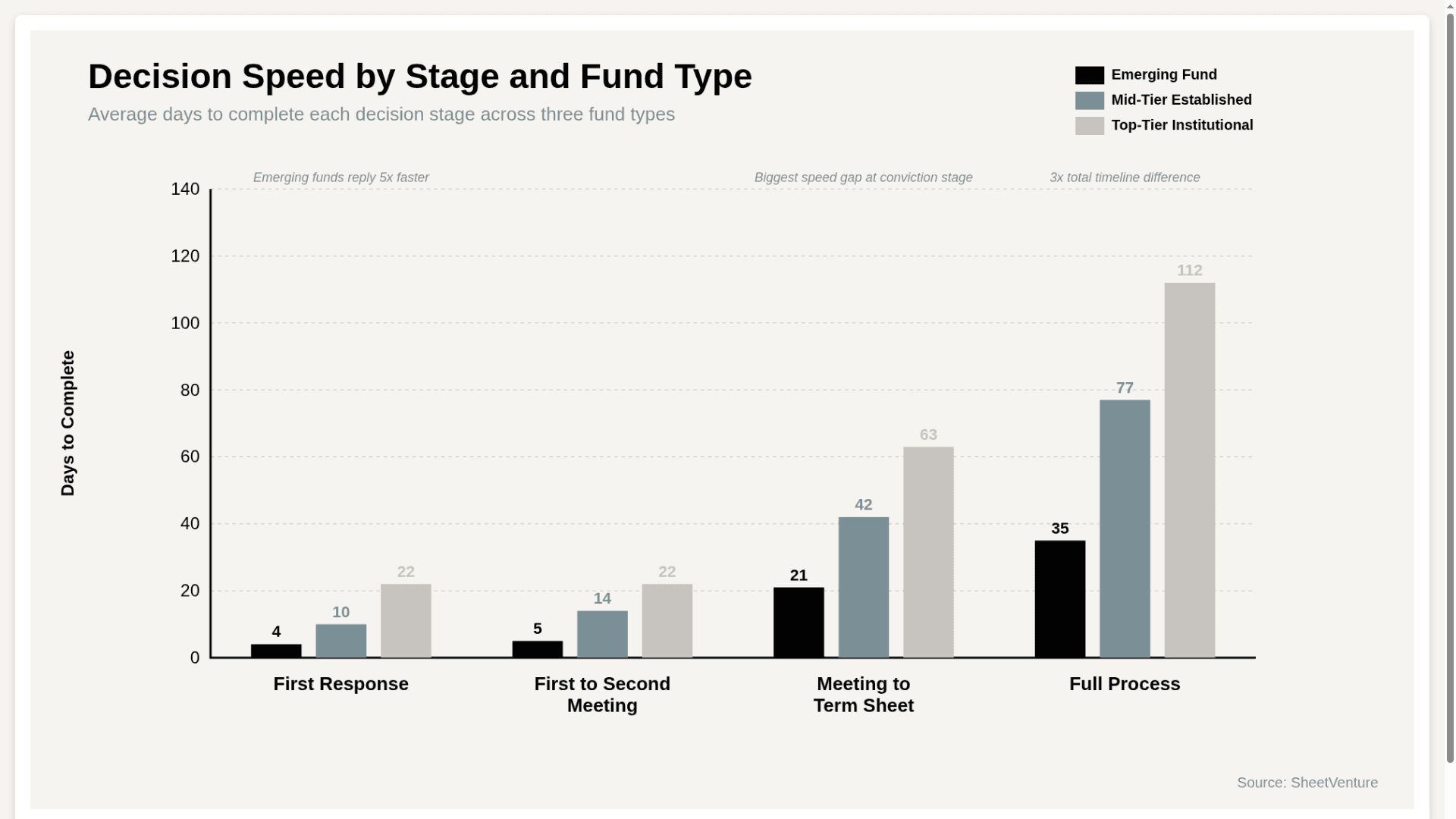
The chart shows the speed gap widening at every successive stage, with the full process difference reaching 77 days between emerging and institutional firms, confirming that fund type selection is a timing decision as much as a capital quality decision.
How to Use This Difference in Your Raise Strategy
Run emerging funds in parallel with institutional processes to create term sheet pressure that accelerates slower firms
Use an emerging fund term sheet as leverage when institutional firms are in late diligence but have not yet committed
Prioritize emerging funds when runway is below 12 months and institutional timelines would expire the raise before close
Use a venture capital database to identify which emerging funds have closed in the last 18 months and are in active early deployment so speed advantage is available to founders who find them first.
The Bottom Line
Newer VC funds make decisions in roughly half the time of established firms because their structures eliminate the consensus layers, portfolio obligations, and process bureaucracy that slow institutional decision-making. Founders who understand this run both fund types in parallel, use emerging fund speed to create pressure on institutional timelines, and match firm type to runway reality.
SheetVenture helps founders identify which fund type is in active deployment at every stage so outreach strategy matches both timeline reality and capital quality.
Find investors who are actually writing cheques
Explore live coverage, or book a walkthrough of the product.