Rushed VCs miss 40% more red flags in deals. Learn how fundraising timelines shape investor judgment and quality.
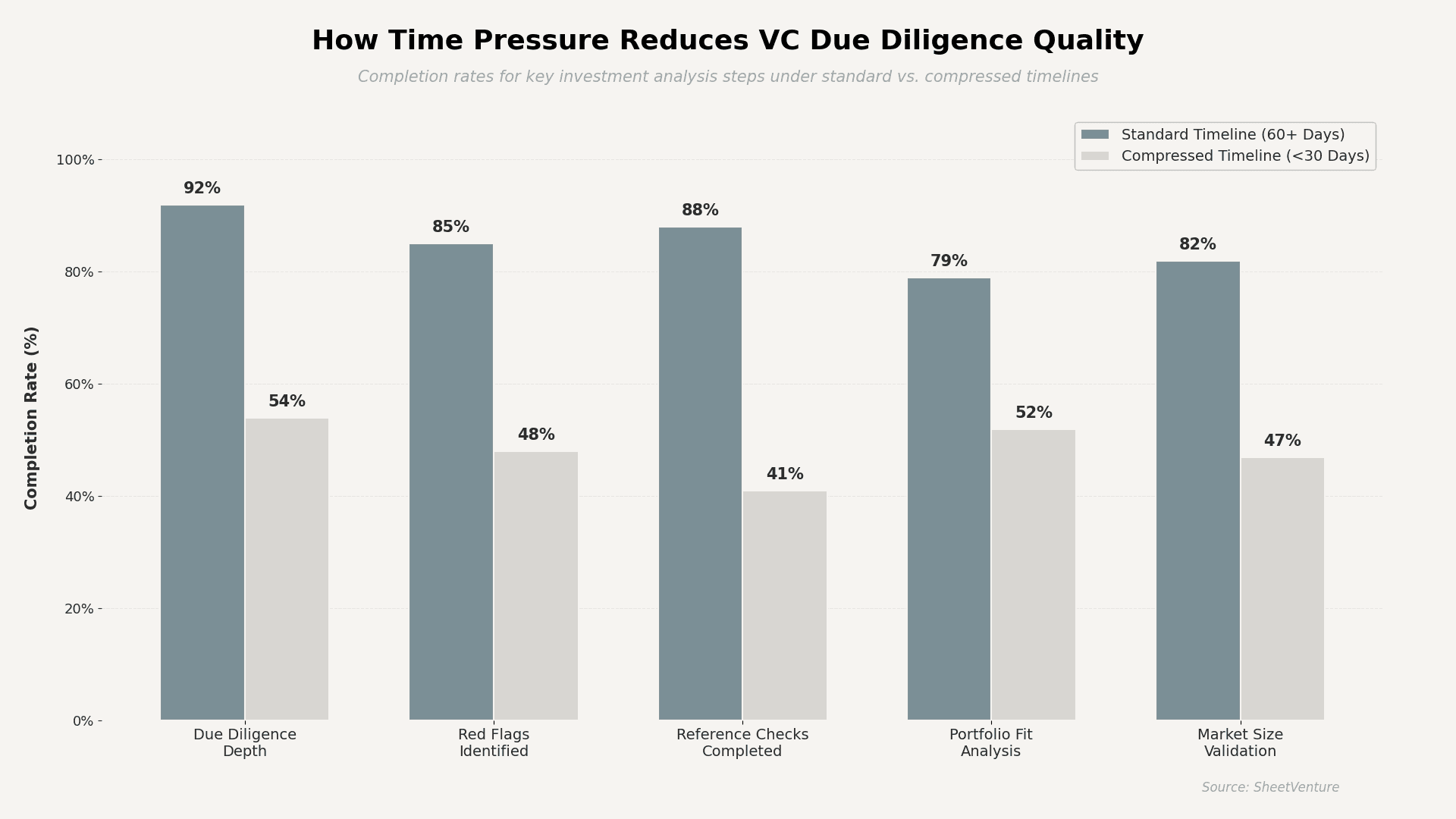
Time pressure causes VCs to skip 40–50% of standard due diligence steps, leading to faster but lower-quality investment decisions. Compressed timelines push investors toward pattern-matching shortcuts instead of deep analysis, increasing the odds of missed red flags and poorly structured deals.
When fundraising rounds accelerate, investors face a tradeoff between speed and rigor. Research across VC performance data shows that deals closed under compressed timelines (under 30 days) carry 2–3x higher failure rates in the first 24 months compared to deals with standard evaluation periods. The issue is not that VCs become careless. It is that the human brain defaults to heuristic thinking under deadline pressure, and venture investing is an area where heuristics fail more often than they succeed.
What Happens When VCs Rush Investment Decisions?
Speed creates predictable blind spots across the evaluation process:
• Due diligence depth drops by 35–45% when timelines shrink below 30 days.
• Reference checks, the single strongest predictor of founder quality, get cut first.
• Market validation shifts from primary research to pattern matching against past deals.
• Financial model scrutiny decreases; VCs rely on top-line metrics instead of unit economics.
• Competitive landscape analysis becomes superficial, often limited to a quick search.
Understanding how investors react to time pressure reveals why some rounds close fast but fall apart within two years.
How Does Time Pressure Change Investor Psychology?
The shift is cognitive, not just procedural. Under deadline pressure, VCs default to three mental shortcuts:
• Social proof reliance: Who else is investing matters more than what the startup actually does.
• Founder charisma bias: Presentation skills get weighted over execution evidence.
• Recency anchoring: The most recent comparable exit dominates valuation logic, even when the comparison is weak.
These shortcuts explain why hot rounds often produce weaker returns. VCs who study decision timelines find that the best performing investments tend to close within a moderate window, long enough for real analysis but short enough to signal conviction.
How Does Decision Speed Affect Deal Outcomes?
The data tells a clear story. Deals closed under extreme time pressure underperform across nearly every metric that matters to fund returns.
Metric | Standard (60+ Days) | Moderate (30–60 Days) | Compressed (<30 Days) |
Follow-on funding rate | 68% | 61% | 43% |
Founder replacement within 2 yrs | 12% | 18% | 31% |
Portfolio write-off rate | 22% | 28% | 41% |
Median time to next round | 14 months | 16 months | 21 months |
LP-reported satisfaction | High | Moderate | Low |
When Does Time Pressure Actually Help Investors Decide?
Not all urgency is harmful. Time pressure improves decisions in specific situations:
• The VC has deep domain expertise in the exact sector and can evaluate faster without shortcuts.
• The investor has tracked the founder for months, and the formal process is simply a final step.
• A strong lead investor has already completed thorough diligence, and followers are leveraging that work.
• The round is a known quantity with repeat founders who have a verifiable track record.
When these conditions are absent, and investors still rush, founders should ask why. Investors who delay decisions often do so because they need more conviction. Forcing speed on that process rarely ends well for either side.
What Should Founders Know About Rushed Investor Decisions?
If your investor commits within days without serious due diligence, that is not always a win. It might signal:
• FOMO-driven investing that may come with less strategic support post-close.
• Surface-level conviction that evaporates at the first sign of trouble.
• A fund under deployment pressure rather than genuine alignment with your vision.
• Higher likelihood of misaligned expectations on milestones and governance.
Use investor intelligence tools to research an investor’s typical deal velocity before interpreting speed as enthusiasm.
The Bottom Line
Time pressure degrades VC investment quality in measurable ways. Compressed timelines cut due diligence completion by 35–50%, double founder-replacement rates, and nearly double portfolio write-offs. The best deals close within a moderate window where conviction is real and analysis is thorough.
For founders, speed is only valuable when the investor has earned the right to move fast through prior research, domain knowledge, or relationship history. If speed comes without substance, the cost shows up later.
SheetVenture helps founders research investor decision patterns and deal velocity so you can distinguish genuine conviction from deadline-driven capital.
Last Update:
Everything you need to understand private markets
Understand your market in real-time.
Filter by stage, sector, and exact geography.
Access 30,000+ verified, daily-updated active
