Competing interest accelerates fundraising when used correctly. Learn four rules that create genuine urgency without damaging credibility with investors.
Founders leverage competing interest without appearing manipulative by doing four things: referencing real conversations accurately rather than inflating them, letting investor behavior create urgency rather than manufactured deadlines, using competing interest to accelerate decisions rather than extract better terms, and framing competition as context rather than pressure.
Competing interest is the most powerful negotiating tool available in a fundraise. Used correctly it compresses timelines and improves terms. Used incorrectly it destroys credibility in a network where every partner knows every other partner.
Why the Line Between Leverage and Manipulation Matters
What legitimate competing interest does:
Creates genuine urgency that accelerates internal partner discussions
Signals external validation that reduces individual investor risk perception
Produces competitive dynamics that improve terms without requiring the founder to demand them
What manufactured competing interest does:
Triggers immediate network verification that exposes the claim within 24 hours
Permanently damages credibility with the firm and every firm in their network
For deeper context, understand how investors react to time pressure during fundraising and why experienced partners distinguish real competitive dynamics from manufactured ones within a single conversation.
The Four Rules for Using Competing Interest Legitimately
Rule 1: Reference What Is Real, Not What You Hope Is True
Accurately describe the stage of every active conversation. "We are in second meetings with two firms and expect term sheets within three weeks" is verifiable and honest. "We have strong interest from several top-tier firms" is vague enough to be interpreted as inflated and experienced investors treat it accordingly.
What investors do with vague claims: Discount them entirely and make decisions as if no competing interest exists.
Rule 2: Let Investor Behavior Create the Urgency
Rather than announcing a deadline, describe what is happening factually. "Another firm has asked for our data room this week" is a statement of fact. "You need to decide by Friday or we are moving on" is a manufactured ultimatum that experienced investors ignore or resent.
Learn how investors interpret momentum during a fundraising round and why behavioral signals carry more weight than verbal claims about competing interest.
Rule 3: Use Competition to Accelerate, Not Extract
Competing interest used to compress decision timelines produces better outcomes than competing interest used to demand better economics. Asking an investor to move faster because of a competing term sheet is legitimate. Using a competing term sheet to demand a 30% higher valuation from a firm that has not yet committed reads as manipulative regardless of whether the competing sheet is real.
Rule 4: Frame Competition as Context, Not Pressure
"I want to make sure you have what you need because we are managing a few parallel conversations" positions the founder as organized and in demand. "You need to move faster because other people want this deal" positions the founder as aggressive and transactional. The information content is identical. The framing determines whether the investor feels respected or cornered.
Competing Interest Framing by Conversation Stage
Conversation Stage | Legitimate Framing | Framing That Reads as Manipulative |
|---|---|---|
First meeting | "We are running a parallel process with several firms" | "Multiple top-tier firms are already interested" |
Post-meeting follow-up | "Another firm has requested our data room this week" | "We have strong competing interest and need your answer soon" |
Active diligence | "We are expecting a term sheet from another firm by end of month" | "You need to match their offer or we are moving on" |
Term sheet received | "We have received a term sheet and are giving existing conversations two weeks to complete" | "Someone offered us a higher valuation, can you beat it" |
Near close | "We are planning to close the round within three weeks" | "This is your last chance to participate at this valuation" |
The pattern: Every legitimate framing describes what is happening factually. Every manipulative framing makes a demand based on what the founder wants the investor to believe. Experienced investors hear the difference in the first sentence.
Founder Credibility Score by Competing Interest Framing Type
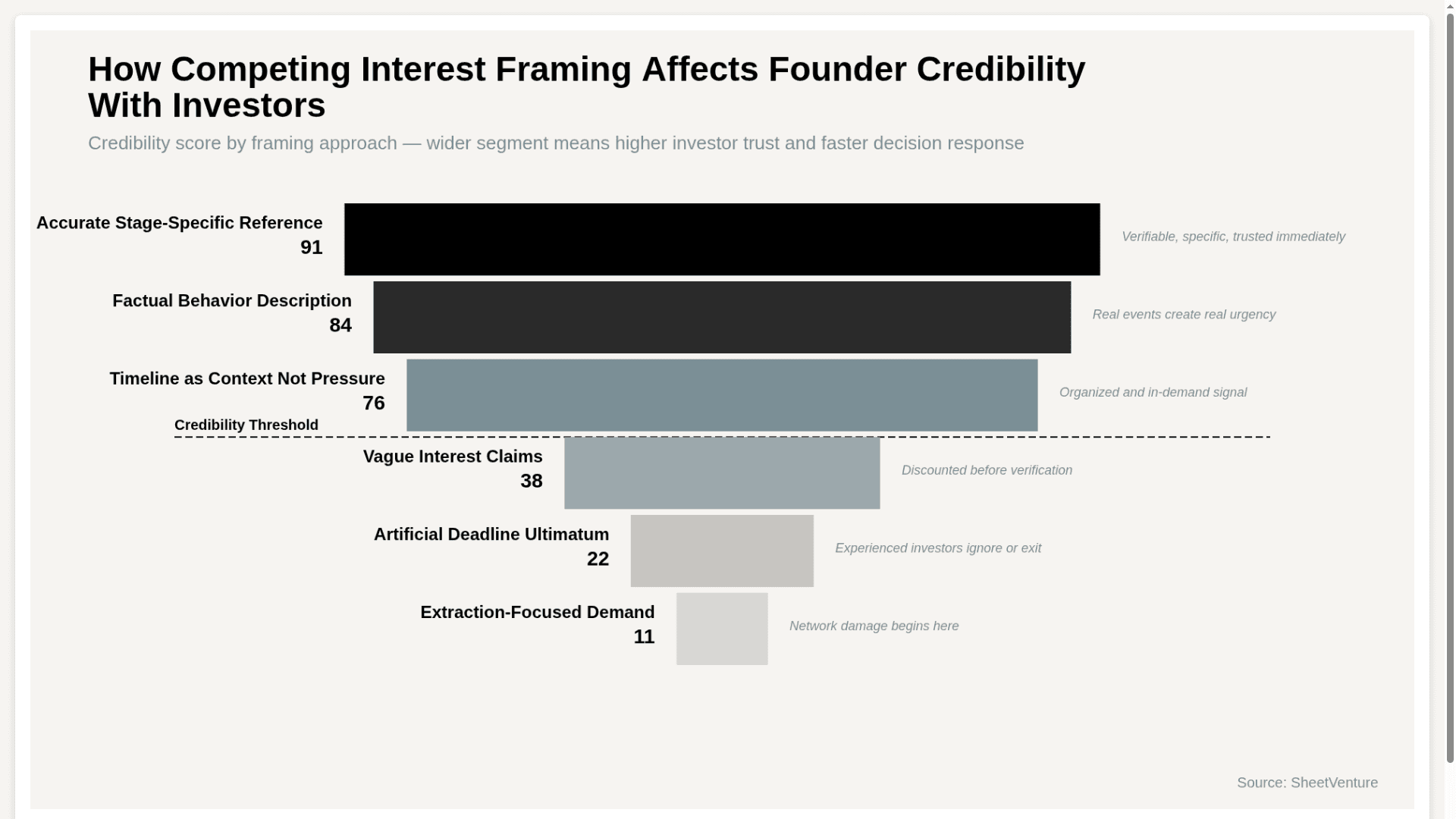
The funnel shows the sharpest width drop occurring between the Timeline as Context segment and Vague Interest Claims, confirming that the credibility cliff is crossed the moment framing shifts from factual description to pressure-based positioning.
How to Build Real Competing Interest Before the Raise
Start outreach to 20 to 25 firms simultaneously so parallel conversations exist before any single firm reaches term sheet stage
Use a venture capital database to identify which firms are in active deployment so parallel conversations convert rather than stall
Update all active conversations when a meaningful milestone occurs so competing interest develops naturally
The principle: The best competing interest strategy is a parallel process designed before outreach begins. Founders who build genuine pipeline density never need to manufacture urgency because real urgency develops automatically when multiple investors are evaluating the same opportunity simultaneously.
Use investor intelligence to research which partners have moved quickly on similar deals so outreach targets investors whose process speed creates natural competitive dynamics.
The Bottom Line
Founders leverage competing interest legitimately by referencing real conversations accurately, letting investor behavior create urgency naturally, using competition to accelerate timelines rather than extract economics, and framing competition as context rather than pressure.
Every manipulative framing is identifiable to experienced investors within a single conversation and the damage spreads through partner networks faster than any founder anticipates. Build real pipeline. Reference it accurately. Let the competition speak for itself.
SheetVenture helps founders build genuine parallel investor pipelines before the raise begins so competing interest develops from real conversations, not from claims that collapse under a single network call.
Last Update:
Mar 12, 2026